03 — ARTWORK
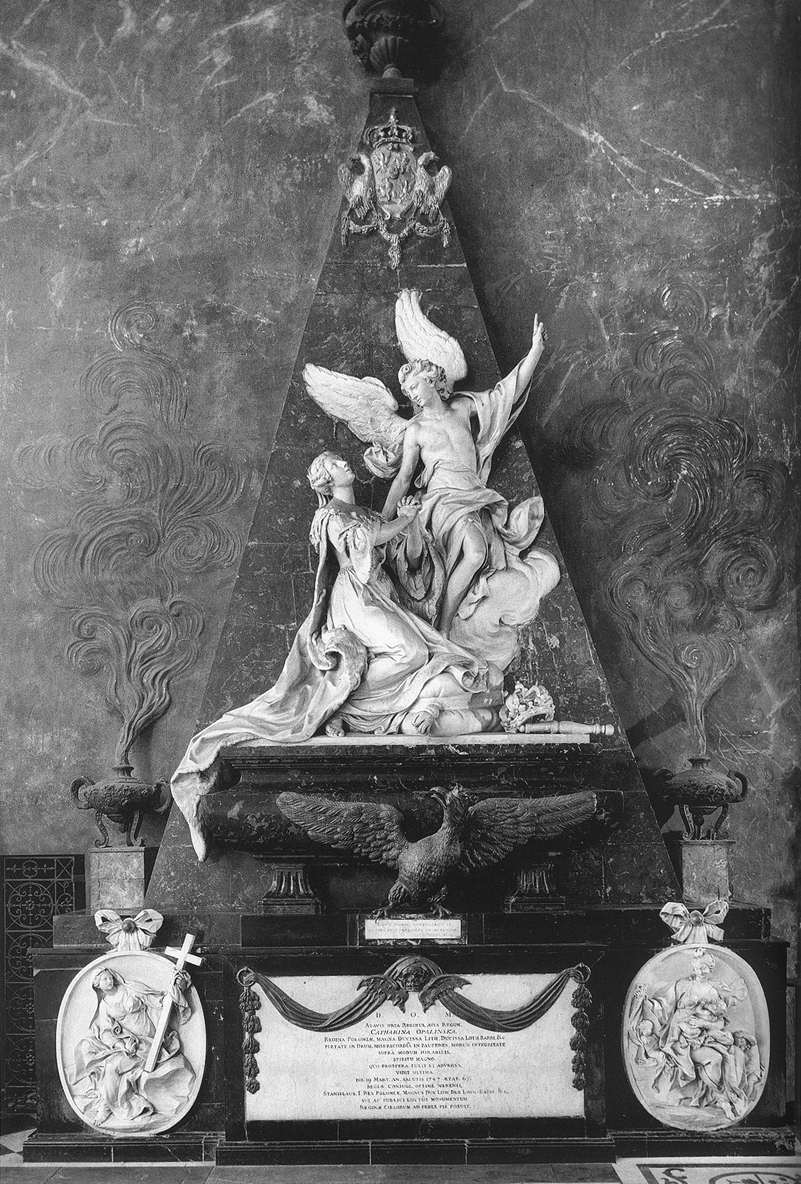
Monument to Queen Catharina Opalinska
ADAM, Nicolas-Sébastien · 1749 →
- MEDIUM
- Marble
- TYPE
- Religious
PALETTE
HOVER OR TAP A SWATCH FOR NAME, SHARE AND HEX. SAMPLED FROM THE IMAGE — INDICATIVE, NOT A PIGMENT ANALYSIS.
DEVELOPMENT BUILD — NOT FOR PUBLIC USE. CONTRIBUTE ON GITHUB.
03 — ARTWORK
ADAM, Nicolas-Sébastien · 1749 →
PALETTE
HOVER OR TAP A SWATCH FOR NAME, SHARE AND HEX. SAMPLED FROM THE IMAGE — INDICATIVE, NOT A PIGMENT ANALYSIS.
COMMENTARY
UNDERLINED TERMS ARE DEFINED IN THE GLOSSARY.
Nicolas-Sébastien was the ideal choice for the tomb of Queen Catharina Opalinska, Queen of Poland and Duchess of Lorraine, set up in 1749 in the church of Bon Secours in his native Nancy. Nevertheless, his brother Lambert-Sigisbert struggled hard to be preferred to the task. But panache was not needed so much as lyricism and a gentle piety, in commemorating the quite unglamorous, humble, religious wife of Stanislas of Lorraine and mother of Marie Leczinska.
Bon Secours had been built by Stanislas a few years before with the intention of its containing tombs of himself and his wife, and the church's title might have suggested to Adam the theme he was to illustrate in his touching masterpieceA term now loosely applied to the finest work by a particular artist or to any work of art of acknowledged greatness or of preeminence in its field. Originally it meant the piece of work by which a craftsman, having finished his training, gained the rank of'master' in his guild. of a soul helped by a vision. The useless royal crown and sceptre, which had proved so barren in life, are deliberately laid aside at the moment of passing from death into immortality. The queen, made youthful again, kneels in prayer, while an angel points her way to heaven. The eagle of Poland, the incense burners that smoke with the queen's praises, are unimportant in the central depiction of a simple allegoryA work of art which represents some abstract quality or idea, either by means of a single figure (personification) or by grouping objects and figures together. Renaissance allegories make frequent allusions both to both Greek and Roman legends and literature, and also to the wealth of Christian allegorical stories and symbols developed during the Middle Ages..
The juxtaposition of the person commemorated and the angel of immortality is not dramatic. In that lack of drama lies its whole point. The hand of the Lord, the revelation of eternal happiness, cannot startle someone who has waited so long for them. The queen's face expresses no surprise, only ecstasy. The angel and she are integrated into a single form, in effect a bas-relieflow relief, a sculptured relief in which the desighn stands out only a little from the background. set against the coloured marbleloosely applied to any hard limestone that can be sawn into thin slabs and will take a good polish so that it is suitable for decorative work; more strictly, it refers to metamorphosed limestones whose structure has been recrystallized by heat or pressure. Marbles are widely disseminated and occur in a great variety of colours and patterns, but certain types have been particularly prized by sculptors. The most famous of Greek white marbles in the ancient world was the close-grained Pentelic, which was quarried at Mount Pentelicon in Attica. The Elgin Marbles are carved in Pentelic. Widely used also were the somewhat coarser-grained translucent white marbles from the Aegean islands of Paros and Naxos. Parian marble was used for the celebrated Mausoleum at Halicarnassus. The pure white Carrara marble, quarried at Massa, Carrara, and Pietra Santa in Tuscany from the 3rd century BC, is the most famous of all sculptors' stones. It was used for the Apollo Belvedere, and was much favoured in the Renaissance, particularly by Michelangelo, who often visited the quarries to select material for his work. Neoclassical sculptors also favoured Carrara marble because of its ability to take a smooth, sleek surface, but it can look rather 'dead' compared with some of the finest Greek marbles. of the pyramid; its steep lines are broken by the long undulating diagonal that runs up from the lowest fold in the queen's mantleAn overcoat, worn open, popular during the second half of the 15th century and the 16th century and often lined with fur along the hem and around the collar. It reached to the knee or foot, depending on the social class of the wearer. and culminates in the extended forefinger of the angel's upraised hand.
@online{wga-r7095db3c98eb8d,
  author       = {Krén, Emil and Marx, Daniel},
  title        = {Monument to Queen Catharina Opalinska by ADAM, Nicolas-Sébastien},
  organization = {{Web Gallery of Art}},
  date         = {2026-09-14},
  url          = {https://beta.wga.hu/artists/adam-nicolas-sbastien-re1bd5565ba942b/monument-to-queen-catharina-opalinska-r7095db3c98eb8d},
  urldate      = {2026-09-14},
  langid       = {english}
}
ACCESSED 2026-09-14. REPLACE THE AUTHOR FIELD WITH THE COMMENTARY AUTHOR WHERE ONE IS NAMED.


