03 — ARTWORK
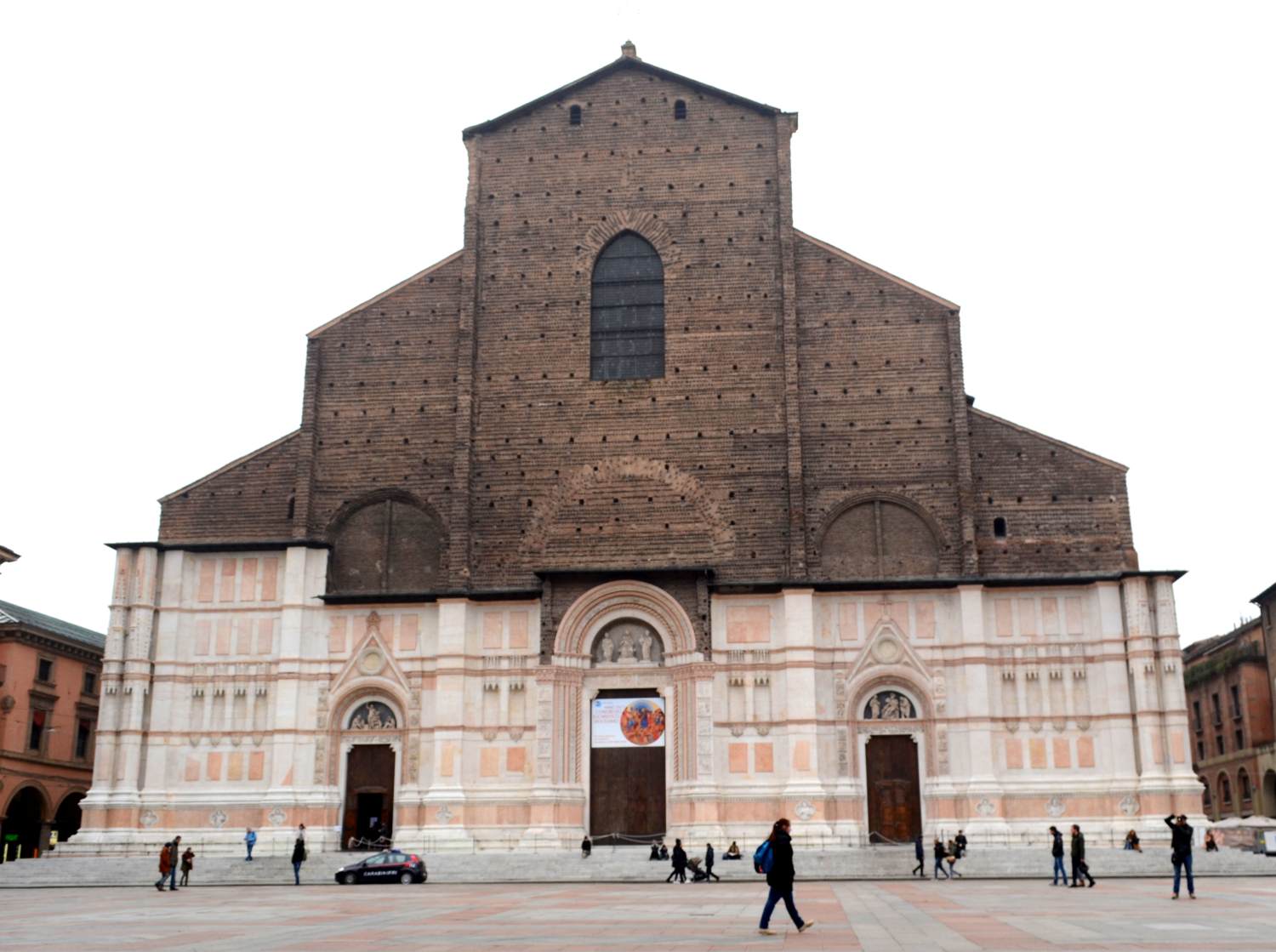
View of the façade
- MEDIUM
- Photo
- TYPE
- Religious
PALETTE
HOVER OR TAP A SWATCH FOR NAME, SHARE AND HEX. SAMPLED FROM THE IMAGE — INDICATIVE, NOT A PIGMENT ANALYSIS.
DEVELOPMENT BUILD — NOT FOR PUBLIC USE. CONTRIBUTE ON GITHUB.
03 — ARTWORK
PALETTE
HOVER OR TAP A SWATCH FOR NAME, SHARE AND HEX. SAMPLED FROM THE IMAGE — INDICATIVE, NOT A PIGMENT ANALYSIS.
COMMENTARY
UNDERLINED TERMS ARE DEFINED IN THE GLOSSARY.
In 1518 Domenico Aimo drew up a masterplan for the façadethe front or principal face of a building, especially one elaborately constructed; a blind façade is a façade that is purely decorative and does not relate to the structure of the building. of San Petronio, which was followed for the decoration of the two existing lateral portals embellished with Old and New Testament scenes (1524-30). The main portala doorway. A portal recessed in several steps was frequently used in Romanesque architecture; this meant that the often relatively small entrance was given considerable emphasis on the façade. in the centre was decorated earlier by Jacopo della Quercia.
The marbleloosely applied to any hard limestone that can be sawn into thin slabs and will take a good polish so that it is suitable for decorative work; more strictly, it refers to metamorphosed limestones whose structure has been recrystallized by heat or pressure. Marbles are widely disseminated and occur in a great variety of colours and patterns, but certain types have been particularly prized by sculptors. The most famous of Greek white marbles in the ancient world was the close-grained Pentelic, which was quarried at Mount Pentelicon in Attica. The Elgin Marbles are carved in Pentelic. Widely used also were the somewhat coarser-grained translucent white marbles from the Aegean islands of Paros and Naxos. Parian marble was used for the celebrated Mausoleum at Halicarnassus. The pure white Carrara marble, quarried at Massa, Carrara, and Pietra Santa in Tuscany from the 3rd century BC, is the most famous of all sculptors' stones. It was used for the Apollo Belvedere, and was much favoured in the Renaissance, particularly by Michelangelo, who often visited the quarries to select material for his work. Neoclassical sculptors also favoured Carrara marble because of its ability to take a smooth, sleek surface, but it can look rather 'dead' compared with some of the finest Greek marbles. reliefs of the lateral portals were carved by teams of sculptors under the direction of Ercole Seccadenari (d 1540). The artists included Alfonso Lombardi, Amico Aspertini, Niccolò Tribolo, Girolamo da Treviso, Zaccaria Zacchi da Volterra (1473-1544), and Properzia de' Rossi. The lunetteIn architecture, a semicircular space, such as that over a door or window or in a vaulted roof, that may contain a window, painting or sculptural decoration. over the left portal contains a figural tableau of the Resurrection (1527) by Lombardi, the lunette over the right portal the Deposition by Aspertini and Seccadenari. The pinnacles are adorned by reliefs (1567-69) by Giacomo Silla, Teodosio de' Rossi (active 1560-1613), and Lazzaro Casario (active 1568-88).
@online{wga-rbf59841ad95a17,
  author       = {Krén, Emil and Marx, Daniel},
  title        = {View of the façade by AIMO, Domenico},
  organization = {{Web Gallery of Art}},
  date         = {2026-09-09},
  url          = {https://beta.wga.hu/artists/aimo-domenico-rbc069e70624ac8/view-of-the-faade-rbf59841ad95a17},
  urldate      = {2026-09-09},
  langid       = {english}
}
ACCESSED 2026-09-09. REPLACE THE AUTHOR FIELD WITH THE COMMENTARY AUTHOR WHERE ONE IS NAMED.


