03 — ARTWORK
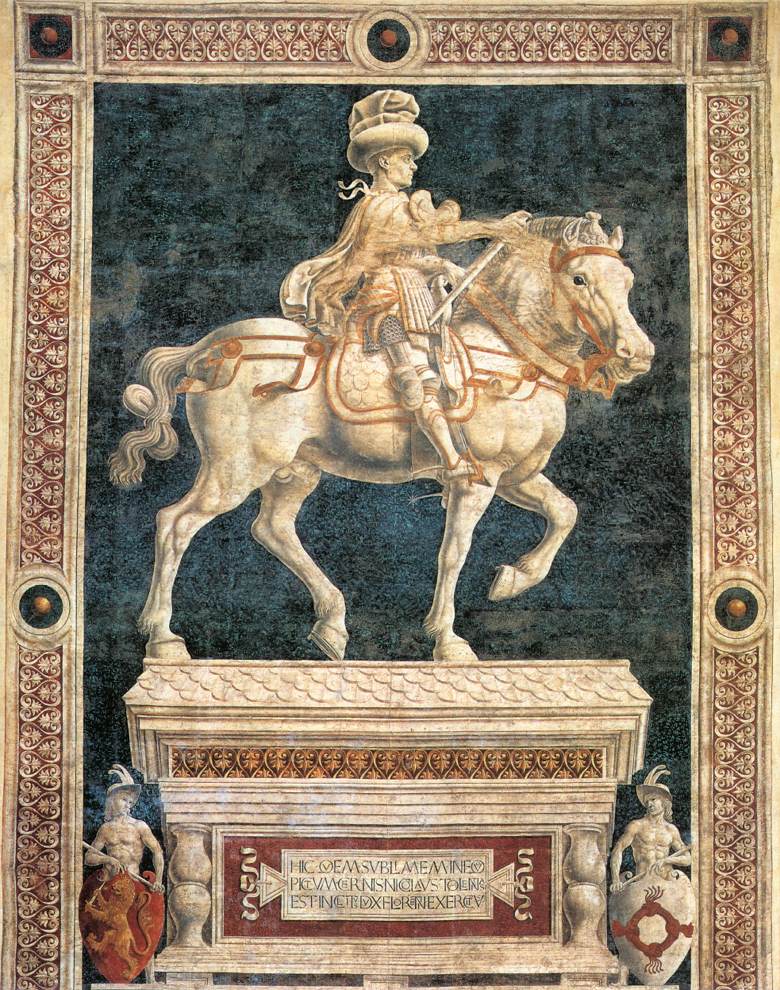
Monument to Niccolò da Tolentino
- MEDIUM
- Fresco
- TYPE
- Other
PALETTE
HOVER OR TAP A SWATCH FOR NAME, SHARE AND HEX. SAMPLED FROM THE IMAGE — INDICATIVE, NOT A PIGMENT ANALYSIS.
DEVELOPMENT BUILD — NOT FOR PUBLIC USE. CONTRIBUTE ON GITHUB.
03 — ARTWORK
PALETTE
HOVER OR TAP A SWATCH FOR NAME, SHARE AND HEX. SAMPLED FROM THE IMAGE — INDICATIVE, NOT A PIGMENT ANALYSIS.
COMMENTARY
UNDERLINED TERMS ARE DEFINED IN THE GLOSSARY.
Not long after the SS. Annunziata comission, the Opera del Duomo commissioned the monument to the commander Niccolò da Tolentino, which Andrea completed in March 1456. For this painting Castagno had to revert to the monumental and heroic model he had used in the Legnaia cycle. His description of the tense muscles of the horse and the general's furrowed face are very acute naturalistic observations that break the rigidity of that model.
A comparison of Andrea's Tolentino with Paolo Uccello's <a onclick="return OpenOther('/html/u/uccello/3florenc/1hawkwoo.html')" href="/html/u/uccello/3florenc/1hawkwoo.html">Sir John Hawkwood,</A> painted in the same cathedralThe principal church of a province or diocese, where the throne of the bishop is placed. For reasons lost to time and tradition, a cathedral always faces west - toward the setting sun. The altar is placed at the east end. The main body, or nave, of the cathedral is usually divided into one main and two side aisles. These lead up to the north and south transepts, or arms of the cross, the shape in which a cathedral is usually formed. several years earlier (1436), is inevitable. While Uccello froze the horse and its rider into a static composition of rigid geometric precision, Andrea expressed through the tension and movement of this frescoWall painting technique in which pigments are applied to wet (fresh) plaster (intonaco). The pigments bind with the drying plaster to form a very durable image. Only a small area can be painted in a day, and these areas, drying to a slightly different tint, can in time be seen. Small amounts of retouching and detail work could be carried out on the dry plaster, a technique known as a secco fresco. all the restlessness and vitality of his spirit.
The Monument to Niccolò da Tolentino in Florence Cathedral is the last work by Castagno that still survives; in 1457 he frescoed a Last SupperChrist's last meal with His disciples before His arrest and trial; the rite of communion is based on this. One of most famous depictions of the event is a fresco painted by Leonardo da Vinci. for the convent of Santa Maria degli Angeli, but it has not come down to us.
@online{wga-r00e2071a02478e,
  author       = {Krén, Emil and Marx, Daniel},
  title        = {Monument to Niccolò da Tolentino by ANDREA DEL CASTAGNO},
  organization = {{Web Gallery of Art}},
  date         = {2026-09-09},
  url          = {https://beta.wga.hu/artists/andrea-del-castagno-rb0e627f5e209d1/monument-to-niccol-da-tolentino-r00e2071a02478e},
  urldate      = {2026-09-09},
  langid       = {english}
}
ACCESSED 2026-09-09. REPLACE THE AUTHOR FIELD WITH THE COMMENTARY AUTHOR WHERE ONE IS NAMED.


