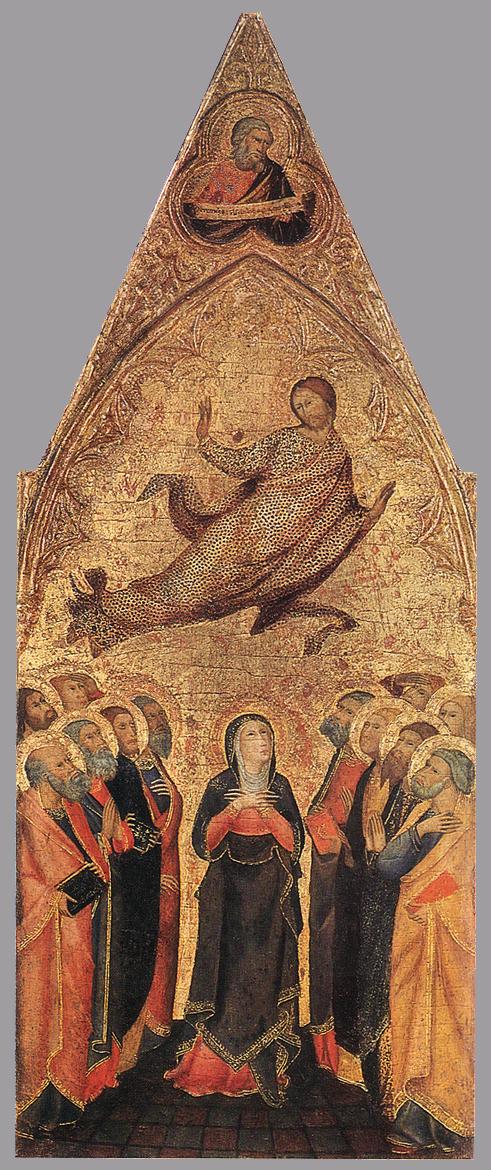
Italian painter and illuminator. He was one of the foremost members of the political faction that ruled Siena from 1368 to 1385, he was elected to the Grand Council and sent as Sienese ambassador to the pope at AvignonGLOSSARYThe decision to move the Papacy here was made in August 1308 by Pope Clement V, who had been residing in France since 1305. The actual move was made in 1309. Six pontificates later, in 1377, the Papacy was brought back to Rome by Gregory XI. All the popes elected at Avignon were French, as were 113 of the 134 cardinals appointed during this time. Yet though the period has been called one of 'captivity' to France, the Avignonese residence was not one of uninterrupted truckling to French kings. The city was not on French territory: it belonged to the Angevin princes of Naples. 'Captivity', like Petrarch's 'unholy Babylon', which he likened to the harlot of the Apocalypse 'full of abominations and the filth of her fornication', was mainly a term of abuse directed at a Papacy that had acquired security enough to revive its legal and financial pretensions and to build lavishly and live well. Between 1100 and 1309 the popes had only spent 82 years in Rome. Avignon gave them a long breathing space to assemble the machinery and the values which characterized the Renaissance Papacy after its final resettlement in Rome. and Naples. His career of painting frescoGLOSSARYWall painting technique in which pigments are applied to wet (fresh) plaster (intonaco). The pigments bind with the drying plaster to form a very durable image. Only a small area can be painted in a day, and these areas, drying to a slightly different tint, can in time be seen. Small amounts of retouching and detail work could be carried out on the dry plaster, a technique known as a secco fresco. cycles and altarpieces for the city's cathedralGLOSSARYThe principal church of a province or diocese, where the throne of the bishop is placed. For reasons lost to time and tradition, a cathedral always faces west - toward the setting sun. The altar is placed at the east end. The main body, or nave, of the cathedral is usually divided into one main and two side aisles. These lead up to the north and south transepts, or arms of the cross, the shape in which a cathedral is usually formed. and churches is also well documented. His art, however, was less noteworthy, his style remained true to the ever popular though increasingly unimaginatively interpreted idioms he had assimilated as a young man from Simone Martini's artistic heirs. His small-scale early works of the Virgin and Child (Oxford, Ashmolean; Berlin, Gemäldegalerie), which draw on the figure types of the Master of the PalazzoGLOSSARYPalaces: large urban dwellings, 'palazzo' in Italian carries no regal connotations. Alberti described the palace as a city in little, and, like cities, Italian Renaissance palaces vary in type according to differences of climate, tradition and social structure. On to these regional stocks were grafted new architectural strains, reflecting theoretical reinterpretations of antiquity and individually influential examples. The atrium and peristyle house described by Vitruvius and now known from Pompeii did not survive antiquity, and much of the interest of Renaissance designs lies in creative misunderstandings of Vitruvius's text. Medieval palace architecture probably inherited the insula type of ancient apartment house, related to the modest strip dwellings which never disappeared from Italian cities. In Florence a merchant palace developed from fortified beginnings, with vaulted shop openings on the ground floor, and the main apartments above, reached by internal stone staircases opening from an inner court. Renaissance developments regularized without changing the essential type, although large cloister-like courtyards were introduced, while shops came to be thought undignified. At Michelozzo's Medici Palace (1444) a square arcaded courtyard with axial entrance lies behind a façade of graduated rustication, with biforate windows, a classical cornice replacing the traditional wooden overhang. The apartments on the 'piano nobile' formed interconnecting suites of rooms of diminishing size and increasing privacy. The classical orders which Alberti introduced to the façade of the Palazzo Rucellai (c.1453) were not taken up by the conservative Florentines, who continued to build variations on the Medici Palace (Palazzo Pitti; Palazzo Strozzi). In the 16th century rustication was reduced to quoins and voussoirs, and large windows appeared on the ground floor, 'kneeling' on elongated volutes. At Urbino the Ducal Palace (1465) reflected Alberti's recommendations for the princely palace, and was in turn influential on late 15th century palaces in Rome (e.g. the Cancelleria). A harmonious Florentine courtyard and ample staircase replace the embattled spaces of medieval seigneurial castles, of which vestiges remain only in the towers flanking the balconies of the duke's private apartments, designed as a scholarly retreat. In the absence of a merchant class or a cultured nobility in 15th century Rome, the architectural pace was set by the papal court. Papal incentives to build, and large households, meant less compact plans for cardinals' palaces, often built next to their titular churches. Renaissance forms appear in the unfinished courtyard of the Palazzo Venezia (1460s), with its arcade system derived from the nearby Theatre of Marcellus, and in the delicately ordered stonework of the Cancelleria (1485). In the 16th century vestigial corner towers and shops disappear from cardinals' palaces, and Antonio da Sangallo's Palazzo Farnese (1516) introduces symmetrical planning and Vitrivuan elements, like the colonnaded vestibule, behind a sober Florentine façade, enlivened by Michelangelo's cornice. A smaller palace type supplied the needs of an enlarged papal bureaucracy, more ambitious for display than for domestic accommodation. Bramante's 'House of Raphael' sets the façade style not only for this new type, but also for Renaissance houses all over Europe. Raphael and Peruzzi made ingenious use of difficult sites (Palazzo da Brescia; Palazzo Massimi), and their sophisticated façades flattered the architectural pretensions of patron and pope (e.g. Palazzo Branconio dell'Aquila). Movement of patrons and architects, especially after the Sack of Rome, meant a diffusion of Roman forms to central and northern Italy, where Sanmicheli's palaces in Verona, and Palladio's in Vicenza, adapted Roman types to suit local conditions. Palladio's 4-columned atrium is a Vitruvian solution to the traditionally wide Veneto entrance hall, and his plan for the Palazzo da Porto-Festa contains explicit references to Vitruvius's House of the Greeks. In Venice, defended by its lagoon and a stable political system, the hereditary aristocracy built palaces open to trade and festivity on the Grand Canal. The traditional Venetian palace has a tripartite structure: long central halls above entrance vestibules used for unloading merchandise are lit on the canal façade by clusters of glazed windows (rare elsewhere), and at the back from small courts with external staircases (as in the Ca' d'Oro). Codussi's palaces introduced biforate windows and a grid of classical orders into the system, while Sansovino's Palazzo Cornaro retains vestiges of the Venetian type (small courtyard; tripartite façade) despite its Bramantesque coupled orders and licentious window surrounds. Other cities, like Genoa, evolved influential types. Through engravings and the illustrated treatises, Italian Renaissance ideas of palace planning, originally evolved in response to specific conditions, came to be applied all over Europe. Venezia Madonna (fl c. 1350), display soft contours, fairly light skin tones and light brushwork. The Child in particular possesses a degree of appealing spontaneity and a sense of arrested movement that is totally lacking in the later series of large panels, such as those to be found in the churches of S Donato, S Francesco and S Stefano, all in Siena.
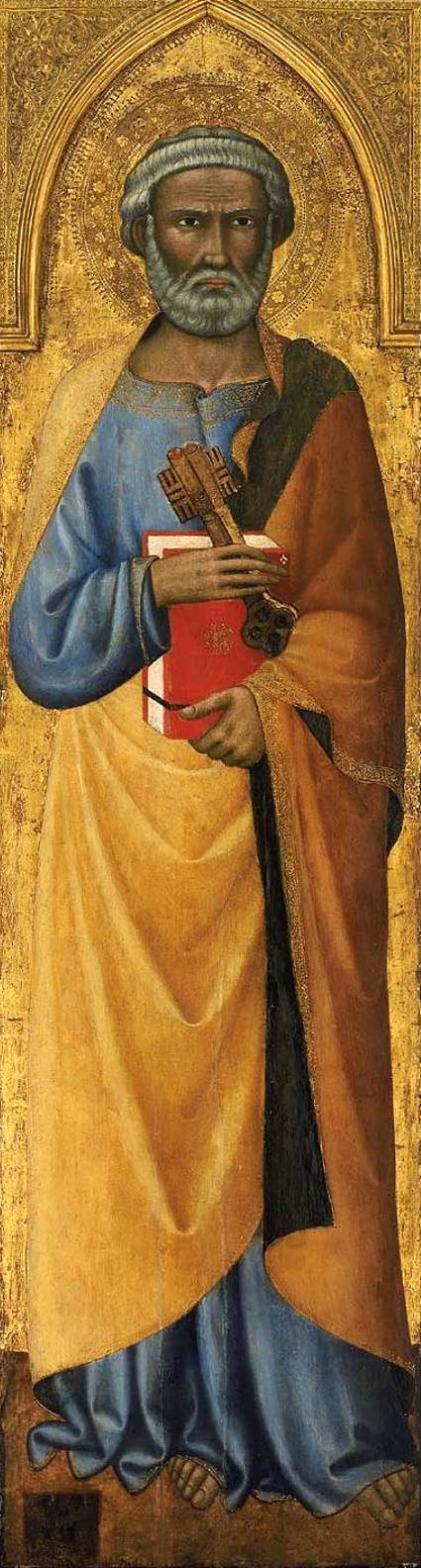
With his brother Lippo Vanni, Bartolo di Fredi, and Taddeo di Bartolo, Andrea Vanni introduced early Sienese art into the fifteenth century. His chief authenticated work is a large polyptychGLOSSARYA painting (usually an altarpiece) made up of a number of panels fastened together. Some polyptychs were very elaborate, the panels being housed in richly carved and decorated wooden frameworks. Duccio's "Maestà" (1308-1311) is a well-known example. in the Church of Santo Stefano at Siena. This painting depicts the Virgin enthroned between Sts. Stephen, James the Less, John the Baptist, and Bartholomew; in the niches above are the figures of the Evangelists, while several saints and an AnnunciationGLOSSARYthe term for the event described in the Gospel according to St. Luke, when the Angel Gabriel brings the Virgin Mary the news that she is to bear her son, Jesus Christ. The Annunciation was among the most widespread pictorial subjects of European art during the Middle Ages and the Renaissance. are painted in five higher projecting compartments. The small heads and the gestures betray a certain stiffness. A very agreeable and carefully painted picture is a Madonna and Child in the Church of San Michele. A Birth of the Virgin, representing James, Catherine, Bartholomew, and Elizabeth, in the galleryGLOSSARYan upper story, similar to a tribune, running along the side of a building and open on one side to the interior; in a church (basilica) above the side aisles, over the ambulatory (central-plan building) and also over the west end. The gallery was used to keep certain groups of worshippers apart (women, noblemen). at Siena, is the joint work of Vanni and Bartolo di Fredi, who often worked together both in art and politics. A CrucifixionGLOSSARYAn important method of capital punishment, particularly among the Persians, Seleucids, Jews, Carthaginians, and Romans from about the 6th century BC to the 4th century AD. Constantine the Great, the first Christian emperor, abolished it in the Roman Empire in AD 337, out of veneration for Jesus Christ, the most famous victim of crucifixion. There were various methods of performing the execution. Usually, the condemned man, after being whipped, or "scourged," dragged the crossbeam of his cross to the place of punishment, where the upright shaft was already fixed in the ground. Stripped of his clothing either then or earlier at his scourging, he was bound fast with outstretched arms to the crossbeam or nailed firmly to it through the wrists. The crossbeam was then raised high against the upright shaft and made fast to it about 9 to 12 feet (approximately 3 metres) from the ground. Next, the feet were tightly bound or nailed to the upright shaft. A ledge inserted about halfway up the upright shaft gave some support to the body; evidence for a similar ledge for the feet is rare and late. Over the criminal's head was placed a notice stating his name and his crime. Death, apparently caused by exhaustion or by heart failure, could be hastened by shattering the legs (crurifragium) with an iron club, so that shock and asphyxiation soon ended his life. with two saints by Vanni is in the Academy at Siena, an Annunciation in two panels in the Palazzo Saraceni, and a St. Sebastian at the museum. Vanni celebrated St Catherine in the frescoes of San Domenico at Siena. He also painted at Naples.