03 — ARTWORK
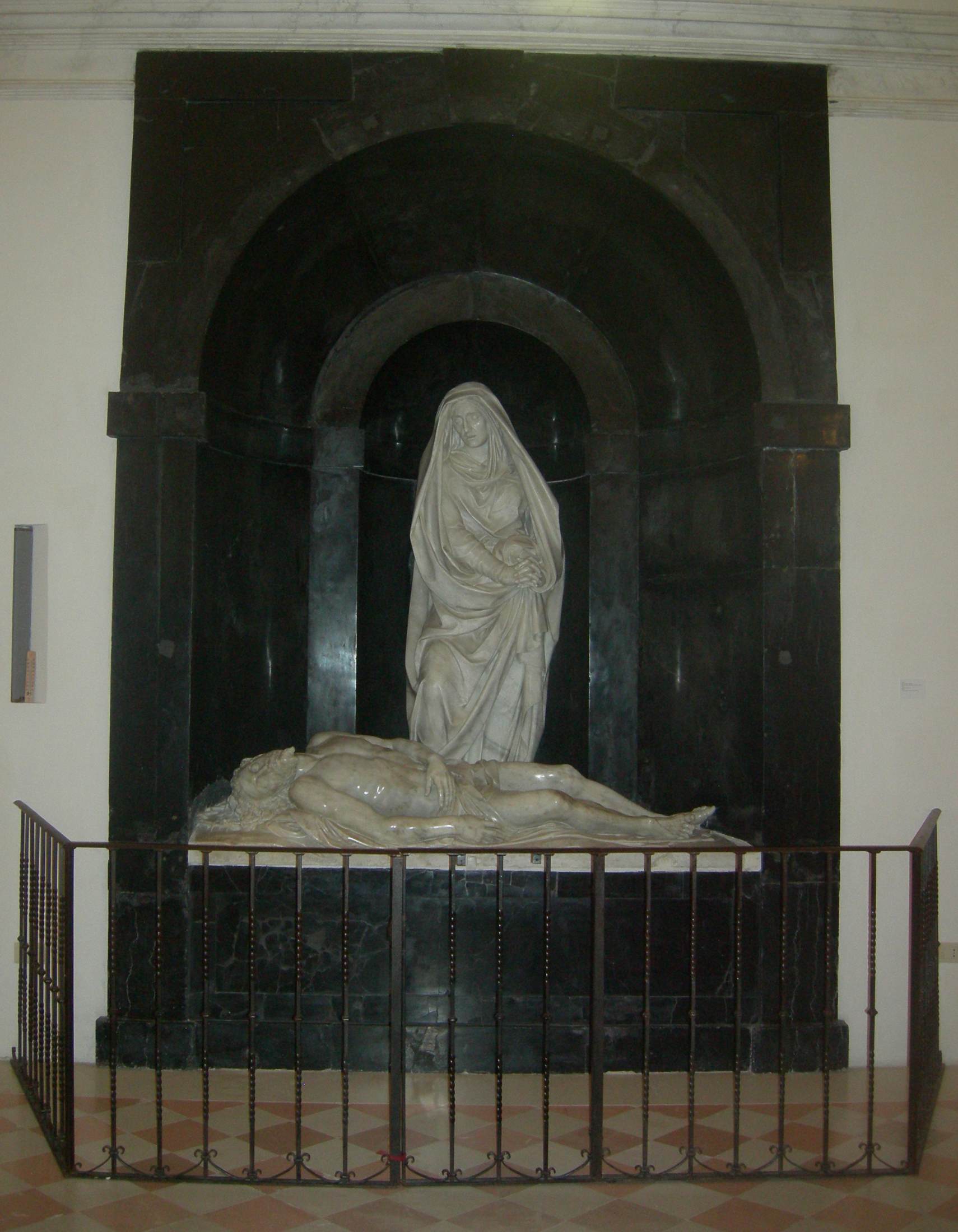
Pietà
- MEDIUM
- Marble
- TYPE
- Religious
PALETTE
HOVER OR TAP A SWATCH FOR NAME, SHARE AND HEX. SAMPLED FROM THE IMAGE — INDICATIVE, NOT A PIGMENT ANALYSIS.
DEVELOPMENT BUILD — NOT FOR PUBLIC USE. CONTRIBUTE ON GITHUB.
03 — ARTWORK
PALETTE
HOVER OR TAP A SWATCH FOR NAME, SHARE AND HEX. SAMPLED FROM THE IMAGE — INDICATIVE, NOT A PIGMENT ANALYSIS.
COMMENTARY
UNDERLINED TERMS ARE DEFINED IN THE GLOSSARY.
In 1583-84 Bandini created the bronzeAn alloy of copper (usually about 90 per cent) and tin, often also containing small amounts of other metals such as lead or zinc. Since antiquity it has been the metal most commonly used in cast sculpture because of its strength, durability, and the fact that it is easily workable - both hot and cold - by a variety of processes. It is easier to cast than copper because it has a lower melting-point, and its great tensile strength makes possible the protrusion of unsupported parts - an advantage over marble sculpture. The colour of bronze is affected by the proportion of tin or other metals present, varying from silverish to a rich, coppery red, and its surface beauty can be enhanced when it acquires a patina. group with Meleager for Francesco Maria II della Rovere, Duke of Urbino. For this uncharacteristically dynamic grouping he probably drew on antiquethe classical age of Greece and Rome began with the Greek migrations of the 2nd millennium BC, and ended in the West in 476 AD with the deposition of the Roman emperor Romulus Augustulus (c. 475 AD); in the East it ended in 529 AD when the Platonic Academy was closed by Justinian (482 - 565 AD). sculpture, a Hippolytus sarcophagusA coffin or tomb, made of stone, wood or terracotta, and sometimes (especially among the Greeks and Romans) carved with inscriptions and reliefs., and on a Wild Boar in the ducal collection (PalazzoPalaces: large urban dwellings, 'palazzo' in Italian carries no regal connotations. Alberti described the palace as a city in little, and, like cities, Italian Renaissance palaces vary in type according to differences of climate, tradition and social structure. On to these regional stocks were grafted new architectural strains, reflecting theoretical reinterpretations of antiquity and individually influential examples. The atrium and peristyle house described by Vitruvius and now known from Pompeii did not survive antiquity, and much of the interest of Renaissance designs lies in creative misunderstandings of Vitruvius's text. Medieval palace architecture probably inherited the insula type of ancient apartment house, related to the modest strip dwellings which never disappeared from Italian cities. In Florence a merchant palace developed from fortified beginnings, with vaulted shop openings on the ground floor, and the main apartments above, reached by internal stone staircases opening from an inner court. Renaissance developments regularized without changing the essential type, although large cloister-like courtyards were introduced, while shops came to be thought undignified. At Michelozzo's Medici Palace (1444) a square arcaded courtyard with axial entrance lies behind a façade of graduated rustication, with biforate windows, a classical cornice replacing the traditional wooden overhang. The apartments on the 'piano nobile' formed interconnecting suites of rooms of diminishing size and increasing privacy. The classical orders which Alberti introduced to the façade of the Palazzo Rucellai (c.1453) were not taken up by the conservative Florentines, who continued to build variations on the Medici Palace (Palazzo Pitti; Palazzo Strozzi). In the 16th century rustication was reduced to quoins and voussoirs, and large windows appeared on the ground floor, 'kneeling' on elongated volutes. At Urbino the Ducal Palace (1465) reflected Alberti's recommendations for the princely palace, and was in turn influential on late 15th century palaces in Rome (e.g. the Cancelleria). A harmonious Florentine courtyard and ample staircase replace the embattled spaces of medieval seigneurial castles, of which vestiges remain only in the towers flanking the balconies of the duke's private apartments, designed as a scholarly retreat. In the absence of a merchant class or a cultured nobility in 15th century Rome, the architectural pace was set by the papal court. Papal incentives to build, and large households, meant less compact plans for cardinals' palaces, often built next to their titular churches. Renaissance forms appear in the unfinished courtyard of the Palazzo Venezia (1460s), with its arcade system derived from the nearby Theatre of Marcellus, and in the delicately ordered stonework of the Cancelleria (1485). In the 16th century vestigial corner towers and shops disappear from cardinals' palaces, and Antonio da Sangallo's Palazzo Farnese (1516) introduces symmetrical planning and Vitrivuan elements, like the colonnaded vestibule, behind a sober Florentine façade, enlivened by Michelangelo's cornice. A smaller palace type supplied the needs of an enlarged papal bureaucracy, more ambitious for display than for domestic accommodation. Bramante's 'House of Raphael' sets the façade style not only for this new type, but also for Renaissance houses all over Europe. Raphael and Peruzzi made ingenious use of difficult sites (Palazzo da Brescia; Palazzo Massimi), and their sophisticated façades flattered the architectural pretensions of patron and pope (e.g. Palazzo Branconio dell'Aquila). Movement of patrons and architects, especially after the Sack of Rome, meant a diffusion of Roman forms to central and northern Italy, where Sanmicheli's palaces in Verona, and Palladio's in Vicenza, adapted Roman types to suit local conditions. Palladio's 4-columned atrium is a Vitruvian solution to the traditionally wide Veneto entrance hall, and his plan for the Palazzo da Porto-Festa contains explicit references to Vitruvius's House of the Greeks. In Venice, defended by its lagoon and a stable political system, the hereditary aristocracy built palaces open to trade and festivity on the Grand Canal. The traditional Venetian palace has a tripartite structure: long central halls above entrance vestibules used for unloading merchandise are lit on the canal façade by clusters of glazed windows (rare elsewhere), and at the back from small courts with external staircases (as in the Ca' d'Oro). Codussi's palaces introduced biforate windows and a grid of classical orders into the system, while Sansovino's Palazzo Cornaro retains vestiges of the Venetian type (small courtyard; tripartite façade) despite its Bramantesque coupled orders and licentious window surrounds. Other cities, like Genoa, evolved influential types. Through engravings and the illustrated treatises, Italian Renaissance ideas of palace planning, originally evolved in response to specific conditions, came to be applied all over Europe. Pitti, Florence). The change in Bandini's style is evident also in the marbleloosely applied to any hard limestone that can be sawn into thin slabs and will take a good polish so that it is suitable for decorative work; more strictly, it refers to metamorphosed limestones whose structure has been recrystallized by heat or pressure. Marbles are widely disseminated and occur in a great variety of colours and patterns, but certain types have been particularly prized by sculptors. The most famous of Greek white marbles in the ancient world was the close-grained Pentelic, which was quarried at Mount Pentelicon in Attica. The Elgin Marbles are carved in Pentelic. Widely used also were the somewhat coarser-grained translucent white marbles from the Aegean islands of Paros and Naxos. Parian marble was used for the celebrated Mausoleum at Halicarnassus. The pure white Carrara marble, quarried at Massa, Carrara, and Pietra Santa in Tuscany from the 3rd century BC, is the most famous of all sculptors' stones. It was used for the Apollo Belvedere, and was much favoured in the Renaissance, particularly by Michelangelo, who often visited the quarries to select material for his work. Neoclassical sculptors also favoured Carrara marble because of its ability to take a smooth, sleek surface, but it can look rather 'dead' compared with some of the finest Greek marbles. PietàA depiction of the Virgin Mary with the crucified body of Jesus across her lap. Developing in Germany in the 14th century, the Pietà became a familiar part of Renaissance religious imagery. One of the best-known examples is Michelangelo's "Pietà" (1497-1500) in St. Peter's, Rome., generally considered his masterpieceA term now loosely applied to the finest work by a particular artist or to any work of art of acknowledged greatness or of preeminence in its field. Originally it meant the piece of work by which a craftsman, having finished his training, gained the rank of'master' in his guild., which was probably influenced by <a onclick="return OpenOther('/html/s/sebastia/pieta.html')" href="/html/s/sebastia/pieta.html">Sebastiano del Piombo's Pietà</a> (Museo Civico, Viterbo) after Michelangelo's design, and also by the antique Niobe Group (Galleria degli Uffizi, Florence), especially the son of Niobe, excavated the year Bandini began the work.
This group was probably intended for the tomb of Francesco Maria II della Rovere.
@online{wga-r32bbe6690d1523,
  author       = {Krén, Emil and Marx, Daniel},
  title        = {Pietà by BANDINI, Giovanni},
  organization = {{Web Gallery of Art}},
  date         = {2026-09-09},
  url          = {https://beta.wga.hu/artists/bandini-giovanni-r41c699392806ea/piet-r32bbe6690d1523},
  urldate      = {2026-09-09},
  langid       = {english}
}
ACCESSED 2026-09-09. REPLACE THE AUTHOR FIELD WITH THE COMMENTARY AUTHOR WHERE ONE IS NAMED.


