03 — ARTWORK
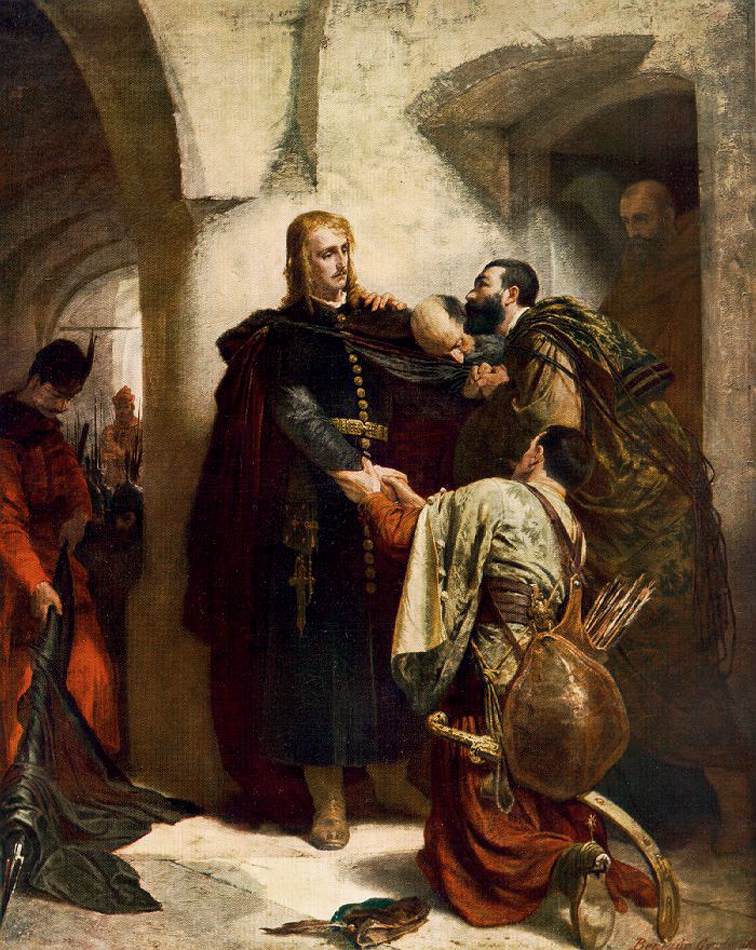
László Hunyadi's Farewell
- MEDIUM
- Oil on canvas, 147 x 121 cm
- TYPE
- Historical
PALETTE
HOVER OR TAP A SWATCH FOR NAME, SHARE AND HEX. SAMPLED FROM THE IMAGE — INDICATIVE, NOT A PIGMENT ANALYSIS.
DEVELOPMENT BUILD — NOT FOR PUBLIC USE. CONTRIBUTE ON GITHUB.
03 — ARTWORK
PALETTE
HOVER OR TAP A SWATCH FOR NAME, SHARE AND HEX. SAMPLED FROM THE IMAGE — INDICATIVE, NOT A PIGMENT ANALYSIS.
COMMENTARY
UNDERLINED TERMS ARE DEFINED IN THE GLOSSARY.
The great solemnity of historical paintings was especially apparent in the large pictures by Gyula Benczúr. His master, Piloty, concerned himself with stage-like scenes from the history of Europe, but Benczúr who great up in Kassa in the turmoil of the War of Independence, felt that it was more important to depict Hungarian history. This early work of his, "László Hunyadi's Farewell", alredy shows his particular talent for composition, human characterization and realistic rendering. There is deep sorrow on the face of László Hunyadi, the central figure, and one feels his tragic fate looming over the paintful farewell of his friends, Subdued light falls on the group and is reflected from the white walls that are painted with masterly realismRealism (with an upper case "R"), also known as the Realist school, denotes a mid-nineteenth century art movement and style in which artists discarded the formulas of Neoclassicism and the theatrical drama of Romanticism to paint familiar scenes and events as they actually looked. Typically it involved some sort of sociopolitical or moral message, in the depiction of ugly or commonplace subjects. One of the main representatives and spokesmen was the painter Gustave Courbet. In the dispute about ways to represent reality, Realism rebelled against the idealistic and classicist tendencies in painting..
The great succes of this painting marked the beginning of Benczúr's sparkling artistic career. He first exhibited it in Pest in 1867 and then in Paris with the works of eleven other Hungarian painters. In 1869, the Pest Picture Galleryan upper story, similar to a tribune, running along the side of a building and open on one side to the interior; in a church (basilica) above the side aisles, over the ambulatory (central-plan building) and also over the west end. The gallery was used to keep certain groups of worshippers apart (women, noblemen). Association bought it for the Hungarian National Museum. It became so popular that the weekly magazine "Hazánk" (Our Native Land) reproduced it as a colour supplement in the 1870s.
@online{wga-rbabf9e9cc05012,
  author       = {Krén, Emil and Marx, Daniel},
  title        = {László Hunyadi's Farewell by BENCZÛR, Gyula},
  organization = {{Web Gallery of Art}},
  date         = {2026-09-09},
  url          = {https://beta.wga.hu/artists/benczr-gyula-r36b746aa5258a9/lszl-hunyadis-farewell-rbabf9e9cc05012},
  urldate      = {2026-09-09},
  langid       = {english}
}
ACCESSED 2026-09-09. REPLACE THE AUTHOR FIELD WITH THE COMMENTARY AUTHOR WHERE ONE IS NAMED.


