03 — ARTWORK
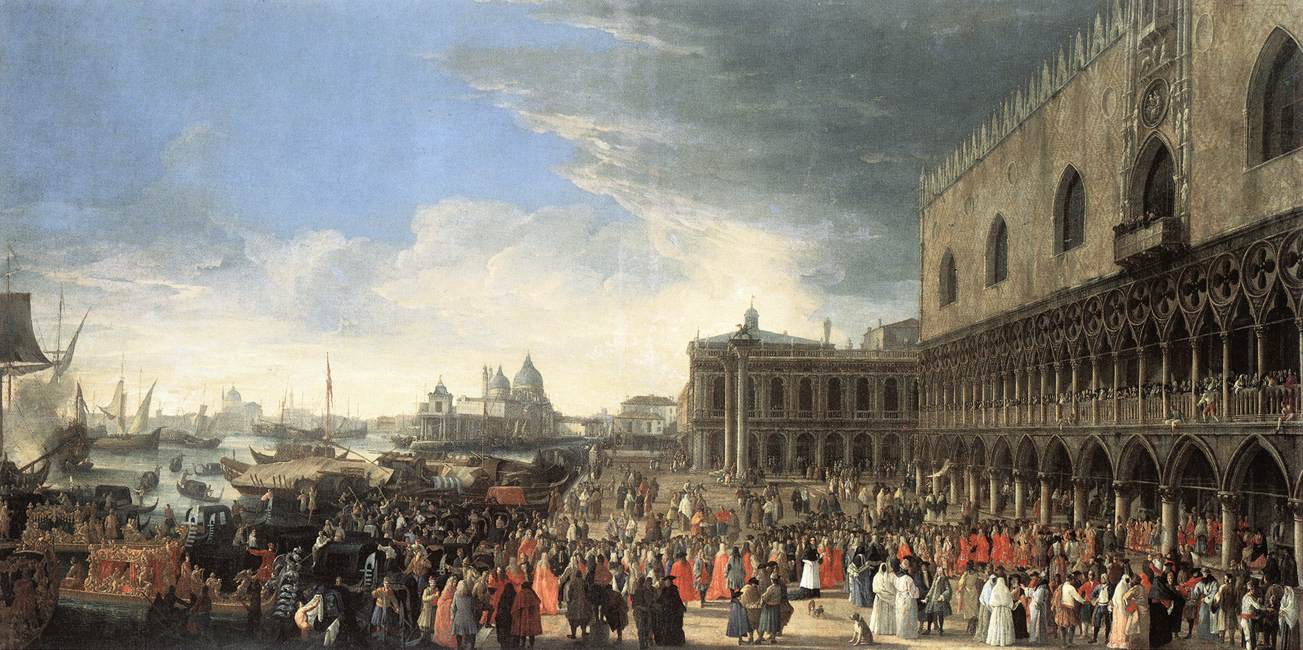
The Reception of Cardinal César d'Estrées
- MEDIUM
- Oil on canvas, 130 x 260 cm
- TYPE
- Landscape
PALETTE
HOVER OR TAP A SWATCH FOR NAME, SHARE AND HEX. SAMPLED FROM THE IMAGE — INDICATIVE, NOT A PIGMENT ANALYSIS.
DEVELOPMENT BUILD — NOT FOR PUBLIC USE. CONTRIBUTE ON GITHUB.
03 — ARTWORK
PALETTE
HOVER OR TAP A SWATCH FOR NAME, SHARE AND HEX. SAMPLED FROM THE IMAGE — INDICATIVE, NOT A PIGMENT ANALYSIS.
COMMENTARY
UNDERLINED TERMS ARE DEFINED IN THE GLOSSARY.
With the help of central perspectivea scientific and mathematical method of three-dimensional representation developed by Filippo Brunelleschi (1376 -1446) at the beginning of the 15th century. Relative to the observer, all the converging lines lead toward a single vanishing point at the centre of the composition. An illusion of depth is created on two-dimensional picture surfaces by precise foreshortening and proportioning of the objects, landscapes, buildings and figures that are being depicted, in accordance with their distance from the observer., the artist leads the eye of the spectator from the Ducal Palace, over the Molo to the Fonteghetto della Farina, where the entrance to the Grand Canal is marked by the silhouette of Santa Maria della Salute and the Punta della Dogana. Further to the left, behind a throng of gondolas and other boats, we can see the hazy profile of the Giudecca.
Owing to the many figures in the foreground, the canvasA woven cloth used as a support for painting. The best-quality canvas is made of linen; other materials used are cotton, hemp, and jute. It is now so familiar a material that the word 'canvas' has become almost a synonym for an oil painting, but it was not until around 1500 that it began to rival the wooden panel (which was more expensive and took longer to prepare) as the standard support for movable paintings (the transition came later in Northern Europe than in Italy). Canvas is not suitable for painting on until it has been coated with a ground, which isolates the fabric from the paint; otherwise it will absorb too much paint, only very rough effects will be obtainable, and parts of the fabric may be rotted by the pigments. It must also be made taut on a stretcher or by some other means. seems to transcend the genreIn a broad sense, the term is used to mean a particular branch or category of art; landscape and portraiture, for example, are genres of painting, and the essay and the short story are genres of literature. of the vedutaa primarily topographical representation of a town or landscape that is depicted in such a life-like manner that the location can be identified.. The schooner behind the gondolas in the left foreground has just fired a salute. A group of dignitaries crosses the Molo in the direction of the Ducal Palace, among them Procurators recognizable by their red robes. A curious crowd watches the procession; it includes many figures also found in Carlevaris's lively oil studies of daily life in the SerenissimaAbbreviation of La Serenissima Repubblica Venezia, "the most serene republic of Venice"), term, in use since the Middle Ages, which describes the splendour and dignity of Venice and is, at the same time, an expression of Venetian self-confidence..
Carlevaris is not the inventor of this veduta: long before, in the 1660s to be precise, the French artist Israel Silvestre made a print of roughly the same view. The Venetian master is undoubtedly responsible for the sense of grandeur about the scene, achieved by raising the vantage point and adding the panorama on the left. Carlevaris often employed this device - especially to represent diplomatic receptions, for which he was famous - shifting the point of view slightly each time. He situated these events in front of the Ducal Palace, where the newly appointed ambassadors presented their credentials to the Doge and Senate, the climax of a ceremony that lasted altogether several days. The Entry of the Earl of Manchester into the Doge's Palace, which the Earl himself commissioned in 1707, is one of the masters best-known works in this series and also one of his two earliest veduta.
The Reception of Cardinal César d'Estrées represents a similar event, so similar, in fact, that until recently this canvas was assumed to be an autograph variant of the English reception. Judging from the staffageThis word, pronounced as French, is used in both English and German to describe the figures and animals which animate a picture intended essentially as a landscape or veduta; in other words, figures which are not really essential and could be added by another painter. In the highly specialized world of the Dutch painters of the 17th century this was very often the case, so that a landscape painter like Wynants rarely did his own staffage; whereas Canaletto or Guardi always did., however, it was not a repetition. Unlike the Entry of the Earl of Manchester a French, not an English mission is shown here, witness the fleur-de-lis on the Ambassador's gondolas in the left foreground. Furthermore the composition draws attention to the prelate in the midst of the crowd; since only one French ambassador to Venice held an ecclesiastical office - Cardinal d'Estrées - the reception must be his.
César d'Estrées (1628—1714), a bishop of Laon who was created cardinal in 1672, was a seasoned diplomat. In January 1701 he was sent to Mantua and Venice to convince them to deny the imperial army passage to Milan despite their neutrality on the issue of the Spanish succession. D'Estrées' mission proved fruitless inasmuch as the Republic refused to alter its position; in April the prelate left empty-handed for Naples to join the Spanish king. Carlevaris may have received and executed the commission during the three months the Cardinal spent in Venice or shortly thereafter. Though it is still unclear whether Venice or the diplomat himself took the initiative, the latter possibility seems most likely, given the fact that most of Carlevaris's paintings of diplomatic receptions were prompted by the ambassadors involved.
The scarcity of information about Carlevaris's work prior to 1703, the year of publication of his famous series of engravings, Le Fabriche, e Vedute di Venetia, accounts for the importance of this painting. A handful of landscapes and several capricci are all that is known of his oeuvreThe complete body of works created by an artist. before then. His first documented commission for painted vedute only dates from 1705, while the two earliest, securely dateable works in this category were executed two years later. The Reception of Cardinal d'Estreés is thus probably the first indication of Carlevaris's competence in this genre; more importantly, however, it is arguably the prototype of the eighteenth-century veduta. <P> <TABLE ALIGN=LEFT CELLPADDING=5 BORDER=1 WIDTH=320 BGCOLOR="#99CCCC"> <TR VALIGN=MIDDLE><TD><IMG SRC="/support/gif/listen.gif" BORDER=0 VALIGN=MIDDLE> Suggested listening (streaming mp3, 5 minutes):<BR><A HREF="#" onClick="w=window.open ('/music1/17_cent/stradella_sinfonia.html', 'newWin', 'scrollbars=yes,status=no,dependent=yes,screenX=0,screenY=0,width=350,height=350');w.opener=this;w.focus();return true"><B>Alessandro Stradella: Sinfonia avanti il Barcheggio</B></A> </TD></TR></TABLE>
@online{wga-r04371b15a208e4,
  author       = {Krén, Emil and Marx, Daniel},
  title        = {The Reception of Cardinal César d'Estrées by CARLEVARIS, Luca},
  organization = {{Web Gallery of Art}},
  date         = {2026-09-09},
  url          = {https://beta.wga.hu/artists/carlevaris-luca-r3dc1051d028c5a/the-reception-of-cardinal-csar-destres-r04371b15a208e4},
  urldate      = {2026-09-09},
  langid       = {english}
}
ACCESSED 2026-09-09. REPLACE THE AUTHOR FIELD WITH THE COMMENTARY AUTHOR WHERE ONE IS NAMED.


