03 — ARTWORK
External view
CASAS Y NÓVOA, Fernando de · 1749 →
- MEDIUM
- Photo
- TYPE
- Other
PALETTE
HOVER OR TAP A SWATCH FOR NAME, SHARE AND HEX. SAMPLED FROM THE IMAGE — INDICATIVE, NOT A PIGMENT ANALYSIS.
DEVELOPMENT BUILD — NOT FOR PUBLIC USE. CONTRIBUTE ON GITHUB.
03 — ARTWORK
CASAS Y NÓVOA, Fernando de · 1749 →
PALETTE
HOVER OR TAP A SWATCH FOR NAME, SHARE AND HEX. SAMPLED FROM THE IMAGE — INDICATIVE, NOT A PIGMENT ANALYSIS.
COMMENTARY
UNDERLINED TERMS ARE DEFINED IN THE GLOSSARY.
CASAS Y NÓVOA, Fernando de (b. 1691, Santiago de Compostela, d. 1749, Santiago de Compostela)
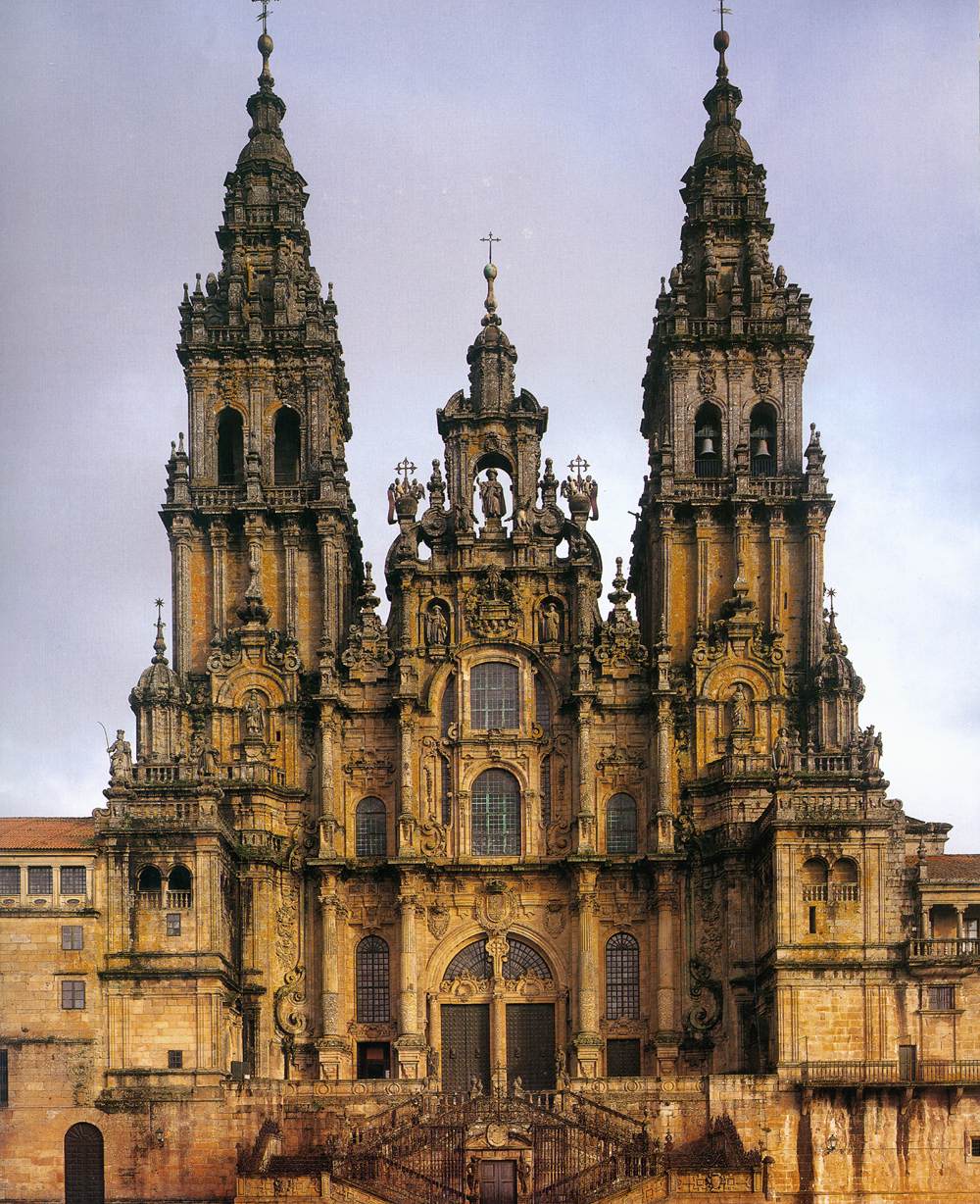
External view 1738-49 Photo CathedralThe principal church of a province or diocese, where the throne of the bishop is placed. For reasons lost to time and tradition, a cathedral always faces west - toward the setting sun. The altar is placed at the east end. The main body, or nave, of the cathedral is usually divided into one main and two side aisles. These lead up to the north and south transepts, or arms of the cross, the shape in which a cathedral is usually formed., Santiago de Compostela
Providing the very traditional church of St James in Santiago de Compostela with a new and more dignified appearance was an ambitious building which started in 1649, but was only completed in stages. It culminated only in the 1740s in the construction of the new façadethe front or principal face of a building, especially one elaborately constructed; a blind façade is a façade that is purely decorative and does not relate to the structure of the building.. Ferdinando de Casas y Nóvoa was entrusted with this task.
The architect first worked on the construction of the still missing north tower which he matched with the south power built by Peña de Toro (c. 1608-1676). The construction of the new façade did not start until 1738. The design required extraordinarily careful planning since it had to accommodate a variety of more or less incompatible requirements: it had to mask and protect the RomanesqueStyle of art and architecture prevailing throughout most of Europe in the 11th and 12th centuries, the first style to achieve such international currency. The dominant art of the Middle Ages was architecture, and 'Romanesque', like 'Gothic', is primarily an architectural term that has been extended to the other arts of the period. As the name suggests, it indicates a derivation from Roman art, and sometimes Romanesque is used to cover all the developments from Roman architecture in the period from the collapse of the Roman Empire until the flowering of the Gothic roughly AD 500-1200. More usually, however, it is applied to a distinctive style that emerged, almost simultaneously, in several countries - France, Germany, Italy, Spain - in the 11th century. It is characterized most obviously by a new massiveness of scale, reflecting the greater political and economic stability that followed a period when Christian civilization seemed in danger of extinction. Romanesque painting and sculpture are generally strongly stylized, with little of the naturalism and humanistic warmth of classical or later Gothic art. The forms of nature are freely translated into linear and sculptural designs which are sometimes majestically calm and severe and at others are agitated by a visionary excitement that can become almost delirious. Because of its expressionistic distortion of natural form, Romanesque art, as with other great non-naturalistic styles of the past, has had to wait for the revolution in sensibility brought about by the development of modern art in order to be widely appreciated. <a onclick="return OpenOther('/html/m/master/mateo/p_gloria.html')" href="/html/m/master/mateo/p_gloria.html">PorticoUsually open porch supported by columns or pillars on the main entrance side of a buildings. Frequently supports a pediment. de la Gloria</a> behind and so allow as much light as possible to reach it; it also had to respondLong narrow column or engaged column, mainly in Gothic architecture, which supports the arches and ribs of groin vaults or the profiles of arcade arches. to the urban structure of the city of pilgrimage and, in particular integrate with a BaroqueThe period in art history from about 1600 to about 1750. In this sense the term covers a wide range of styles and artists. In painting and sculpture there were three main forms of Baroque: (1) sumptuous display, a style associated with the Catholic Counter Reformation and the absolutist courts of Europe (Bernini, Rubens); (2) dramatic realism (Caravaggio); and (3) everyday realism, a development seen in particular in Holland (Rembrandt, Vermeer). In architecture, there was an emphasis on expressiveness and grandeur, achieved through scale, the dramatic use of light and shadow, and increasingly elaborate decoration. In a more limited sense the term Baroque often refers to the first of these categories. The development of the Baroque reflects the period's religious tensions (Catholic versus Protestant); a new and more expansive world view based on science and exploration; and the growth of absolutist monarchies. flight of steps, the construction of which had already been started.
Ferdinando de Casas y Nóvoa resolved this aesthetic and technical problems in a remarkable way, retaining the dignity of a Romanesque building while providing it with a context within the Baroque city. The synthesis of old and new idioms seen here anticipates to some extent the architectural eclecticismA nineteenth and twentieth-century architectural style in which a single piece of work incorporates a mixture of elements from previous historical styles to create something that is new and original. of later centuries.
The picture shows the west façade of the cathedral, the Fachada del Obradoiro, so-called because in its filigree lightness it was seen as comparable to goldsmith's work.
@online{wga-rb1151ba3e86283,
  author       = {Krén, Emil and Marx, Daniel},
  title        = {External view by CASAS Y NÓVOA, Fernando de},
  organization = {{Web Gallery of Art}},
  date         = {2026-09-13},
  url          = {https://beta.wga.hu/artists/casas-y-nvoa-fernando-de-r84e9f34131447d/external-view-rb1151ba3e86283},
  urldate      = {2026-09-13},
  langid       = {english}
}
ACCESSED 2026-09-13. REPLACE THE AUTHOR FIELD WITH THE COMMENTARY AUTHOR WHERE ONE IS NAMED.
The archive catalogues no further works by this artist.
TRY SAME COLLECTION →