03 — ARTWORK
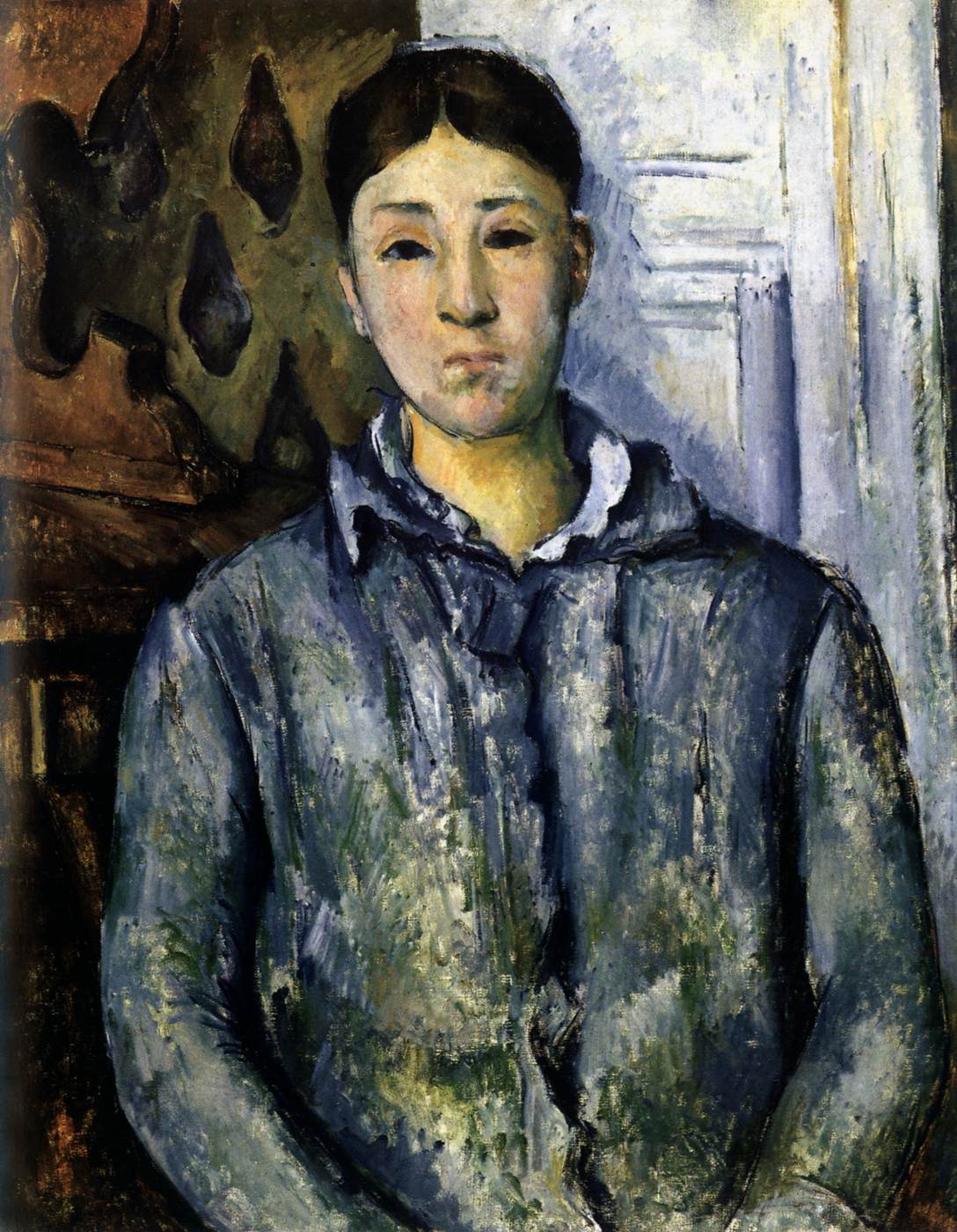
Madame Cézanne in Blue
- MEDIUM
- Oil on canvas, 73 x 60 cm
- TYPE
- Portrait
PALETTE
HOVER OR TAP A SWATCH FOR NAME, SHARE AND HEX. SAMPLED FROM THE IMAGE — INDICATIVE, NOT A PIGMENT ANALYSIS.
DEVELOPMENT BUILD — NOT FOR PUBLIC USE. CONTRIBUTE ON GITHUB.
03 — ARTWORK
PALETTE
HOVER OR TAP A SWATCH FOR NAME, SHARE AND HEX. SAMPLED FROM THE IMAGE — INDICATIVE, NOT A PIGMENT ANALYSIS.
COMMENTARY
UNDERLINED TERMS ARE DEFINED IN THE GLOSSARY.
In April 1886, Cézanne married Hortense Fiquet in Aix. The reason why, after so long, he decided to make his relationship with Hortense official, despite not having loved her for a long time, was probable to ensure that their son Paul, now aged fourteen, did not suffer the stigma of having unmarried parents.
The present portraitThe Roman portrait bust survived in the form of life-sized reliquaries of saints, but it was in 15th century Florence that the individual features and character of a contemporary sitter were accurately recorded by sculptors such as Donatello, Desiderio da Settignano, Mino da Fiesole and the Rossellino. A similar degree of realism occurs in 15th century tomb sculpture. The equestrian portrait, based on antique statues such as the Marcus Aurelius monument (Rome, Campidoglio), was revived in the 14th century. Two examples in fresco are Simone Martini's Guidoriccio (c. 1328; Siena, Palazzo Pubblico) and the posthumous portrait of Sir John Hawkwood (1436; Florence, Cathedral) by Uccello, which gives the illusion of a 3-dimensional statue seen from below. The Venetian Republic ordered imposing monuments from Donatello (1447; Gattarnelata, Padua) and Verrocchio (14799; Colleoni, Venice), whilst other statesmen ordered their own images to be erected in public places, directly relating themselves to the military heroes of ancient Rome. Another form of political portraiture derived from antiquity was the commemorative portrait medal designed by artists such as Pisanello. The carved or painted profile portrait became popular in the 1450s. The realism of the clear, flattened image, painted under the influence of Flemish examples by the Pollaiuolo brothers, Piero della Francesca and Botticelli, was superseded by the three-quarter and frontal portrait, psychologically more complex, such as Leonardo's enigmatic Mona Lisa (Paris, Louvre) with her momentary smile or Andrea del Sarto's arresting Portrait of a Man (London, National Gallery). The 16th century portrait became generalized, Lotto's Andrea Odoni (1527; Royal Collection) being an idealized concept of a collector rather than an individual. Group portraits, decorating whole rooms, include the narrative scenes of the Gonzaga court painted by Mantegna (completed 1474; Mantua, Palazzo Ducale) and the elaborate schemes commissioned by the Farnese family in Rome from Vasari (1546; Palazzo della Cancelleria) and Salviati (after 1553; Palazzo Farnese). Portraits were also incorporated into religious narratives, as in Ghirlandaio's fresco cycle painted for Giovanni Tornabuoni in S. Maria Novella, Florence (1486-90). shows Hortense sitting against a background which is divided into two parts: on the right is a door, with strictly geometric paneling; on the left is patterned wallpaper and the ornamental top of an occasional table. The pale, cool blue of the door is in sharp contrast with the warm earthy tones of the wall-hanging and the piece of furniture. The sitter is posed leaning slightly to one side, a motionless, monumental figure. The flesh tints of her serious, withdrawn looking face echo the colours of the background, and the opening of her jacket also helps to divide the composition into two.
Cézanne uses a similar process in his portraits to that of his landscapes: they are formal, strict, with a monumental, permanent quality.
@online{wga-r217f182f232a92,
  author       = {Krén, Emil and Marx, Daniel},
  title        = {Madame Cézanne in Blue by CÉZANNE, Paul},
  organization = {{Web Gallery of Art}},
  date         = {2026-09-08},
  url          = {https://beta.wga.hu/artists/czanne-paul-r7acc44883e4fc9/madame-czanne-in-blue-r217f182f232a92},
  urldate      = {2026-09-08},
  langid       = {english}
}
ACCESSED 2026-09-08. REPLACE THE AUTHOR FIELD WITH THE COMMENTARY AUTHOR WHERE ONE IS NAMED.


