03 — ARTWORK
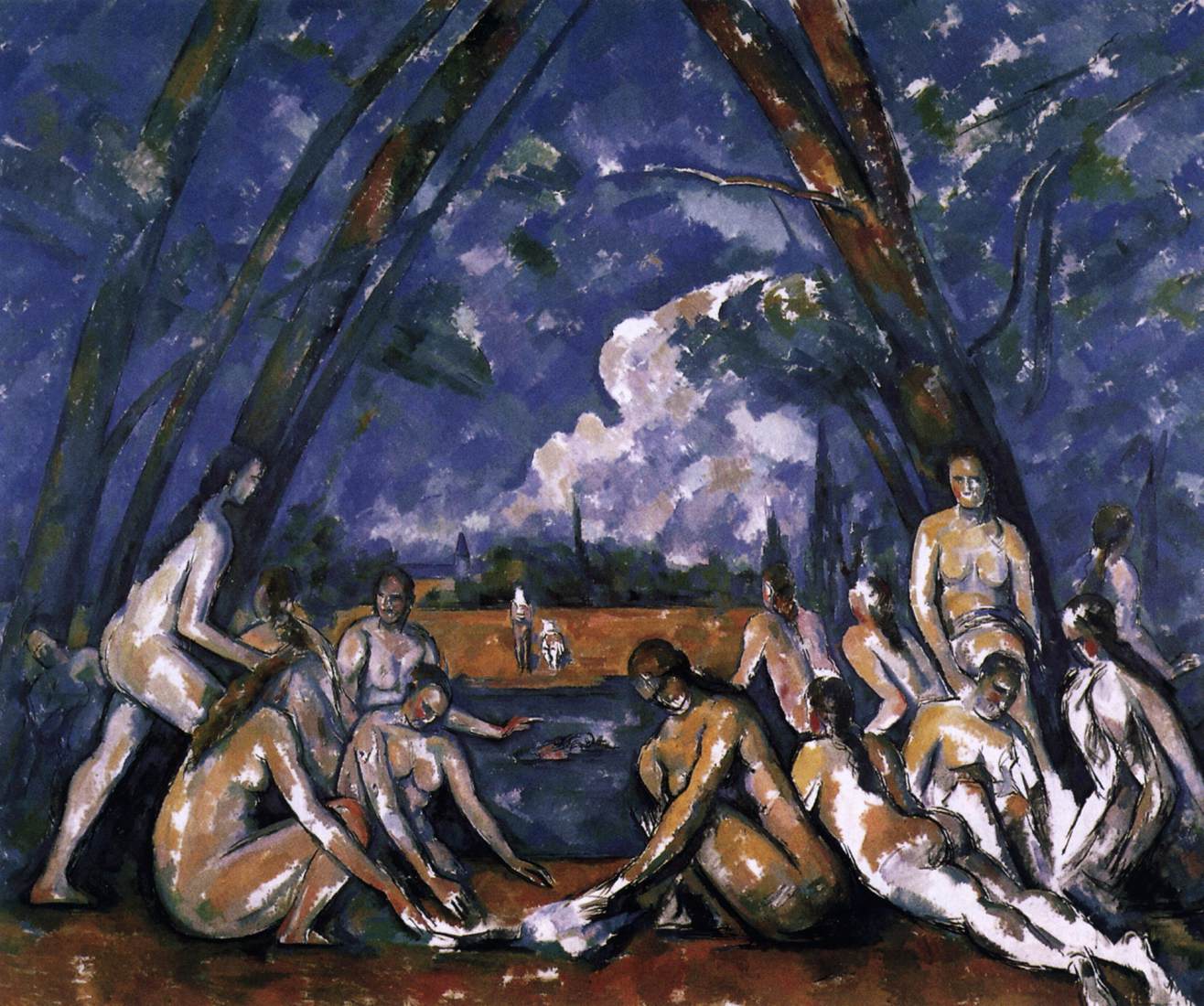
The Large Bathers
- MEDIUM
- Oil on canvas, 208 x 249 cm
- TYPE
- Other
PALETTE
HOVER OR TAP A SWATCH FOR NAME, SHARE AND HEX. SAMPLED FROM THE IMAGE — INDICATIVE, NOT A PIGMENT ANALYSIS.
DEVELOPMENT BUILD — NOT FOR PUBLIC USE. CONTRIBUTE ON GITHUB.
03 — ARTWORK
PALETTE
HOVER OR TAP A SWATCH FOR NAME, SHARE AND HEX. SAMPLED FROM THE IMAGE — INDICATIVE, NOT A PIGMENT ANALYSIS.
COMMENTARY
UNDERLINED TERMS ARE DEFINED IN THE GLOSSARY.
Cézanne painted three large versions of the female bathers, all during the last seven years of his life. The version in Philadelphia is the largest. This was the first time that Cézanne had painted such a monumental canvasA woven cloth used as a support for painting. The best-quality canvas is made of linen; other materials used are cotton, hemp, and jute. It is now so familiar a material that the word 'canvas' has become almost a synonym for an oil painting, but it was not until around 1500 that it began to rival the wooden panel (which was more expensive and took longer to prepare) as the standard support for movable paintings (the transition came later in Northern Europe than in Italy). Canvas is not suitable for painting on until it has been coated with a ground, which isolates the fabric from the paint; otherwise it will absorb too much paint, only very rough effects will be obtainable, and parts of the fabric may be rotted by the pigments. It must also be made taut on a stretcher or by some other means.. Two other versions are in The Barnes Foundation, Merion, and in the National Galleryan upper story, similar to a tribune, running along the side of a building and open on one side to the interior; in a church (basilica) above the side aisles, over the ambulatory (central-plan building) and also over the west end. The gallery was used to keep certain groups of worshippers apart (women, noblemen)., London.
The figures in all three compositions are remarkably simply and coarsely painted. The female creatures frolicking on the riverbank are not graceful, rather they are sturdy, angular, oddly proportioned and plump, and have nothing erotic about them. Cézanne avoided any suggestion of individuality and instead has generalised the figures in the same way as the landscapes, so that both have equal artistic weight.
In the Philadelphia version, Cézanne has focused on the trunks which bear the weight of the trees. These create a framework which is both static and dynamic. The figures are also aligned in the same way as the trees; this is probably most apparent in the female figure on the far left, whose upper body and left leg are inclined at exactly the same angle as the tree trunk. However, the contours and arms of the other figures also echo the geometry of the framework.
Cézanne spent more than seven years working on this version. The strict triangular composition makes it the most classicalRelating to the culture of ancient Greece and Rome (classical Antiquity). The classical world played a profoundly important role in the Renaissance, with Italian scholars, writers, and artists seeing their own period as the rebirth (the "renaissance") of classical values after the Middle Ages. The classical world was considered the golden age for the arts, literature, philosophy, and politics. Concepts of the classical, however, changed greatly from one period to the next. Roman literature provided the starting point in the 14th century, scholars patiently finding, editing and translating a wide range of texts. In the 15th century Greek literature, philosophy and art - together with the close study of the remains of Roman buildings and sculptures-expanded the concept of the classical and ensured it remained a vital source of ideas and inspiration. of this series.
@online{wga-raa9b9b3cf5b1ae,
  author       = {Krén, Emil and Marx, Daniel},
  title        = {The Large Bathers by CÉZANNE, Paul},
  organization = {{Web Gallery of Art}},
  date         = {2026-09-08},
  url          = {https://beta.wga.hu/artists/czanne-paul-r7acc44883e4fc9/the-large-bathers-raa9b9b3cf5b1ae},
  urldate      = {2026-09-08},
  langid       = {english}
}
ACCESSED 2026-09-08. REPLACE THE AUTHOR FIELD WITH THE COMMENTARY AUTHOR WHERE ONE IS NAMED.


