03 — ARTWORK
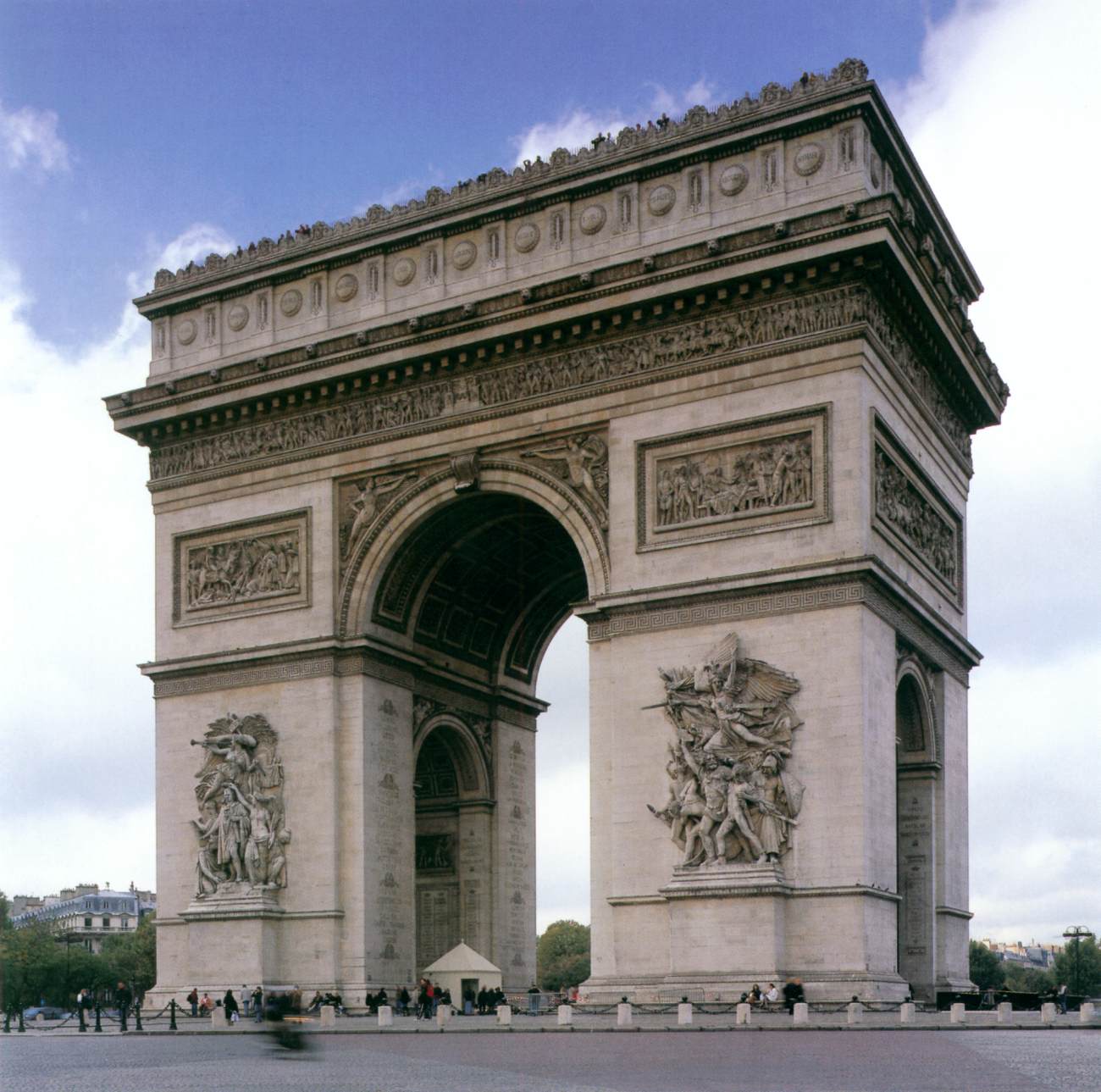
General view
CHALGRIN, Jean-François-Thérese →
- MEDIUM
- Photo
- TYPE
- Other
PALETTE
HOVER OR TAP A SWATCH FOR NAME, SHARE AND HEX. SAMPLED FROM THE IMAGE — INDICATIVE, NOT A PIGMENT ANALYSIS.
DEVELOPMENT BUILD — NOT FOR PUBLIC USE. CONTRIBUTE ON GITHUB.
03 — ARTWORK
CHALGRIN, Jean-François-Thérese →
PALETTE
HOVER OR TAP A SWATCH FOR NAME, SHARE AND HEX. SAMPLED FROM THE IMAGE — INDICATIVE, NOT A PIGMENT ANALYSIS.
COMMENTARY
UNDERLINED TERMS ARE DEFINED IN THE GLOSSARY.
The Arc de Triomphe, in full Arc de Triomphe de l'Étoile, massive triumphal archIn the architecture of ancient Rome, a large and usually free-standing ceremonial archway built to celebrate a military victory. Often decorated with architectural features and relief sculptures, they usually consisted of a large archway flanked by two smaller ones. The triumphal archway was revived during the Renaissance, though usually as a feature of a building rather than as an independent structure. In Renaissance painting they appear as allusion to classical antiquity. in Paris, France, is one of the world's best-known commemorative monuments. It stands at the centre of the Place Charles de Gaulle (formerly called the Place de l'Étoile). Napoleon I commissioned the triumphal archThe pointed arch is widely regarded as the main identifiable feature of Gothic architecture (distinct from the round arch of the Romanesque period). The three most common Gothic arches are the Equilateral, Lancet and Tudor. in 1806 — after his great victory at the Battle of Austerlitz (1805) — to celebrate the military achievements of the French armies. The arch, designed by Jean-François-Thérese Chalgrin, is 50 metres high and 45 metres wide. It sits in a circular plaza from which 12 grand avenues radiate, forming a star (étoile).
Construction of the arch began in 1806, on August 15, Napoleon's birthday. Little more than the foundation had been completed by the time of his marriage to the Austrian archduchess Marie-Louise in 1810, so, in honour of her ceremonial entry into Paris, a full-scale depiction of the completed design, created from wood and painted canvasA woven cloth used as a support for painting. The best-quality canvas is made of linen; other materials used are cotton, hemp, and jute. It is now so familiar a material that the word 'canvas' has become almost a synonym for an oil painting, but it was not until around 1500 that it began to rival the wooden panel (which was more expensive and took longer to prepare) as the standard support for movable paintings (the transition came later in Northern Europe than in Italy). Canvas is not suitable for painting on until it has been coated with a ground, which isolates the fabric from the paint; otherwise it will absorb too much paint, only very rough effects will be obtainable, and parts of the fabric may be rotted by the pigments. It must also be made taut on a stretcher or by some other means., was erected at the site. That gave Chalgrin the opportunity to see his design in place on the site, and he made some small amendments to it. At the time of his death in 1811, only a small portion of the structure had been completed, and work slowed further after Napoleon's abdication as emperor and the Bourbon Restoration (1814). Thus, little more was accomplished until the resumption of work was ordered in 1823 by King Louis XVIII, who was motivated by the success of the French invasion of Spain that restored King Ferdinand VII's power as absolute monarch. The basic structure of the monument was finished by 1831; work was completed in 1836, during the reign of King Louis-Philippe, who opened it officially on July 29.
Chalgrin's design is Neoclassical, inspired in part by the Arch of Titus in the Roman Forum. Decorative high-reliefA sculptural work in which all or part projects from the flat surface. There are three basic forms: low relief (bas-relief, basso rilievo), in which figures project less than half their depth from the background; medium relief (mezzo-rilievo), in which figures are seen half round; and high relief (alto rilievo), in which figures are almost detached from their background. sculptures celebrating military victories of the Revolution and the First Empire were executed on the façades of the arch's four pedestals by François Rude, Jean-Pierre Cortot, and Antoine Etex. The most famous of those sculptures is Rude's group Departure of the Volunteers of 1792 (popularly called La Marseillaise). Other surfaces are decorated with the names of hundreds of generals and battles.
The Arc de Triomphe continues to serve as an iconic symbol of France, to the country itself and to the world. The coffins of many French luminaries, such as Victor Hugo and Ferdinand Foch, have lain in state there before their interment elsewhere. In addition, victory parades have frequently marched past the arch, both those of invading powers (such as Germany, in 1871 and 1940) and of France and its allies (in 1918, 1944 [upon the liberation of Paris during World War II], and 1945 [after the end of the war in Europe]).
@online{wga-r801a0974f299d2,
  author       = {Krén, Emil and Marx, Daniel},
  title        = {General view by CHALGRIN, Jean-François-Thérese},
  organization = {{Web Gallery of Art}},
  date         = {2026-09-13},
  url          = {https://beta.wga.hu/artists/chalgrin-jean-franois-threse-rcb7100a17f769e/general-view-r801a0974f299d2},
  urldate      = {2026-09-13},
  langid       = {english}
}
ACCESSED 2026-09-13. REPLACE THE AUTHOR FIELD WITH THE COMMENTARY AUTHOR WHERE ONE IS NAMED.


