03 — ARTWORK
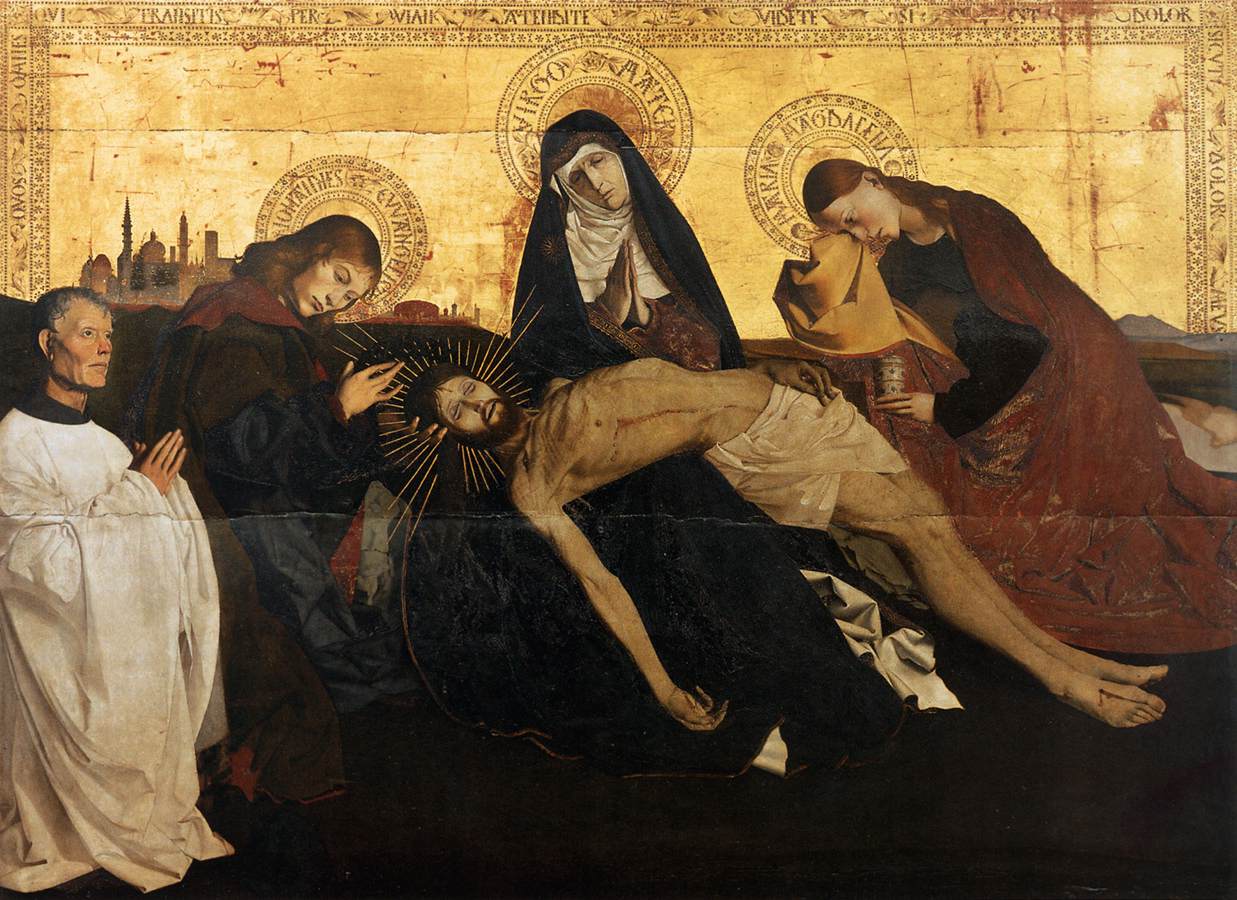
Pietà de Villeneuve-lès-Avignon
CHARONTON, Enguerrand · 1460 →
- MEDIUM
- Tempera on wood, 162 x 218 cm
- TYPE
- Religious
PALETTE
HOVER OR TAP A SWATCH FOR NAME, SHARE AND HEX. SAMPLED FROM THE IMAGE — INDICATIVE, NOT A PIGMENT ANALYSIS.
DEVELOPMENT BUILD — NOT FOR PUBLIC USE. CONTRIBUTE ON GITHUB.
03 — ARTWORK
CHARONTON, Enguerrand · 1460 →
PALETTE
HOVER OR TAP A SWATCH FOR NAME, SHARE AND HEX. SAMPLED FROM THE IMAGE — INDICATIVE, NOT A PIGMENT ANALYSIS.
COMMENTARY
UNDERLINED TERMS ARE DEFINED IN THE GLOSSARY.
PietàA depiction of the Virgin Mary with the crucified body of Jesus across her lap. Developing in Germany in the 14th century, the Pietà became a familiar part of Renaissance religious imagery. One of the best-known examples is Michelangelo's "Pietà" (1497-1500) in St. Peter's, Rome. de Villeneuve-lès-AvignonThe decision to move the Papacy here was made in August 1308 by Pope Clement V, who had been residing in France since 1305. The actual move was made in 1309. Six pontificates later, in 1377, the Papacy was brought back to Rome by Gregory XI. All the popes elected at Avignon were French, as were 113 of the 134 cardinals appointed during this time. Yet though the period has been called one of 'captivity' to France, the Avignonese residence was not one of uninterrupted truckling to French kings. The city was not on French territory: it belonged to the Angevin princes of Naples. 'Captivity', like Petrarch's 'unholy Babylon', which he likened to the harlot of the Apocalypse 'full of abominations and the filth of her fornication', was mainly a term of abuse directed at a Papacy that had acquired security enough to revive its legal and financial pretensions and to build lavishly and live well. Between 1100 and 1309 the popes had only spent 82 years in Rome. Avignon gave them a long breathing space to assemble the machinery and the values which characterized the Renaissance Papacy after its final resettlement in Rome. c. 1460 TemperaA method of painting in which the pigments are mixed with an emulsion of water and egg yolks or whole eggs (sometimes glue or milk). Tempera was widely used in Italian art in the 14th and 15th centuries, both for panel painting and fresco, then being replaced by oil paint. Tempera colors are bright and translucent, though because the paint dried very quickly there is little time to blend them, graduated tones being created by adding lighter or darker dots or lines of color to an area of dried paint. on wood, 162 x 218 cm Musée du Louvre, Paris
The figures, which might have been taken from GothicGothic, which may well have originated with Alberti as a derogatory term and which certainly corresponds to Vasari's 'maniera tedesca' ('German style'), is properly the descriptive term for an artistic style which achieved its first full flowering in the Ile de France and the surrounding areas in the period between c. 1200 and c. 1270, and which then spread throughout northern Europe. It is characterized by the hitherto unprecedented integration of the arts of sculpture, painting, stained glass and architecture which is epitomized in the great cathedrals of Chartres, Amiens, and Reims or in the Sainte Chapelle in Paris. In all the arts the predominantly planar forms of the Romanesque are replaced by an emphasis on line. There is a transcendental quality, whether in the soaring forms of the pointed arches or in the new stress on the humanity of Christ, which similarly distinguishes it from the preceding Romanesque style. In thinking of Nicola (d. c. 1284) or Giovanni Pisano (d. after 1314) there is same danger of forgetting what had happened in French sculpture half a century or more earlier, and likewise it is hard to remember that the spectacular achievements of early Renaissance art are a singularly localized eddy in the continuing stream of late gothic European art. By northern European standards few Italian works of art can be called gothic without qualification, and the story of 13th and 14th century Italian architecture is as much one of resistance to the new style as of its reception, whether directly from France or through German or central European intermediaries. In sculpture and in painting, the Italian reluctance to distort the human figure, conditioned by a never wholly submerged awareness of the omnipresent antique heritage, gives a special quality to the work of even those artists such as Giovanni Pisano or Simone Martini who most closely approached a pure gothic style. Nevertheless, the vitalizing role of Northern gothic art throughout the early Renaissance and the period leading up to it should never be underestimated. The artistic, like the cultural and commercial, interaction was continuous and much of the Italian achievement is incomprehensible if seen in isolation. It is not merely at the level of direct exchanges between one artist and another, or the influence of one building; painting, manuscript or piece of sculpture upon another, that the effects are to be felt. The streaming quality of line which is so characteristic of Brunelleschi's early Renaissance architecture surely reflects a sensitivity to the gothic contribution which is entirely independent of, and lies much deeper than, the superficial particularities of form. The counterflow of influence and inspiration from South to North must likewise not be underrated. In particular, the contribution of Italian painters from Duccio and Simone Martini onwards is central to the evolution of the so-called International Gothic style developing in Burgundy, Bohemia and north Italy in the late 14th and early 15th centuries. sculpture, are placed before a chased golden background. To the left of the middle distance is the view of a small town with spires, to the right austere mountains. The suffering figure of the Virgin dominates the painting. No longer young, her pallid face is immobile in its grief. Her blue mantleAn overcoat, worn open, popular during the second half of the 15th century and the 16th century and often lined with fur along the hem and around the collar. It reached to the knee or foot, depending on the social class of the wearer. covers her head, revealing a white veil, and spreads out in huge folds to her feet. In a strange pose, the back arched, the body rigid, Christ, a white cloth wrapped across his loins, appears to be floating on her lap. A young St John bends in loving tenderness above him, with the kneeling donora patron who commissioned a work of art for a church. Donors sometimes had their portraits included in the work they were donating as a sign of piety. beside St John. On the right the mourning, pitiful figure of St Mary Magdalen completes the diagonal line arching over the Virgin and St John to the donor. The yellow-lined red cloak of the Magdalen extends around her in a great curve. Her left hand holds the vase of ointment, with the right she presses the edge of her cloak to her eye.
Its concentrated emotion, dramatic force and religious content make this painting the supreme manifestation in mediaeval art of the tragedy of Christ, only softened by the tender expression on St John's face. The Virgin's sorrow is profound and austere, almost unbending; the Magdalen's is softer, more womanly. This masterpieceA term now loosely applied to the finest work by a particular artist or to any work of art of acknowledged greatness or of preeminence in its field. Originally it meant the piece of work by which a craftsman, having finished his training, gained the rank of'master' in his guild. has been claimed for many schools, including the Catalan and Portuguese, but it seems almost certain that the painter was the French Charonton. With this work the master enriched French and European painting with one of the finest representations of the Pietà in existence.
@online{wga-rac9065952b941c,
  author       = {Krén, Emil and Marx, Daniel},
  title        = {Pietà de Villeneuve-lès-Avignon by CHARONTON, Enguerrand},
  organization = {{Web Gallery of Art}},
  date         = {2026-09-13},
  url          = {https://beta.wga.hu/artists/charonton-enguerrand-r55a72944449365/piet-de-villeneuve-ls-avignon-rac9065952b941c},
  urldate      = {2026-09-13},
  langid       = {english}
}
ACCESSED 2026-09-13. REPLACE THE AUTHOR FIELD WITH THE COMMENTARY AUTHOR WHERE ONE IS NAMED.


