03 — ARTWORK
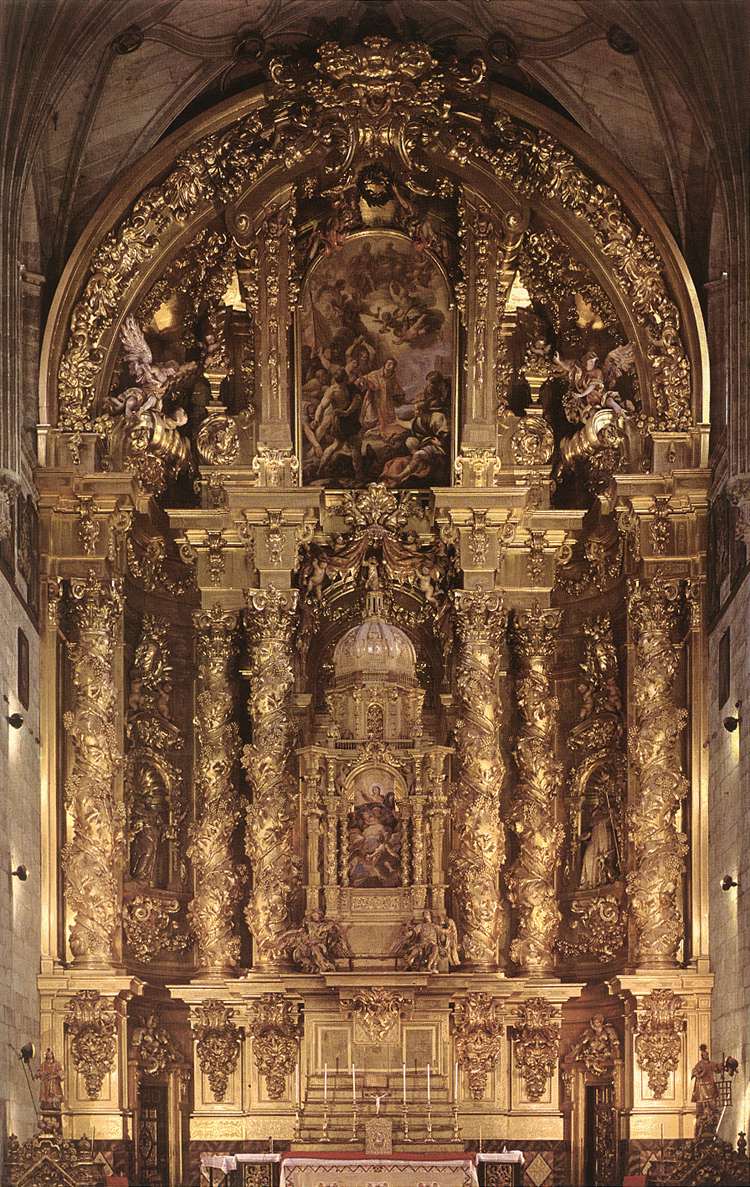
Main Altar
CHURRIGUERA, José Benito · 1700 →
- MEDIUM
- Wood, height about 30 m
- TYPE
- Religious
PALETTE
HOVER OR TAP A SWATCH FOR NAME, SHARE AND HEX. SAMPLED FROM THE IMAGE — INDICATIVE, NOT A PIGMENT ANALYSIS.
DEVELOPMENT BUILD — NOT FOR PUBLIC USE. CONTRIBUTE ON GITHUB.
03 — ARTWORK
CHURRIGUERA, José Benito · 1700 →
PALETTE
HOVER OR TAP A SWATCH FOR NAME, SHARE AND HEX. SAMPLED FROM THE IMAGE — INDICATIVE, NOT A PIGMENT ANALYSIS.
COMMENTARY
UNDERLINED TERMS ARE DEFINED IN THE GLOSSARY.
This grandiose altar, whose construction required more than four thousand pieces of wood, inaugurated BaroqueThe period in art history from about 1600 to about 1750. In this sense the term covers a wide range of styles and artists. In painting and sculpture there were three main forms of Baroque: (1) sumptuous display, a style associated with the Catholic Counter Reformation and the absolutist courts of Europe (Bernini, Rubens); (2) dramatic realism (Caravaggio); and (3) everyday realism, a development seen in particular in Holland (Rembrandt, Vermeer). In architecture, there was an emphasis on expressiveness and grandeur, achieved through scale, the dramatic use of light and shadow, and increasingly elaborate decoration. In a more limited sense the term Baroque often refers to the first of these categories. The development of the Baroque reflects the period's religious tensions (Catholic versus Protestant); a new and more expansive world view based on science and exploration; and the growth of absolutist monarchies. 18th-century architecture. It was designed in 1693 by José Benito Churriguera, who had won fame at Salamanca in 1689 with his design of a huge catafalque for the funeral ceremony of Dona Maria Luisa de Barbón, wife of Charles II. José belonged to a family of Salamanca architects who enriched their city with some very fine monuments. If we compare this altarpieceA picture or sculpture that stands on or is set up behind an altar. The term reredos is used for an ornamental screen or partition, not directly attached to the altar table but affixed to the wall behind it. A diptych is an altarpiece consisting of two panels, a triptych one of three panels, and a polyptych one of four or more panels. From the 14th to 16th century, the altarpiece was one of the most important commissions in European art; it was through the altarpiece that some of the most decisive developments in painting and sculpture came about. with that executed by Bernardo Simon de Piñeda in 1670-1673, for Santa Caridad in Seville, it is clear that the latter is still the work of a sculptor; the San Esteban altarpiece is the first example of 18th-century Baroque style 'entallador', which obtains its effects from the rhythm of the decorated surface, supported by a robust, monumental structure.
@online{wga-rc2ef0498fc007c,
  author       = {Krén, Emil and Marx, Daniel},
  title        = {Main Altar by CHURRIGUERA, José Benito},
  organization = {{Web Gallery of Art}},
  date         = {2026-09-13},
  url          = {https://beta.wga.hu/artists/churriguera-jos-benito-r310d0b80559ceb/main-altar-rc2ef0498fc007c},
  urldate      = {2026-09-13},
  langid       = {english}
}
ACCESSED 2026-09-13. REPLACE THE AUTHOR FIELD WITH THE COMMENTARY AUTHOR WHERE ONE IS NAMED.
The archive catalogues no further works by this artist.
TRY SAME COLLECTION →