03 — ARTWORK
Martyrdom Scenes
- MEDIUM
- Fresco
- TYPE
- Religious
PALETTE
HOVER OR TAP A SWATCH FOR NAME, SHARE AND HEX. SAMPLED FROM THE IMAGE — INDICATIVE, NOT A PIGMENT ANALYSIS.
DEVELOPMENT BUILD — NOT FOR PUBLIC USE. CONTRIBUTE ON GITHUB.
03 — ARTWORK
PALETTE
HOVER OR TAP A SWATCH FOR NAME, SHARE AND HEX. SAMPLED FROM THE IMAGE — INDICATIVE, NOT A PIGMENT ANALYSIS.
COMMENTARY
UNDERLINED TERMS ARE DEFINED IN THE GLOSSARY.
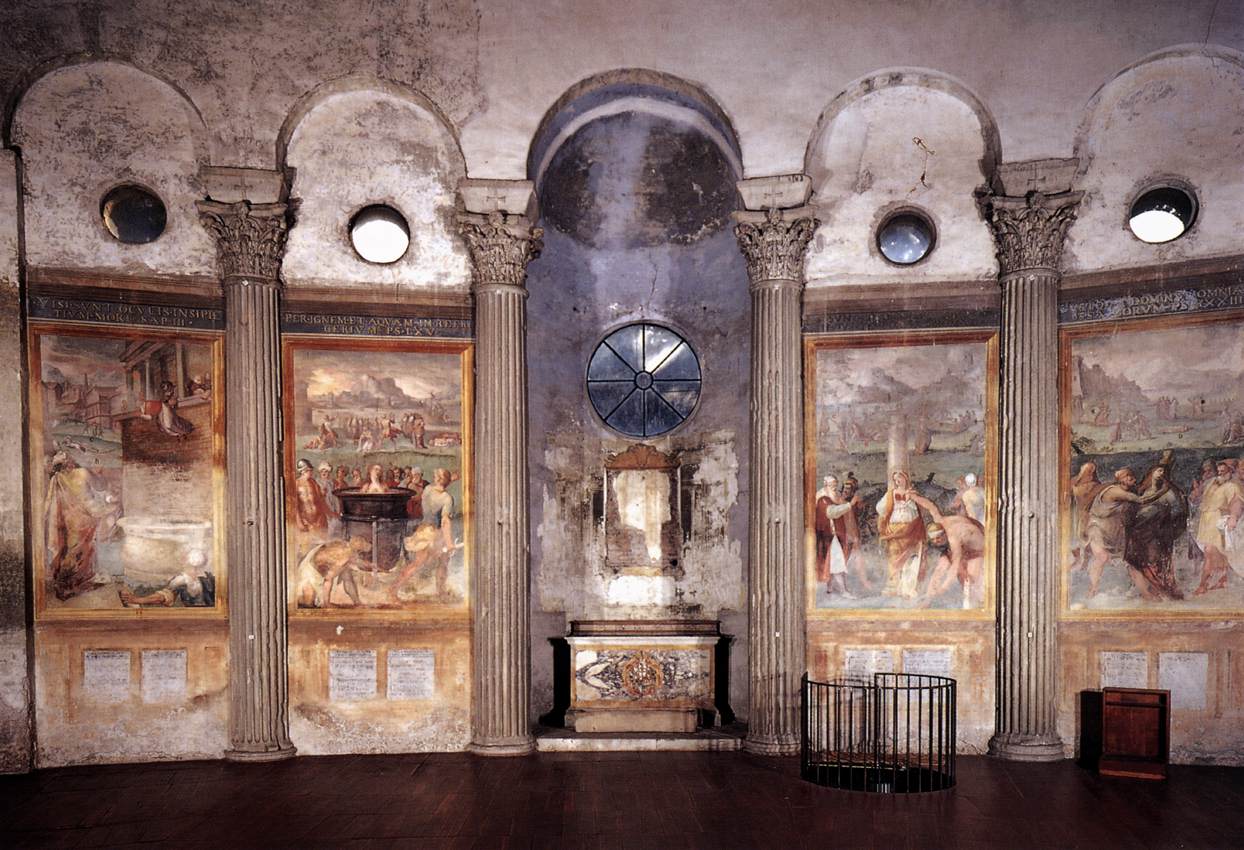
The centrally planned sixth-century church of San Stefano Rotondo was restored under Gregory XIII, partly in accordance with his papal bull of 1580 uniting the colleges for German and Hungarian JesuitsThe Society of Jesus, a Roman Catholic teaching order founded by St. Ignatius Loyola in 1534. The express purpose of the Jesuits was to fight heresy within the Church (they played a leading role in the Counter Reformation), and to spread the faith through missionary work in the many parts of the world recently discovered by Western explorers and colonists. at the site. Around the periphery of the interior of the church, Niccolò Circignani, who had worked for the pope at the Vatican Palace, led a team of artists that painted a frescoWall painting technique in which pigments are applied to wet (fresh) plaster (intonaco). The pigments bind with the drying plaster to form a very durable image. Only a small area can be painted in a day, and these areas, drying to a slightly different tint, can in time be seen. Small amounts of retouching and detail work could be carried out on the dry plaster, a technique known as a secco fresco. cycle of thirty-one scenes of explicitly graphic martyrdoms. Beginning with Christ's CrucifixionAn important method of capital punishment, particularly among the Persians, Seleucids, Jews, Carthaginians, and Romans from about the 6th century BC to the 4th century AD. Constantine the Great, the first Christian emperor, abolished it in the Roman Empire in AD 337, out of veneration for Jesus Christ, the most famous victim of crucifixion. There were various methods of performing the execution. Usually, the condemned man, after being whipped, or "scourged," dragged the crossbeam of his cross to the place of punishment, where the upright shaft was already fixed in the ground. Stripped of his clothing either then or earlier at his scourging, he was bound fast with outstretched arms to the crossbeam or nailed firmly to it through the wrists. The crossbeam was then raised high against the upright shaft and made fast to it about 9 to 12 feet (approximately 3 metres) from the ground. Next, the feet were tightly bound or nailed to the upright shaft. A ledge inserted about halfway up the upright shaft gave some support to the body; evidence for a similar ledge for the feet is rare and late. Over the criminal's head was placed a notice stating his name and his crime. Death, apparently caused by exhaustion or by heart failure, could be hastened by shattering the legs (crurifragium) with an iron club, so that shock and asphyxiation soon ended his life., it continues through the execution of the Apostles and early Christian saints - appropriate subjects for the Early Christian martyrial structure. The cycle derives from a book commissioned by Ignatius of Loyola to instruct the faithful and to provide a focus for meditation on the Gospel stories through both notes and images. The frescoes are notable for their blatant didacticism, uniting words to images. Each martyrdomthe sufferings, torture and death inflicted on a person on account of his faith or convictions. carries a hortatory biblical inscription across the top and each has double caption below - one text in Latin, another translating Latin into Italian - which identifies the figures in the painting.
The series of frescoes were <a onclick="return OpenOther('/html/c/cavalier/ecclesia.html')" href="/html/c/cavalier/ecclesia.html">engraved by Giovanni Battista de' Cavalieri</a> and published in a book by Bartolomeo Grassi in 1585 in Rome. At the beginning of the 17th century, the book was reworked in a laterally reversed format by Jan van Haelbeck and published in Paris by <a onclick="return OpenOther('/bio/l/leclerc/biograph.html')" href="/bio/l/leclerc/biograph.html">Jean Leclerc.</a>
@online{wga-r06ead84824f891,
  author       = {Krén, Emil and Marx, Daniel},
  title        = {Martyrdom Scenes by CIRCIGNANI, Niccolò},
  organization = {{Web Gallery of Art}},
  date         = {2026-09-09},
  url          = {https://beta.wga.hu/artists/circignani-niccol-rfa0bf4bef53e5b/martyrdom-scenes-r06ead84824f891},
  urldate      = {2026-09-09},
  langid       = {english}
}
ACCESSED 2026-09-09. REPLACE THE AUTHOR FIELD WITH THE COMMENTARY AUTHOR WHERE ONE IS NAMED.
The archive catalogues no further works by this artist.
TRY SAME COLLECTION →