03 — ARTWORK
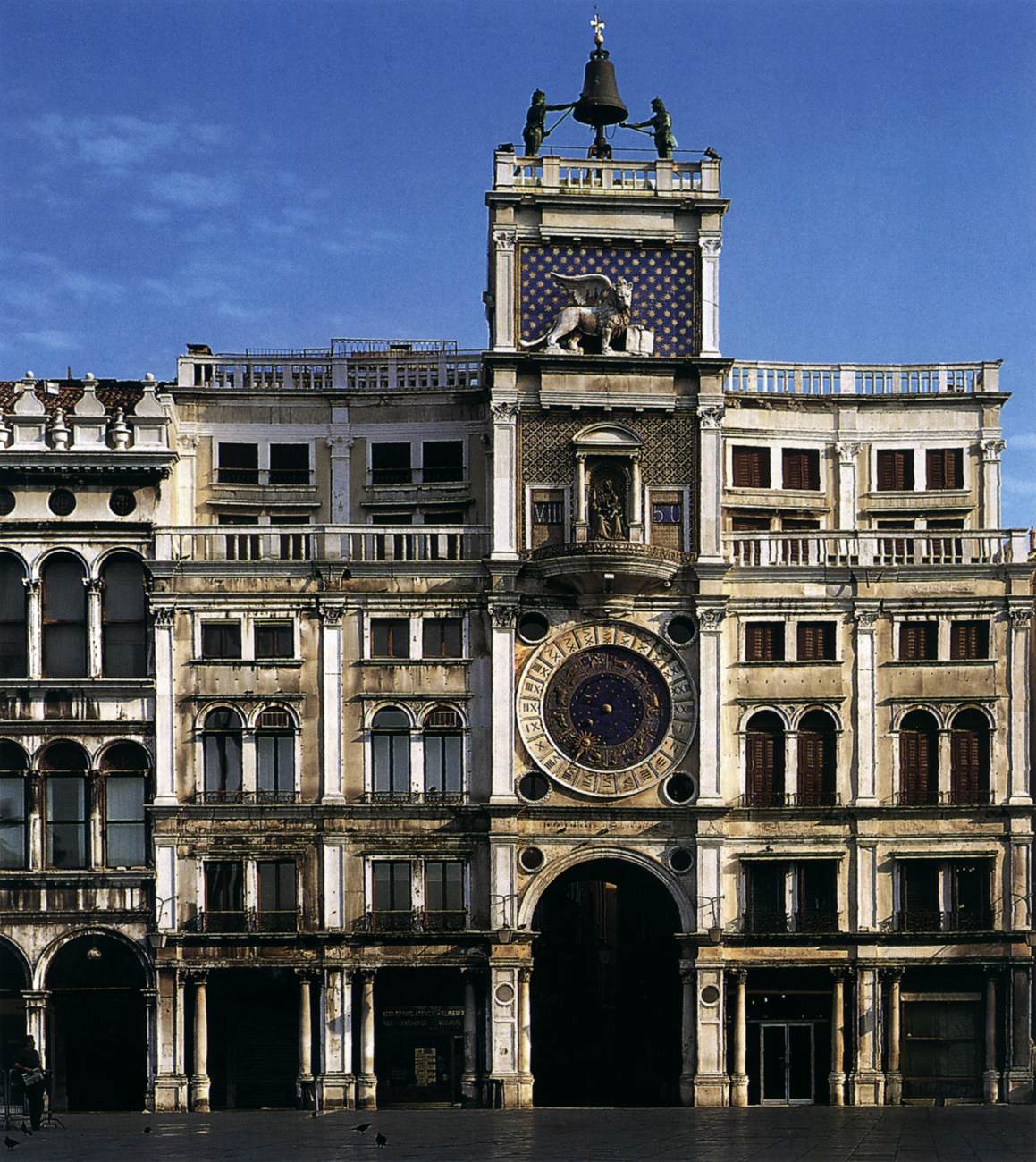
Torre dell'Orologio
- MEDIUM
- Photo
- TYPE
- Other
PALETTE
HOVER OR TAP A SWATCH FOR NAME, SHARE AND HEX. SAMPLED FROM THE IMAGE — INDICATIVE, NOT A PIGMENT ANALYSIS.
DEVELOPMENT BUILD — NOT FOR PUBLIC USE. CONTRIBUTE ON GITHUB.
03 — ARTWORK
PALETTE
HOVER OR TAP A SWATCH FOR NAME, SHARE AND HEX. SAMPLED FROM THE IMAGE — INDICATIVE, NOT A PIGMENT ANALYSIS.
COMMENTARY
UNDERLINED TERMS ARE DEFINED IN THE GLOSSARY.
At the close of the fifteenth century Codussi was busy on an important public commission, the Torre dell'Orologio (clock tower), which stands at the entrance to a long commercial street that leads off from San Marco and twists its way down to the merchant area of Rialto. Rather than build a simple bell tower, Codussi opted to use the idea of a triumphal archIn the architecture of ancient Rome, a large and usually free-standing ceremonial archway built to celebrate a military victory. Often decorated with architectural features and relief sculptures, they usually consisted of a large archway flanked by two smaller ones. The triumphal archway was revived during the Renaissance, though usually as a feature of a building rather than as an independent structure. In Renaissance painting they appear as allusion to classical antiquity.: this one would have a single supporting archThe pointed arch is widely regarded as the main identifiable feature of Gothic architecture (distinct from the round arch of the Romanesque period). The three most common Gothic arches are the Equilateral, Lancet and Tudor. topped by a square panelTerm in painting for a support of wood, metal, or other rigid substance, as distinct from canvas. Until the adoption of canvas in the 15th century nearly all the movable paintings of Europe were executed on wood, and even up to the beginning of the 17th century it is probable that as much painting was done on the one support as on the other. Painters who worked on a small scale often used copper panels (Elsheimer is a leading example), and in the colonial art of South America copper and tin and even lead and zinc were used. On a larger scale, slate has occasionally been used as a support, notably by Rubens for his altarpiece for Sta Maria in Vallicella (the Chiesa Nuova) in Rome; the picture he originally painted was said to reflect the light unpleasantly and slate was used for the replacement to produce a more matt finish. For wood panels the Italian masters of the Renaissance preferred white poplar, while oak was the most common wood used in northern Europe. Many other types were used, however; analysis of the contents of art galleries has yielded a long list, including beech, cedar, chestnut, fir, larch, linden, mahogany, olive, and walnut. In the 20th century cedar, teak, and dark walnut are favourites, and modern painters have also used plywood, fibre-board, and other synthetic materials as supports. containing a clock face and a moving dial with the signs of the zodiac. The two upper orders are smaller in size but still on square bases. The first of these contains an aediculaA shrine or niche framed by two columns, piers, or pilasters carrying an entablature and pediment (triangular or segmental). with the Virgin, the other the lion of St Mark with Doge Barbarigo (destroyed). The attic is crowned by a balustradeA rail supported by a row of small posts or open-work panels. which supports two bronzeAn alloy of copper (usually about 90 per cent) and tin, often also containing small amounts of other metals such as lead or zinc. Since antiquity it has been the metal most commonly used in cast sculpture because of its strength, durability, and the fact that it is easily workable - both hot and cold - by a variety of processes. It is easier to cast than copper because it has a lower melting-point, and its great tensile strength makes possible the protrusion of unsupported parts - an advantage over marble sculpture. The colour of bronze is affected by the proportion of tin or other metals present, varying from silverish to a rich, coppery red, and its surface beauty can be enhanced when it acquires a patina. Moors who ring the hours. This was the earliest, basic structure of the Torre dell'Orologio.
The tower was, however, immediately enlarged in 1499 by the addition of two side wings, giving a total of four symmetrical spans. This modification helped to accentuate the aims set for the tower in terms of perspectiveThe method of representing three-dimensional objects on a flat surface. Perspective gives a picture a sense of depth. The most important form of perspective in the Renaissance was linear perspective (first formulated by the architect Brunelleschi in the early 15th century), in which the real or suggested lines of objects converge on a vanishing point on the horizon, often in the middle of the composition (centralized perspective). The first artist to make a systematic use of linear perspective was Masaccio, and its principles were set out by the architect Alberti in a book published in 1436. The use of linear perspective had a profound effect on the development of Western art and remained unchallenged until the 20th century. and stage setting; it acts as a landmark both in the Piazza itself and for the visual line leading from the Molo (pierOne of the massive supports on which an arch or upper part of a church stands. A pier is generally larger than a column, but may consist of a cluster of columns.) to the start of the Mercerie, the busiest street in Venice, giving the impression of a truly theatrical backdrop.
@online{wga-r73368061820b59,
  author       = {Krén, Emil and Marx, Daniel},
  title        = {Torre dell'Orologio by CODUSSI, Mauro},
  organization = {{Web Gallery of Art}},
  date         = {2026-09-09},
  url          = {https://beta.wga.hu/artists/codussi-mauro-r44b41b61108838/torre-dellorologio-r73368061820b59},
  urldate      = {2026-09-09},
  langid       = {english}
}
ACCESSED 2026-09-09. REPLACE THE AUTHOR FIELD WITH THE COMMENTARY AUTHOR WHERE ONE IS NAMED.


