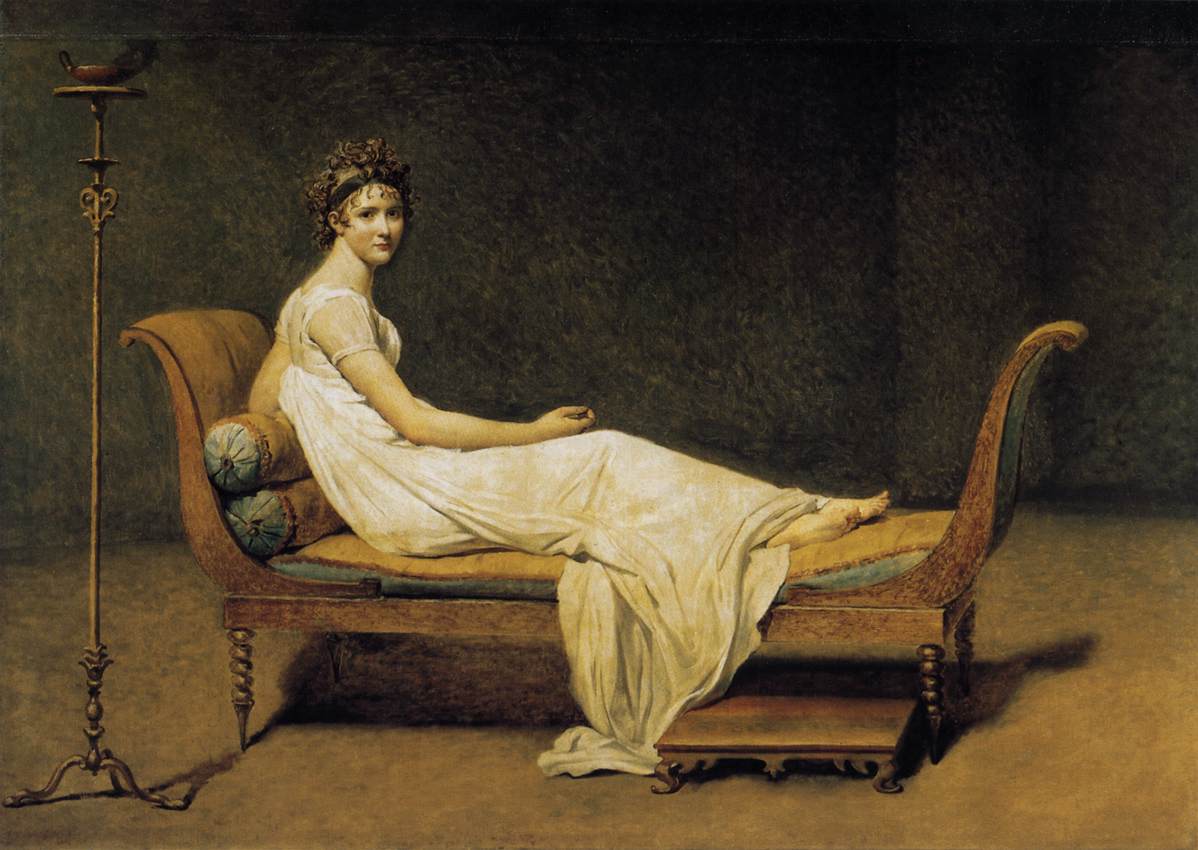
03 — ARTWORK
Madame Récamier
- MEDIUM
- Oil on canvas, 173 x 244 cm
- TYPE
- Portrait
PALETTE
HOVER OR TAP A SWATCH FOR NAME, SHARE AND HEX. SAMPLED FROM THE IMAGE — INDICATIVE, NOT A PIGMENT ANALYSIS.
DEVELOPMENT BUILD — NOT FOR PUBLIC USE. CONTRIBUTE ON GITHUB.
03 — ARTWORK
PALETTE
HOVER OR TAP A SWATCH FOR NAME, SHARE AND HEX. SAMPLED FROM THE IMAGE — INDICATIVE, NOT A PIGMENT ANALYSIS.
COMMENTARY
UNDERLINED TERMS ARE DEFINED IN THE GLOSSARY.
This is a case where a comparison will give a good idea of how differently the same subject was handled by Jacques-Louis David and one of his numerous pupils. David started the portraitThe Roman portrait bust survived in the form of life-sized reliquaries of saints, but it was in 15th century Florence that the individual features and character of a contemporary sitter were accurately recorded by sculptors such as Donatello, Desiderio da Settignano, Mino da Fiesole and the Rossellino. A similar degree of realism occurs in 15th century tomb sculpture. The equestrian portrait, based on antique statues such as the Marcus Aurelius monument (Rome, Campidoglio), was revived in the 14th century. Two examples in fresco are Simone Martini's Guidoriccio (c. 1328; Siena, Palazzo Pubblico) and the posthumous portrait of Sir John Hawkwood (1436; Florence, Cathedral) by Uccello, which gives the illusion of a 3-dimensional statue seen from below. The Venetian Republic ordered imposing monuments from Donatello (1447; Gattarnelata, Padua) and Verrocchio (14799; Colleoni, Venice), whilst other statesmen ordered their own images to be erected in public places, directly relating themselves to the military heroes of ancient Rome. Another form of political portraiture derived from antiquity was the commemorative portrait medal designed by artists such as Pisanello. The carved or painted profile portrait became popular in the 1450s. The realism of the clear, flattened image, painted under the influence of Flemish examples by the Pollaiuolo brothers, Piero della Francesca and Botticelli, was superseded by the three-quarter and frontal portrait, psychologically more complex, such as Leonardo's enigmatic Mona Lisa (Paris, Louvre) with her momentary smile or Andrea del Sarto's arresting Portrait of a Man (London, National Gallery). The 16th century portrait became generalized, Lotto's Andrea Odoni (1527; Royal Collection) being an idealized concept of a collector rather than an individual. Group portraits, decorating whole rooms, include the narrative scenes of the Gonzaga court painted by Mantegna (completed 1474; Mantua, Palazzo Ducale) and the elaborate schemes commissioned by the Farnese family in Rome from Vasari (1546; Palazzo della Cancelleria) and Salviati (after 1553; Palazzo Farnese). Portraits were also incorporated into religious narratives, as in Ghirlandaio's fresco cycle painted for Giovanni Tornabuoni in S. Maria Novella, Florence (1486-90). of Madame Récamier in 1800 which was never finished. (However, incidentally, this portrait helped a contemporary item of furniture to become known under her name.) When the master learned that the lady had also commissioned his pupil Gérard to paint her, he is said to have refused any further service.
In David's portrait, noble simplicity, expressed by the simple dress and the Spartan decoration, is also eloquent in the open face. This might well appear more to the modern viewer than Gérard's version, which was judged to be more representative and flattering at the time. And comparisons with portraits of Madame Récamier by other artists suggest that Gérard had achieved a better likeness than David. The Spartan severity of David's composition, the Neoclassical sparseness of the arrangement, the cool handling of the room, the distanced pose, with the lady turning her shoulder to the viewer, were all elements with which NeoclassicismA style in European art and architecture from the mid 18th century until the end of the 19th century. Based as it was on the use of ancient Greek and Roman models and motifs, its development was greatly influenced by the excavations at Pompeii and Herculaneum, and by the theories of the German art historian Johann Joachim Winckelmann (1717-1768). Intellectually and politically it was closely linked to the Enlightenment's rejection of the aristocratic frivolity of Rococo, the style of the Ancien Régime. Among Neoclassicism's leading figures were the French painter Jacques-Louis David (1744-1825), the German painter Anton Raffael Mengs (1728-1729), and the Italian sculptor Antonio Canova (1757-1822). had operated for long enough.
Gérard, by contrast, sets the lady in a noble park loggiaA gallery or room open on one or more sides, its roof supported by columns. Loggias in Italian Renaissance buildings were generally on the upper levels. Renaissance loggias were also separate structure, often standing in markets and town squares, that could be used for public ceremonies., where she seems to be inviting to conversation. Her low-cut bodice is seductive, the red curtain flatters the subject and gives the flesh a rosy tint. Where David gave the beautiful woman a rather severe touch around the mouth, Gérard embellishes her features with the hint of a gentle smile, making her look younger. By contrast, David's portrait in the antiquethe classical age of Greece and Rome began with the Greek migrations of the 2nd millennium BC, and ended in the West in 476 AD with the deposition of the Roman emperor Romulus Augustulus (c. 475 AD); in the East it ended in 529 AD when the Platonic Academy was closed by Justinian (482 - 565 AD). manner looks rather forced. Perhaps these were the reasons why his painting was never finished. Madame Récamier gave Gérard's portrait of her to her admirer Prince Augustus of Prussia, a nephew of Frederick II, who had met the French beauty at the salonIn the French language of the 18th and 19th centuries it designated an actual exhibition space, as well as the academic art exhibitions staged in the Salon d'Apollon of the Louvre since 1667. From 1737, the exhibitions took place biennially and, after the French Revolution, annually in the Salon Carré of the Louvre in Paris. Towards the end of the 19th century the official Salon jury was dissolved in order to make way for a committee of state-approved artists, i.e. former Salon members, who created the highly influential Société des Artistes Français. of Madame de Staël. For state reasons a marriage was impossible, but in the painting Madame Récamier was ever present in the palace which Schinkel furnished for the Prince in 1817.
@online{wga-r8f8339377f3372,
  author       = {Krén, Emil and Marx, Daniel},
  title        = {Madame Récamier by DAVID, Jacques-Louis},
  organization = {{Web Gallery of Art}},
  date         = {2026-09-09},
  url          = {https://beta.wga.hu/artists/david-jacques-louis-rbd07aa6641b868/madame-rcamier-r8f8339377f3372},
  urldate      = {2026-09-09},
  langid       = {english}
}
ACCESSED 2026-09-09. REPLACE THE AUTHOR FIELD WITH THE COMMENTARY AUTHOR WHERE ONE IS NAMED.


