03 — ARTWORK
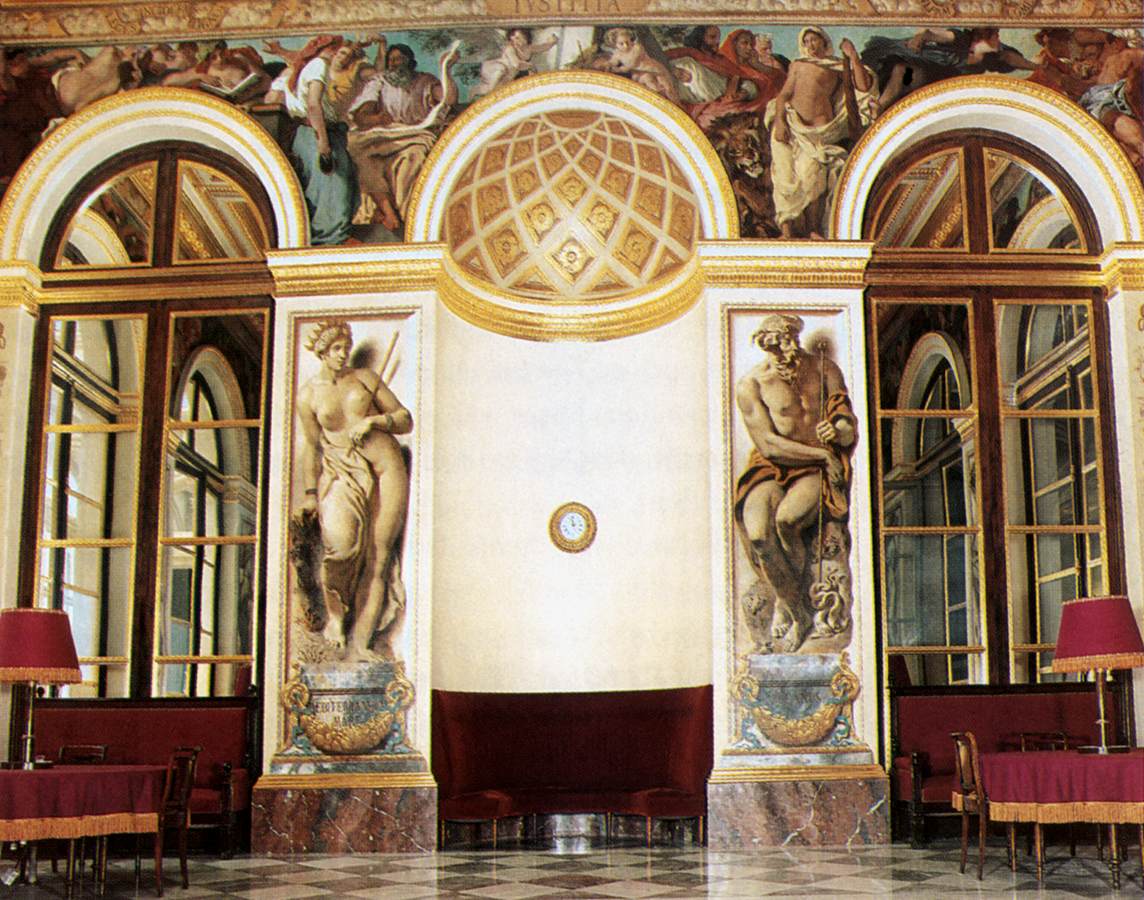
Decoration of the west wall
- MEDIUM
- Oil and virgin wax on plaster
- TYPE
- Mythological
PALETTE
HOVER OR TAP A SWATCH FOR NAME, SHARE AND HEX. SAMPLED FROM THE IMAGE — INDICATIVE, NOT A PIGMENT ANALYSIS.
DEVELOPMENT BUILD — NOT FOR PUBLIC USE. CONTRIBUTE ON GITHUB.
03 — ARTWORK
PALETTE
HOVER OR TAP A SWATCH FOR NAME, SHARE AND HEX. SAMPLED FROM THE IMAGE — INDICATIVE, NOT A PIGMENT ANALYSIS.
COMMENTARY
UNDERLINED TERMS ARE DEFINED IN THE GLOSSARY.
The picture shows the Justice (260 x 1100 cm), the Mediterranean (300 x 118 cm) and the Ocean (300 x 118 cm).
By a decree dated 31 August, 1833, Delacroix was commissioned to undertake his first state decoration, that of the SalonIn the French language of the 18th and 19th centuries it designated an actual exhibition space, as well as the academic art exhibitions staged in the Salon d'Apollon of the Louvre since 1667. From 1737, the exhibitions took place biennially and, after the French Revolution, annually in the Salon Carré of the Louvre in Paris. Towards the end of the 19th century the official Salon jury was dissolved in order to make way for a committee of state-approved artists, i.e. former Salon members, who created the highly influential Société des Artistes Français. du Roi or Throne Room of the Palais Bourbon. This was the first of a succession of major commissions, on which Delacroix continued to lavish his talents until illness intervened. Between 1833 and 1854, Delacroix's monumental compositions spread across the Salon du Roi, the Library of the Palais du Luxembourg, the Galerie d'Apollon in the Louvre and the Salon de la Paix in the Hotel de Ville.
This was a different matter from even the largest easelStand on which a painting is supported while the artist works on it. The oldest representation of an easel is on an Egyptian relief of the Old Kingdom (c. 2600-2150 BC). Renaissance illustrations of the artist at work show all kinds of contrivances, the commonest being the three-legged easel with pegs, such as we still use today. Light folding easels were not made until the 18th and 19th centuries, when painters took to working out of doors. The studio easel, a 19th-century invention, is a heavy piece of furniture, which runs on castors or wheels, and served to impress the c1ients of portrait painters. Oil painters need an easel which will support the canvas almost vertically or tip it slightly forward to prevent reflection from the wet paint, whereas the watercolourist must be able to lay his paper nearly flat so that the wet paint will not run down. The term 'easel-painting' is applied to any picture small enough to have been painted on a standard easel. paintings. Delacroix had now to exercise his imagination on huge surfaces of very various shape: domes, ceilings, semidomes, friezes, pilasters, and cofferingAn ornamental system of deep panels recessed into a vault, arch or ceiling. Coffered ceilings, occasionally made of wood, were frequently used in Renaissance palaces.. The essence of decorative painting is unity with the architectural framework that it invests. It was this aspect of the commissions that offered Delacroix the greatest opportunity for experiment and enabled him to give of his best.
Like Michelangelo when he began the decoration of the Sistine Chapela small separate place for worship, either part of a large church or a separate building., Delacroix knew nothing about the technique of frescoWall painting technique in which pigments are applied to wet (fresh) plaster (intonaco). The pigments bind with the drying plaster to form a very durable image. Only a small area can be painted in a day, and these areas, drying to a slightly different tint, can in time be seen. Small amounts of retouching and detail work could be carried out on the dry plaster, a technique known as a secco fresco.. So before executing the first commission, Delacroix spent several weeks with his family in the abbaye de Valmont, in Normandy, experimenting with fresco. These experiments enabled him to invent his own technique. Aware of the limitations of distemperA technique of painting in which pigments are diluted with water and bound with a glue. It was usually used for painting wall decorations and frescoes, though a few artists, notably Andrea Mantegna (1430/31-1506), also used it on canvas., and noting that fresco did not easily adapt to the climate, he decided to paint the walls of the Salon du Roi with oil, to which he added a little colourless wax or encaustic. This allowed him to imitate the mat surface of fresco and protect the colours from the effects of damp; it also made it possible to retouch his work, which the use of distemper would have ruled out. This was the technique that he used for all subsequent decorations.
Throughout 1837, Delacroix worked alone on the Salon du Roi, accepting assistance only for certain ornaments, and in 1838, the public could finally admire the finished work. It comprised four large sections of a coffered ceiling each decorated with a large allegorical figure in classicalRelating to the culture of ancient Greece and Rome (classical Antiquity). The classical world played a profoundly important role in the Renaissance, with Italian scholars, writers, and artists seeing their own period as the rebirth (the "renaissance") of classical values after the Middle Ages. The classical world was considered the golden age for the arts, literature, philosophy, and politics. Concepts of the classical, however, changed greatly from one period to the next. Roman literature provided the starting point in the 14th century, scholars patiently finding, editing and translating a wide range of texts. In the 15th century Greek literature, philosophy and art - together with the close study of the remains of Roman buildings and sculptures-expanded the concept of the classical and ensured it remained a vital source of ideas and inspiration. dress: Justice, Agriculture, Industry and War. In addition, there were four little coffers representing Putti bearing emblems. On the pilasters, he personified the rivers of France and the seas or oceans that they flow into, such as The Garonne and The Mediterranean. A friezea horizontal band of architectural decoration; in a classical entablature, the horizontal member band between the architrave and the cornice. running round the upper wall above the windows and doors echoes these themes, contrasting the evils of war with the virtues of justice, industry and agriculture.
@online{wga-rdbe223a35a1ac0,
  author       = {Krén, Emil and Marx, Daniel},
  title        = {Decoration of the west wall by DELACROIX, Eugène},
  organization = {{Web Gallery of Art}},
  date         = {2026-09-09},
  url          = {https://beta.wga.hu/artists/delacroix-eugne-r44dd9951dc0def/decoration-of-the-west-wall-rdbe223a35a1ac0},
  urldate      = {2026-09-09},
  langid       = {english}
}
ACCESSED 2026-09-09. REPLACE THE AUTHOR FIELD WITH THE COMMENTARY AUTHOR WHERE ONE IS NAMED.


