03 — ARTWORK
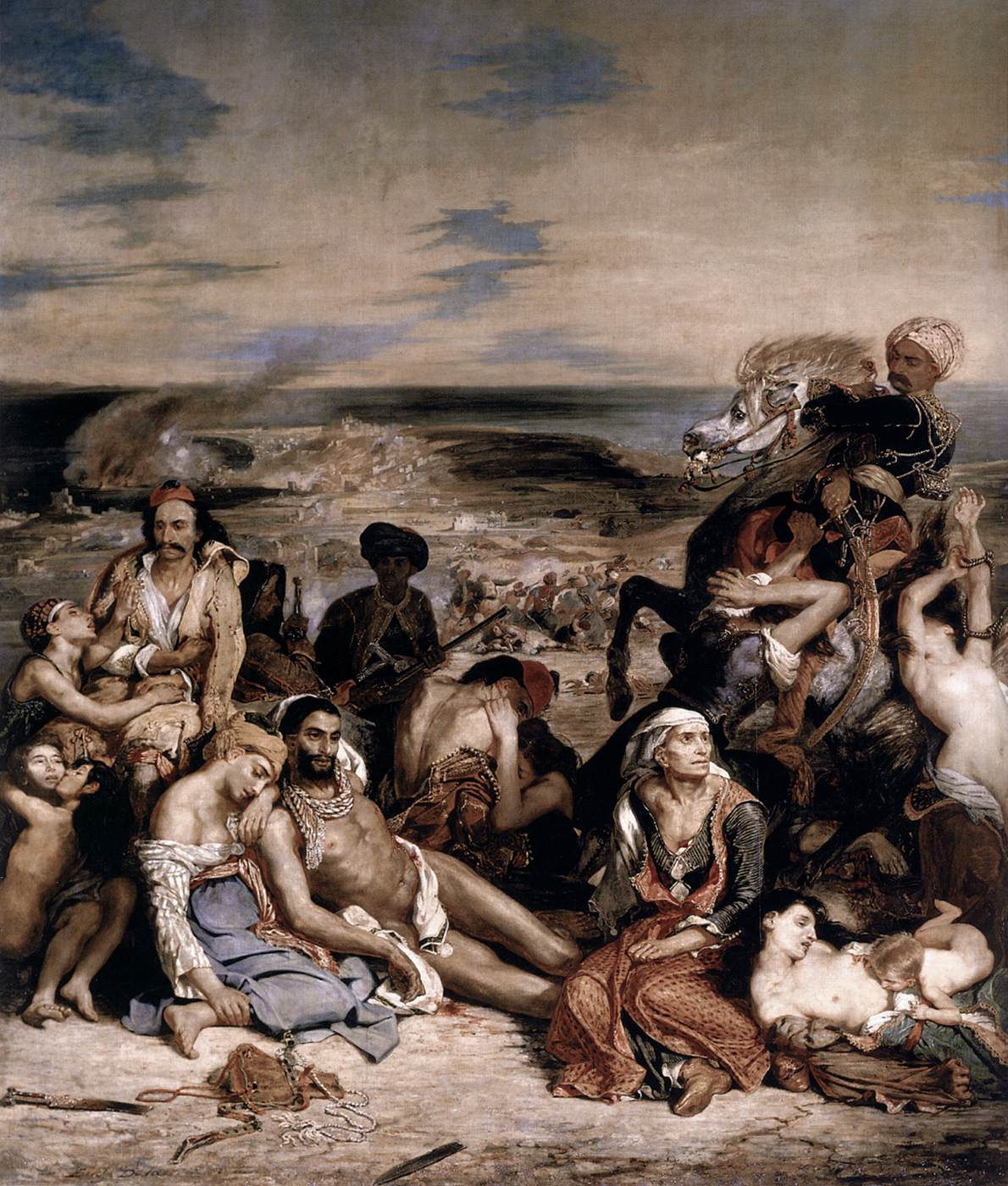
The Massacre at Chios
- MEDIUM
- Oil on canvas, 419 x 354 cm
- TYPE
- Historical
PALETTE
HOVER OR TAP A SWATCH FOR NAME, SHARE AND HEX. SAMPLED FROM THE IMAGE — INDICATIVE, NOT A PIGMENT ANALYSIS.
DEVELOPMENT BUILD — NOT FOR PUBLIC USE. CONTRIBUTE ON GITHUB.
03 — ARTWORK
PALETTE
HOVER OR TAP A SWATCH FOR NAME, SHARE AND HEX. SAMPLED FROM THE IMAGE — INDICATIVE, NOT A PIGMENT ANALYSIS.
COMMENTARY
UNDERLINED TERMS ARE DEFINED IN THE GLOSSARY.
A spectacular illustration of the enthusiasm aroused amongst the romantic youth by the revolt of the Greeks against the Turks, the Massacre at Chios was directly inspired by the savage Turkish repression of the population of the island of Chios in April 1822. The critics at the SalonIn the French language of the 18th and 19th centuries it designated an actual exhibition space, as well as the academic art exhibitions staged in the Salon d'Apollon of the Louvre since 1667. From 1737, the exhibitions took place biennially and, after the French Revolution, annually in the Salon Carré of the Louvre in Paris. Towards the end of the 19th century the official Salon jury was dissolved in order to make way for a committee of state-approved artists, i.e. former Salon members, who created the highly influential Société des Artistes Français. of 1824 received this fine painting very unfavourably. Delacroix had been inspired by Constable's Hay-Wain, which was exhibited at the same Salon, reworking the landscape background with a vibrant touch.
Horrified by the massacres perpetrated in Greece by the SublimeTerm that came into general use in the 18th century to denote a new aesthetic concept that was held to be distinct from the beautiful and the Picturesque and was associated with ideas of awe and vastness. The outstanding work on the concept of the Sublime in English was Edmund Burke's A Philosophical Enquiry into the Origin of our Ideas of the Sublime and Beautiful (1757). This book was one of the first to realize (in contrast with the emphasis on clarity and precision during the Age of Enlightenment) the power of suggestiveness to stimulate imagination. The cult of the Sublime had varied expressions in the visual arts, notably the taste for the 'savage' landscapes of Salvator Rosa and the popularity among painters of subjects from Homer, John Milton, and Ossian (the legendary Gaelic warrior and bard, whose verses - actually fabrications - were published in the 1760s to great acclaim). The vogue for the Sublime, with that for the Picturesque, helped shape the attitudes that led to Romanticism. Porte, Delacroix denounced this crime against humanity - this genocide. His denunciation took immediate form in The Massacre of Chios; his gesture parallels that of his fervent admirer, Picasso, in his representation of the massacre at Guernica. Delacroix depicted a landscape racked with fire, stretching desolately behind a group of prisoners awaiting execution. The Massacre is all but a manifesto in its liberated expression of light and atmosphere through colour; after it, 19th century painting could never be the same again.
@online{wga-rf619b3eb2b8bf3,
  author       = {Krén, Emil and Marx, Daniel},
  title        = {The Massacre at Chios by DELACROIX, Eugène},
  organization = {{Web Gallery of Art}},
  date         = {2026-09-13},
  url          = {https://beta.wga.hu/artists/delacroix-eugne-r44dd9951dc0def/the-massacre-at-chios-rf619b3eb2b8bf3},
  urldate      = {2026-09-13},
  langid       = {english}
}
ACCESSED 2026-09-13. REPLACE THE AUTHOR FIELD WITH THE COMMENTARY AUTHOR WHERE ONE IS NAMED.


