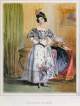
French painter and lithographer. In 1822, he began exhibiting at the Paris SalonGLOSSARYIn the French language of the 18th and 19th centuries it designated an actual exhibition space, as well as the academic art exhibitions staged in the Salon d'Apollon of the Louvre since 1667. From 1737, the exhibitions took place biennially and, after the French Revolution, annually in the Salon Carré of the Louvre in Paris. Towards the end of the 19th century the official Salon jury was dissolved in order to make way for a committee of state-approved artists, i.e. former Salon members, who created the highly influential Société des Artistes Français.. At some point, he opened an art school together with his brother Eugène, who was also a painter. By 1830 Devéria had become a successful illustrator and had published a many lithographs in form of notebooks and albums (e.g. his illustrations to Goethe's Faust, 1828) and romantic novels. He also produced many engravings of libertine contents.
Devéria was also known for doing portraits of artists and writers, whom he entertained in his Paris studio on Rue de l'Ouest. The list of his sitters includes Alexandre Dumas, père, Prosper Mérimée, Sir Walter Scott, David, Alfred de Musset, Sainte-Beuve, Honoré de Balzac, Géricault, Victor Hugo, Marie Dorval, Alphonse de Lamartine, Alfred de Vigny and Franz Liszt. His paintings were mainly done using watercolours.
In 1849 he was appointed director of the Bibliothèque Nationale's department of engravings. Achille taught drawing and lithographyGLOSSARYThe oldest planographic printing method, invented by Aloys Senefelder in Munich between 1790 and 1798 and later modified numerous times. In this method the drawing is applied to limestone with lithographic ink or chalk. The acid applied afterwards to the plate causes the printing ink to adhere only to the drawing and only the drawing is transferred to the paper in the subsequent printing process. to his son, Théodule Devéria, and father and son collaborated on a family portraitGLOSSARYThe Roman portrait bust survived in the form of life-sized reliquaries of saints, but it was in 15th century Florence that the individual features and character of a contemporary sitter were accurately recorded by sculptors such as Donatello, Desiderio da Settignano, Mino da Fiesole and the Rossellino. A similar degree of realism occurs in 15th century tomb sculpture. The equestrian portrait, based on antique statues such as the Marcus Aurelius monument (Rome, Campidoglio), was revived in the 14th century. Two examples in fresco are Simone Martini's Guidoriccio (c. 1328; Siena, Palazzo Pubblico) and the posthumous portrait of Sir John Hawkwood (1436; Florence, Cathedral) by Uccello, which gives the illusion of a 3-dimensional statue seen from below. The Venetian Republic ordered imposing monuments from Donatello (1447; Gattarnelata, Padua) and Verrocchio (14799; Colleoni, Venice), whilst other statesmen ordered their own images to be erected in public places, directly relating themselves to the military heroes of ancient Rome. Another form of political portraiture derived from antiquity was the commemorative portrait medal designed by artists such as Pisanello. The carved or painted profile portrait became popular in the 1450s. The realism of the clear, flattened image, painted under the influence of Flemish examples by the Pollaiuolo brothers, Piero della Francesca and Botticelli, was superseded by the three-quarter and frontal portrait, psychologically more complex, such as Leonardo's enigmatic Mona Lisa (Paris, Louvre) with her momentary smile or Andrea del Sarto's arresting Portrait of a Man (London, National Gallery). The 16th century portrait became generalized, Lotto's Andrea Odoni (1527; Royal Collection) being an idealized concept of a collector rather than an individual. Group portraits, decorating whole rooms, include the narrative scenes of the Gonzaga court painted by Mantegna (completed 1474; Mantua, Palazzo Ducale) and the elaborate schemes commissioned by the Farnese family in Rome from Vasari (1546; Palazzo della Cancelleria) and Salviati (after 1553; Palazzo Farnese). Portraits were also incorporated into religious narratives, as in Ghirlandaio's fresco cycle painted for Giovanni Tornabuoni in S. Maria Novella, Florence (1486-90). album from 1853 until Achille's death. They applied inkGLOSSARYColoured fluid used for writing, drawing, or printing. Inks usually have staining power without body, but printers' inks are pigments mixed with oil and varnish, and are opaque. The use of inks goes back in China and Egypt to at least 2500 BC. They were usually made from lampblack (a pigment made from soot) or a red ochre ground into a solution of glue or gums. These materials were moulded into dry sticks or blocks, which were then mixed with water for use. Ink brought from China or Japan in such dry form came to be known in the West as 'Chinese ink' or 'Indian ink'. The names are also given to a similar preparation made in Europe. wash to several of the portraits in the album, possibly in preparation for printing lithographs from the photographs. The album photographs by Théodule are dated 1854.