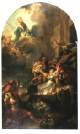
French painter. In 1748 he won second place in the Prix de RomeGLOSSARYA scholarship, founded concurrently with the French Academy in Rome (1666), that enabled prize-winning students at the Academie Royale de Peinture et de Sculpture in Paris to spend a period (usually 4 years) in Rome at the state's expense. Prizes for architecture began to be awarded regularly in 1723, and prizes for engravers and musicians were added in the 19th century. The prizes were meant to perpetuate the academic tradition and during the 18th and 19th centuries winning the award was the traditional stepping stone to the highest honours for painters and sculptors. Many distinguished artists (as well as many nonentities) were Prix de Rome winners, notably David, Fragonard, and Ingres among painters and Clodion, Girardon, and Houdon among sculptors. The prizes are still awarded and the system has been adopted by other countries. competition and subsequently became a pupil of Carle van Loo at the Ecole Royale des Eleves Protégés, Paris. In 1752 he arrived to complete his artistic education at the Académie de France in Rome, where he discovered the art of Raphael and of Domenichino, as well as that of such BaroqueGLOSSARYThe period in art history from about 1600 to about 1750. In this sense the term covers a wide range of styles and artists. In painting and sculpture there were three main forms of Baroque: (1) sumptuous display, a style associated with the Catholic Counter Reformation and the absolutist courts of Europe (Bernini, Rubens); (2) dramatic realism (Caravaggio); and (3) everyday realism, a development seen in particular in Holland (Rembrandt, Vermeer). In architecture, there was an emphasis on expressiveness and grandeur, achieved through scale, the dramatic use of light and shadow, and increasingly elaborate decoration. In a more limited sense the term Baroque often refers to the first of these categories. The development of the Baroque reflects the period's religious tensions (Catholic versus Protestant); a new and more expansive world view based on science and exploration; and the growth of absolutist monarchies. masters as Pietro da Cortona, Luca Giordano and Francesco Solimena. He also stayed in Parma and visited Venice, Bologna and Turin. His experiences in Italy confirmed him in his lifelong vocation for large-scale history paintingGLOSSARYPainting concerned with the representation of scenes from the Bible, history (usually classical history), and classical literature. From the Renaissance to the 19th century it was considered the highest form of painting, its subjects considered morally elevating..
He entered the Académie in 1758. Next year he exhibited at the SalonGLOSSARYIn the French language of the 18th and 19th centuries it designated an actual exhibition space, as well as the academic art exhibitions staged in the Salon d'Apollon of the Louvre since 1667. From 1737, the exhibitions took place biennially and, after the French Revolution, annually in the Salon Carré of the Louvre in Paris. Towards the end of the 19th century the official Salon jury was dissolved in order to make way for a committee of state-approved artists, i.e. former Salon members, who created the highly influential Société des Artistes Français. The Death of the Virgin and the painting was highly acclaimed. He visited Antwerp and in 1767 painted in Paris The Miracle of the Fervents, a robust hommage to Rubens.
He was summoned by Catherine II to Russia in 1791 and he participated in decorative works at her court. He became professor at St Petersburg Academy of Arts. He died in Russia in 1806.