03 — ARTWORK
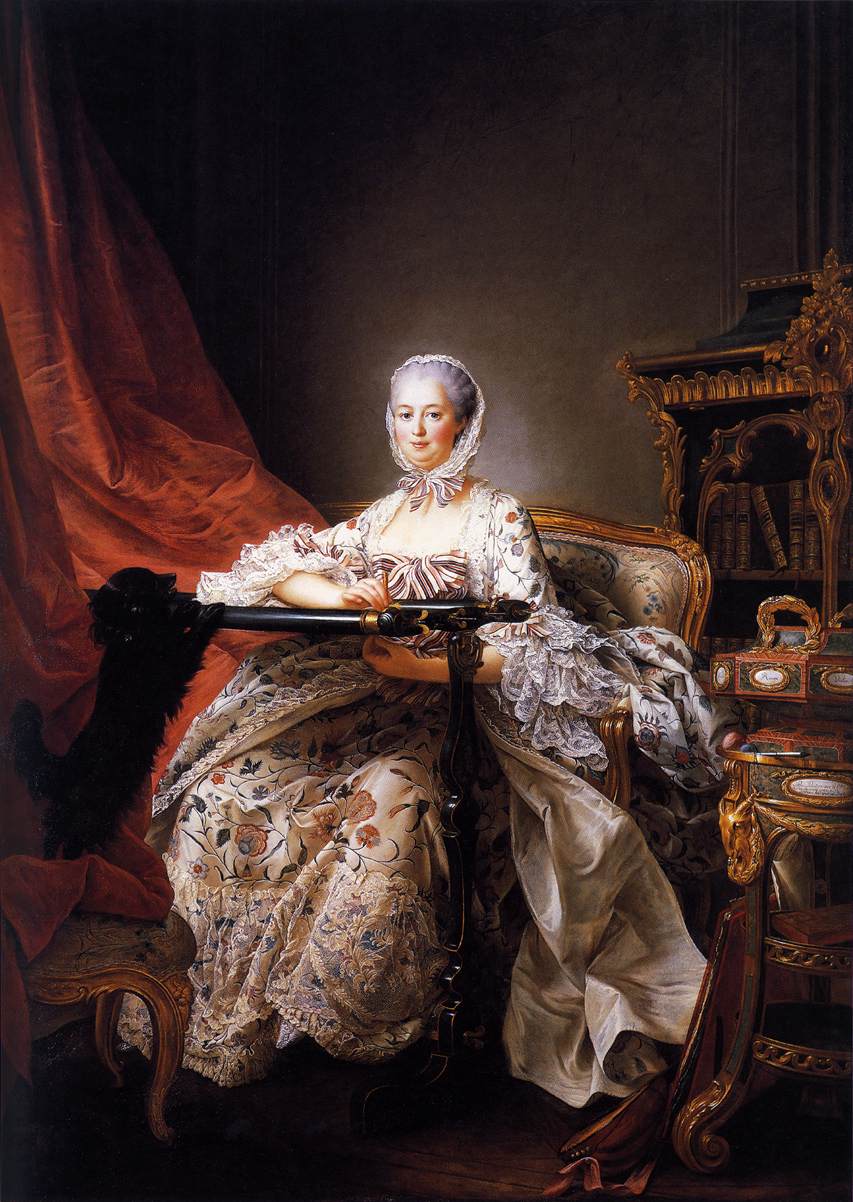
Madame de Pompadour
DROUAIS, François-Hubert · 1764 →
- MEDIUM
- Oil on canvas, 217 x 157 cm
- TYPE
- Portrait
PALETTE
HOVER OR TAP A SWATCH FOR NAME, SHARE AND HEX. SAMPLED FROM THE IMAGE — INDICATIVE, NOT A PIGMENT ANALYSIS.
DEVELOPMENT BUILD — NOT FOR PUBLIC USE. CONTRIBUTE ON GITHUB.
03 — ARTWORK
DROUAIS, François-Hubert · 1764 →
PALETTE
HOVER OR TAP A SWATCH FOR NAME, SHARE AND HEX. SAMPLED FROM THE IMAGE — INDICATIVE, NOT A PIGMENT ANALYSIS.
COMMENTARY
UNDERLINED TERMS ARE DEFINED IN THE GLOSSARY.
The son of a painter, Hubert Drouais, François-Hubert became a successful portraitist at the French court. He was especially fashionable for his likenesses of aristocratic children dressed as gardeners or Savoyard beggars to emphasise their 'natural' or 'filial' characters (little Savoyard hurdy-gurdy players brought their earnings back every year to their mothers in the Haute Savoie). This sumptuous portraitThe Roman portrait bust survived in the form of life-sized reliquaries of saints, but it was in 15th century Florence that the individual features and character of a contemporary sitter were accurately recorded by sculptors such as Donatello, Desiderio da Settignano, Mino da Fiesole and the Rossellino. A similar degree of realism occurs in 15th century tomb sculpture. The equestrian portrait, based on antique statues such as the Marcus Aurelius monument (Rome, Campidoglio), was revived in the 14th century. Two examples in fresco are Simone Martini's Guidoriccio (c. 1328; Siena, Palazzo Pubblico) and the posthumous portrait of Sir John Hawkwood (1436; Florence, Cathedral) by Uccello, which gives the illusion of a 3-dimensional statue seen from below. The Venetian Republic ordered imposing monuments from Donatello (1447; Gattarnelata, Padua) and Verrocchio (14799; Colleoni, Venice), whilst other statesmen ordered their own images to be erected in public places, directly relating themselves to the military heroes of ancient Rome. Another form of political portraiture derived from antiquity was the commemorative portrait medal designed by artists such as Pisanello. The carved or painted profile portrait became popular in the 1450s. The realism of the clear, flattened image, painted under the influence of Flemish examples by the Pollaiuolo brothers, Piero della Francesca and Botticelli, was superseded by the three-quarter and frontal portrait, psychologically more complex, such as Leonardo's enigmatic Mona Lisa (Paris, Louvre) with her momentary smile or Andrea del Sarto's arresting Portrait of a Man (London, National Gallery). The 16th century portrait became generalized, Lotto's Andrea Odoni (1527; Royal Collection) being an idealized concept of a collector rather than an individual. Group portraits, decorating whole rooms, include the narrative scenes of the Gonzaga court painted by Mantegna (completed 1474; Mantua, Palazzo Ducale) and the elaborate schemes commissioned by the Farnese family in Rome from Vasari (1546; Palazzo della Cancelleria) and Salviati (after 1553; Palazzo Farnese). Portraits were also incorporated into religious narratives, as in Ghirlandaio's fresco cycle painted for Giovanni Tornabuoni in S. Maria Novella, Florence (1486-90). of Madame de Pompadour, Louis XV's mistress, similarly employs the imagery of bourgeois virtue and industry to flatter a great lady.
In this case, however, the fiction is less pronounced: the Marquise de Pompadour had been born plain Mademoiselle Poisson. Pretty, charming, good-natured and well-educated, at the age of nine she had been told by a fortune-teller that she would reign over the heart of a king - after which her family called her Reinette, 'little Queen' (twenty years later she was to reward the woman with the gift of an enormous sum, six hundred livres). Married to the nephew of her mother's rich lover, she began to entertain Parisian intellectuals at her salonIn the French language of the 18th and 19th centuries it designated an actual exhibition space, as well as the academic art exhibitions staged in the Salon d'Apollon of the Louvre since 1667. From 1737, the exhibitions took place biennially and, after the French Revolution, annually in the Salon Carré of the Louvre in Paris. Towards the end of the 19th century the official Salon jury was dissolved in order to make way for a committee of state-approved artists, i.e. former Salon members, who created the highly influential Société des Artistes Français.; Voltaire is the best-known of the 'philosophes' whom she captivated and supported. She soon attracted the eye of the king, Louis XV, and by 1745, separated from her husband, she was installed at Versailles and ennobled. To her enemies she remained always a Parisian bourgeoise, member of a class which was enriching itself, as they saw it, at their expense. She kept the friendship and interest of the king, however, even after their sexual relationship had ended in 1751-2, by her affection, her charm, and above all through her interest in music and the arts.
Drouais's painting faithfully records her pursuits, surrounding her with books, a mandolin, an artist's folio, her beloved pet dog, and dressing her in a lavishly embroidered silk dress edged with yards of superb lace. Her embroidery - more accurately, tambouring - wools are kept in an elaborate work-table in the latest fashion, with Sèvres plaques (Madame de Pompadour had earlier taken the porcelain factory of Vincennes under her protection and transferred it to Sèvres, near one of her houses). She looks up at the viewer as she might have done at the king when he came into her apartment through their private staircase; a woman no longer young, yet still with that 'wonderful complexion' and 'those eyes not so very big, but the brightest, wittiest and most sparkling', as praised by a contemporary. Yet there is more here than we can see at first sight. As his signature tells us, Drouais painted the Marquise's face from the life in April 1763 on a separate rectangle which was then joined to the rest of the canvasA woven cloth used as a support for painting. The best-quality canvas is made of linen; other materials used are cotton, hemp, and jute. It is now so familiar a material that the word 'canvas' has become almost a synonym for an oil painting, but it was not until around 1500 that it began to rival the wooden panel (which was more expensive and took longer to prepare) as the standard support for movable paintings (the transition came later in Northern Europe than in Italy). Canvas is not suitable for painting on until it has been coated with a ground, which isolates the fabric from the paint; otherwise it will absorb too much paint, only very rough effects will be obtainable, and parts of the fabric may be rotted by the pigments. It must also be made taut on a stretcher or by some other means.. She must have approved of the likeness for other, half-length portraits were commissioned from Drouais. But this picture was finished in May 1764, some weeks after her death on 5 April at the age of 43. All her life she had suffered from ill-health, and even in her last illness stoically wore rouge and smiled at everybody. Drouais's suave and grand yet somehow intimate portrait installs her in our memory as she would have wished to be remembered. <P> <TABLE ALIGN=LEFT CELLPADDING=5 BORDER=1 WIDTH=320 BGCOLOR="#99CCCC"> <TR VALIGN=MIDDLE><TD><IMG SRC="/support/gif/listen.gif" BORDER=0 VALIGN=MIDDLE> Suggested listening (streaming mp3, 12 minutes):<BR><A HREF="#" onClick="w=window.open ('/music1/18_cent/vivaldi_mandolin_concerto.html', 'newWin', 'scrollbars=yes,status=no,dependent=yes,screenX=0,screenY=0,width=350,height=350');w.opener=this;w.focus();return true"><B>Antonio Vivaldi: Concerto in G major for two mandolins and orchestra, RV 532</B></A> </TD></TR></TABLE>
@online{wga-r9b26d3e406dbae,
  author       = {Krén, Emil and Marx, Daniel},
  title        = {Madame de Pompadour by DROUAIS, François-Hubert},
  organization = {{Web Gallery of Art}},
  date         = {2026-09-09},
  url          = {https://beta.wga.hu/artists/drouais-franois-hubert-ra2a1befc2df826/madame-de-pompadour-r9b26d3e406dbae},
  urldate      = {2026-09-09},
  langid       = {english}
}
ACCESSED 2026-09-09. REPLACE THE AUTHOR FIELD WITH THE COMMENTARY AUTHOR WHERE ONE IS NAMED.


