03 — ARTWORK
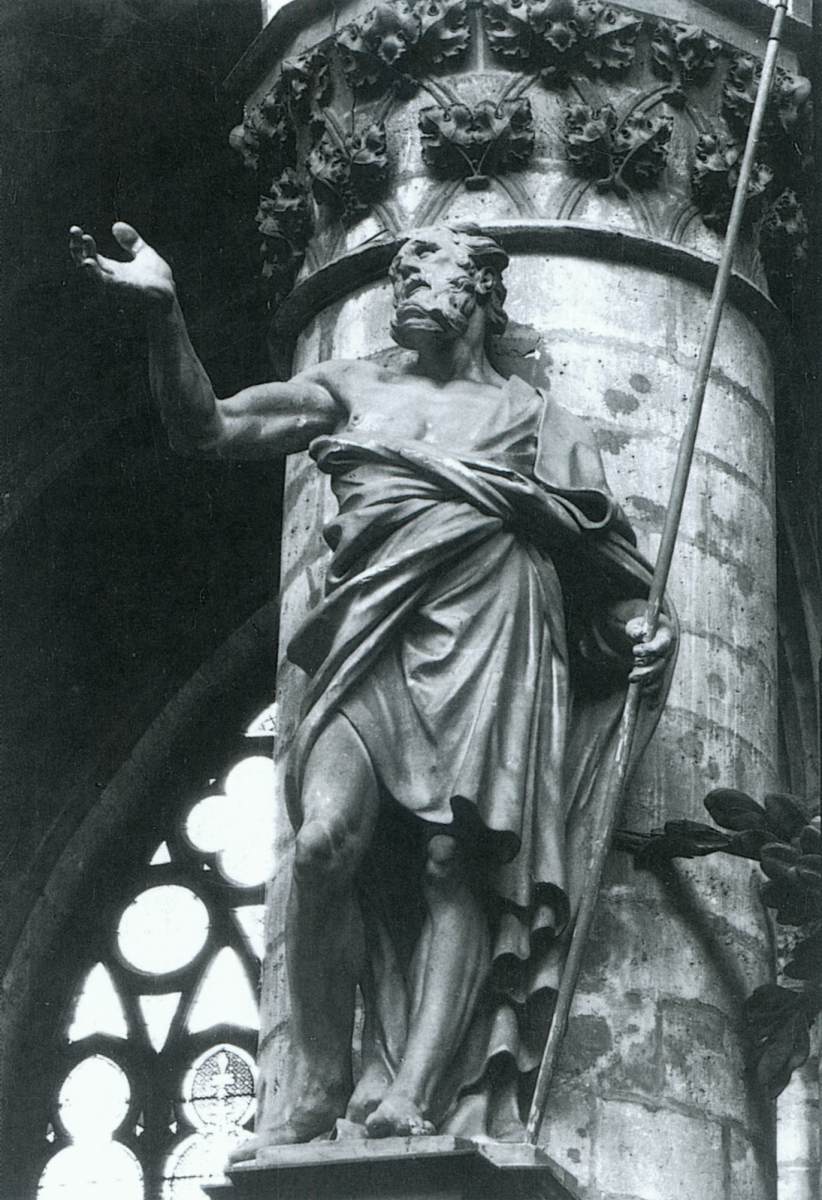
St Thomas
DUQUESNOY, Jérôme, the Younger · 1644 →
- MEDIUM
- Marble
- TYPE
- Religious
PALETTE
HOVER OR TAP A SWATCH FOR NAME, SHARE AND HEX. SAMPLED FROM THE IMAGE — INDICATIVE, NOT A PIGMENT ANALYSIS.
DEVELOPMENT BUILD — NOT FOR PUBLIC USE. CONTRIBUTE ON GITHUB.
03 — ARTWORK
DUQUESNOY, Jérôme, the Younger · 1644 →
PALETTE
HOVER OR TAP A SWATCH FOR NAME, SHARE AND HEX. SAMPLED FROM THE IMAGE — INDICATIVE, NOT A PIGMENT ANALYSIS.
COMMENTARY
UNDERLINED TERMS ARE DEFINED IN THE GLOSSARY.
Returning to Brussels from Italy Duquesnoy was immediately charged with important commissions. Among the first commissions were the four statues of apostles for the church of St Gudule (now St Michael's CathedralThe principal church of a province or diocese, where the throne of the bishop is placed. For reasons lost to time and tradition, a cathedral always faces west - toward the setting sun. The altar is placed at the east end. The main body, or nave, of the cathedral is usually divided into one main and two side aisles. These lead up to the north and south transepts, or arms of the cross, the shape in which a cathedral is usually formed.. These are classicist figures, wearing togas, part of a series on which Lucas Faydherbe and Cornelis van Mildert also worked. The St Thomas makes clear how much Jérôme Duquesnoy owed to the style of his elder brother François. Apart from the gentle drapery and classicalRelating to the culture of ancient Greece and Rome (classical Antiquity). The classical world played a profoundly important role in the Renaissance, with Italian scholars, writers, and artists seeing their own period as the rebirth (the "renaissance") of classical values after the Middle Ages. The classical world was considered the golden age for the arts, literature, philosophy, and politics. Concepts of the classical, however, changed greatly from one period to the next. Roman literature provided the starting point in the 14th century, scholars patiently finding, editing and translating a wide range of texts. In the 15th century Greek literature, philosophy and art - together with the close study of the remains of Roman buildings and sculptures-expanded the concept of the classical and ensured it remained a vital source of ideas and inspiration. contrappostoAn asymmetrical pose in which the one part of the body is counterbalanced by another about the body's central axis. Ancient Greek sculptors developed contrapposto by creating figures who stand with their weight on one leg, the movement of the hips to one side being balanced by a counter movement of the torso. Contrapposto was revived during the Renaissance and frequently used by Mannerist artist, who developed a greater range of contrapposto poses., it also shows a controlled expressiveness in the features which follows the example of François Duquesnoy's St Andrew in St Peter's in Rome.
@online{wga-r2e5483bb269ab3,
  author       = {Krén, Emil and Marx, Daniel},
  title        = {St Thomas by DUQUESNOY, Jérôme, the Younger},
  organization = {{Web Gallery of Art}},
  date         = {2026-09-13},
  url          = {https://beta.wga.hu/artists/duquesnoy-jrme-the-younger-r7a048eac0e15d0/st-thomas-r2e5483bb269ab3},
  urldate      = {2026-09-13},
  langid       = {english}
}
ACCESSED 2026-09-13. REPLACE THE AUTHOR FIELD WITH THE COMMENTARY AUTHOR WHERE ONE IS NAMED.


