03 — ARTWORK
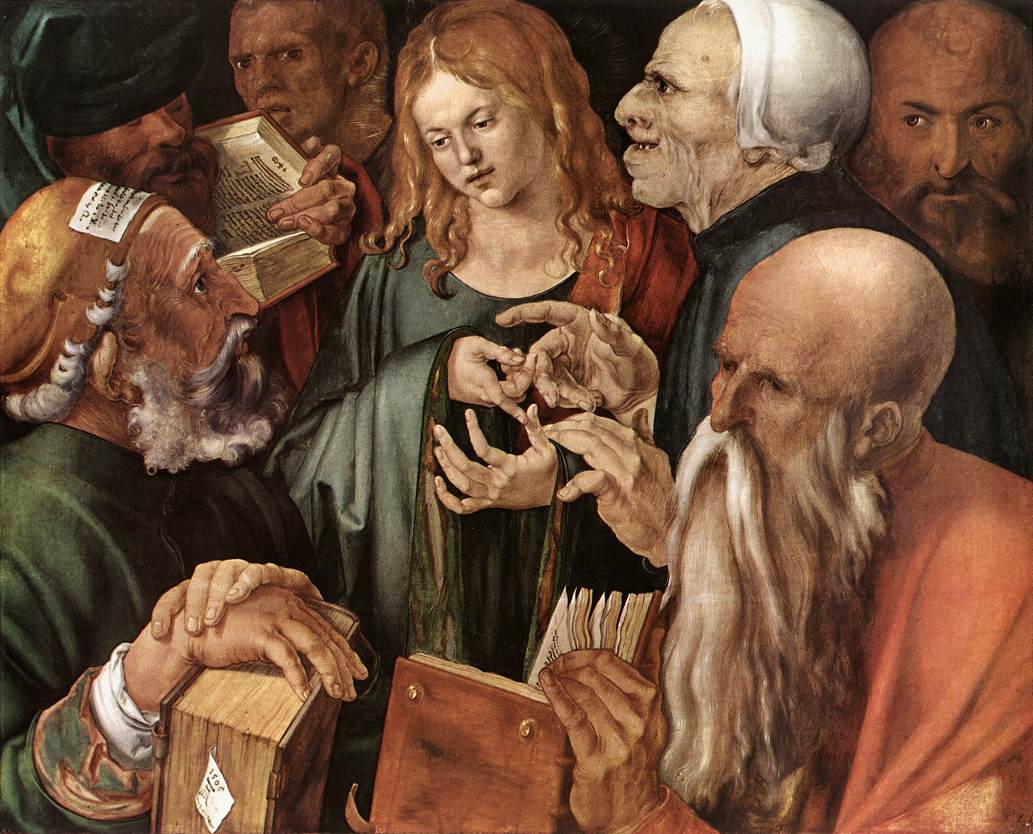
Christ Among the Doctors
- MEDIUM
- Oil on panel, 65 x 80 cm
- TYPE
- Religious
PALETTE
HOVER OR TAP A SWATCH FOR NAME, SHARE AND HEX. SAMPLED FROM THE IMAGE — INDICATIVE, NOT A PIGMENT ANALYSIS.
DEVELOPMENT BUILD — NOT FOR PUBLIC USE. CONTRIBUTE ON GITHUB.
CURRENT LOCATION · Museo Thyssen-Bornemisza
03 — ARTWORK
PALETTE
HOVER OR TAP A SWATCH FOR NAME, SHARE AND HEX. SAMPLED FROM THE IMAGE — INDICATIVE, NOT A PIGMENT ANALYSIS.
COMMENTARY
UNDERLINED TERMS ARE DEFINED IN THE GLOSSARY.
At the same time as the Feast of the Rose Garlands, Dürer was working on the painting of Christ among the Doctors. The theme derives from the Gospel of St Luke (Luke 2, 41-52).
On the bookmark at the bottom left of the panelTerm in painting for a support of wood, metal, or other rigid substance, as distinct from canvas. Until the adoption of canvas in the 15th century nearly all the movable paintings of Europe were executed on wood, and even up to the beginning of the 17th century it is probable that as much painting was done on the one support as on the other. Painters who worked on a small scale often used copper panels (Elsheimer is a leading example), and in the colonial art of South America copper and tin and even lead and zinc were used. On a larger scale, slate has occasionally been used as a support, notably by Rubens for his altarpiece for Sta Maria in Vallicella (the Chiesa Nuova) in Rome; the picture he originally painted was said to reflect the light unpleasantly and slate was used for the replacement to produce a more matt finish. For wood panels the Italian masters of the Renaissance preferred white poplar, while oak was the most common wood used in northern Europe. Many other types were used, however; analysis of the contents of art galleries has yielded a long list, including beech, cedar, chestnut, fir, larch, linden, mahogany, olive, and walnut. In the 20th century cedar, teak, and dark walnut are favourites, and modern painters have also used plywood, fibre-board, and other synthetic materials as supports., Dürer has recorded that this picture was `the work of five days', a pointed reference to his inscription on The AltarpieceA picture or sculpture that stands on or is set up behind an altar. The term reredos is used for an ornamental screen or partition, not directly attached to the altar table but affixed to the wall behind it. A diptych is an altarpiece consisting of two panels, a triptych one of three panels, and a polyptych one of four or more panels. From the 14th to 16th century, the altarpiece was one of the most important commissions in European art; it was through the altarpiece that some of the most decisive developments in painting and sculpture came about. of the Rose Garlands, the work of five months. Christ among the Doctors is not only a smaller panel, but the brushwork is much more spontaneous and the paint is applied with broad and fluid strokes. Despite Dürer's statement about five days, he based it on a number of careful studies, including one of Christ's gesticulating fingers. Although not present on the original painting, two early copies of the panel have the word `Romae' added to the inscription on the bookmark and this suggests that Dürer visited Rome late in 1506. It may also be significant that the original painting was in Rome's Galleria Barberini until its acquisition by Baron Heinrich von Thyssen-Bornemisza in 1935.
The story recorded in the panel is of Christ's visit to Solomon's Temple in Jerusalem, where he debated with the learned Jewish doctors (or scribes). According to the Bible, this was the first occasion on which Christ taught. Dürer's daring composition does not use the conventional temple setting which he earlier used in the lower left panel of The Seven Sorrows of the Virgin. Instead he gives a close-up view of the faces of six doctors crowding round the young Jesus. The elderly doctors, caricatured faces which may well have been influenced by Leonardo da Vinci, argue with Christ by quoting from the Scriptures and gesticulating. Christ, a sober boy of 12, quietly gestures with his fingers to make a point. Dürer contrasts Christ's youthful hands with the gnarled fingers of the ugly old man with the white cap and a gap-toothed grin.
@online{wga-r3770726242bad2,
  author       = {Krén, Emil and Marx, Daniel},
  title        = {Christ Among the Doctors by DÜRER, Albrecht},
  organization = {{Web Gallery of Art}},
  date         = {2026-09-13},
  url          = {https://beta.wga.hu/artists/drer-albrecht-r9b10ff91cb62c2/christ-among-the-doctors-r3770726242bad2},
  urldate      = {2026-09-13},
  langid       = {english}
}
ACCESSED 2026-09-13. REPLACE THE AUTHOR FIELD WITH THE COMMENTARY AUTHOR WHERE ONE IS NAMED.


