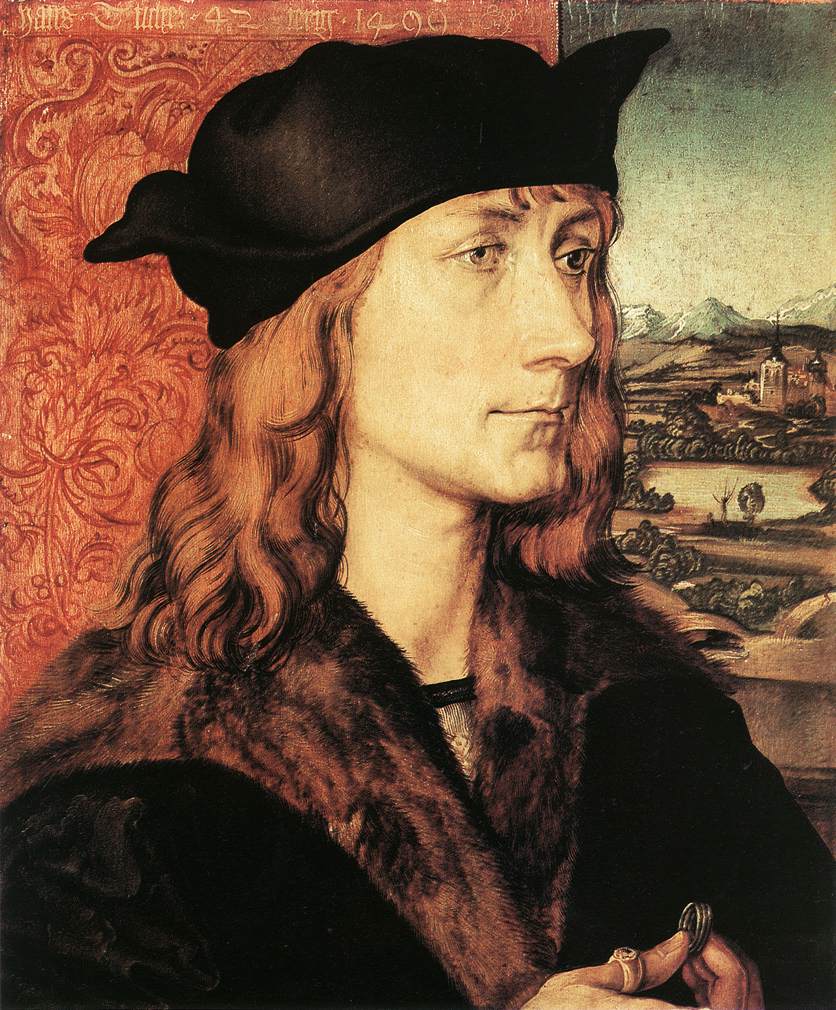
03 — ARTWORK
Hans Tucher
- MEDIUM
- Oil on panel, 28 x 24 cm
- TYPE
- Portrait
PALETTE
HOVER OR TAP A SWATCH FOR NAME, SHARE AND HEX. SAMPLED FROM THE IMAGE — INDICATIVE, NOT A PIGMENT ANALYSIS.
DEVELOPMENT BUILD — NOT FOR PUBLIC USE. CONTRIBUTE ON GITHUB.
CURRENT LOCATION · Schlossmuseum (Weimar)
03 — ARTWORK
PALETTE
HOVER OR TAP A SWATCH FOR NAME, SHARE AND HEX. SAMPLED FROM THE IMAGE — INDICATIVE, NOT A PIGMENT ANALYSIS.
COMMENTARY
UNDERLINED TERMS ARE DEFINED IN THE GLOSSARY.
The panelTerm in painting for a support of wood, metal, or other rigid substance, as distinct from canvas. Until the adoption of canvas in the 15th century nearly all the movable paintings of Europe were executed on wood, and even up to the beginning of the 17th century it is probable that as much painting was done on the one support as on the other. Painters who worked on a small scale often used copper panels (Elsheimer is a leading example), and in the colonial art of South America copper and tin and even lead and zinc were used. On a larger scale, slate has occasionally been used as a support, notably by Rubens for his altarpiece for Sta Maria in Vallicella (the Chiesa Nuova) in Rome; the picture he originally painted was said to reflect the light unpleasantly and slate was used for the replacement to produce a more matt finish. For wood panels the Italian masters of the Renaissance preferred white poplar, while oak was the most common wood used in northern Europe. Many other types were used, however; analysis of the contents of art galleries has yielded a long list, including beech, cedar, chestnut, fir, larch, linden, mahogany, olive, and walnut. In the 20th century cedar, teak, and dark walnut are favourites, and modern painters have also used plywood, fibre-board, and other synthetic materials as supports. is the left side of a diptychin medieval art a picture, often an altarpiece, consisting of two folding wings without a fixed central area. that includes the portraitThe Roman portrait bust survived in the form of life-sized reliquaries of saints, but it was in 15th century Florence that the individual features and character of a contemporary sitter were accurately recorded by sculptors such as Donatello, Desiderio da Settignano, Mino da Fiesole and the Rossellino. A similar degree of realism occurs in 15th century tomb sculpture. The equestrian portrait, based on antique statues such as the Marcus Aurelius monument (Rome, Campidoglio), was revived in the 14th century. Two examples in fresco are Simone Martini's Guidoriccio (c. 1328; Siena, Palazzo Pubblico) and the posthumous portrait of Sir John Hawkwood (1436; Florence, Cathedral) by Uccello, which gives the illusion of a 3-dimensional statue seen from below. The Venetian Republic ordered imposing monuments from Donatello (1447; Gattarnelata, Padua) and Verrocchio (14799; Colleoni, Venice), whilst other statesmen ordered their own images to be erected in public places, directly relating themselves to the military heroes of ancient Rome. Another form of political portraiture derived from antiquity was the commemorative portrait medal designed by artists such as Pisanello. The carved or painted profile portrait became popular in the 1450s. The realism of the clear, flattened image, painted under the influence of Flemish examples by the Pollaiuolo brothers, Piero della Francesca and Botticelli, was superseded by the three-quarter and frontal portrait, psychologically more complex, such as Leonardo's enigmatic Mona Lisa (Paris, Louvre) with her momentary smile or Andrea del Sarto's arresting Portrait of a Man (London, National Gallery). The 16th century portrait became generalized, Lotto's Andrea Odoni (1527; Royal Collection) being an idealized concept of a collector rather than an individual. Group portraits, decorating whole rooms, include the narrative scenes of the Gonzaga court painted by Mantegna (completed 1474; Mantua, Palazzo Ducale) and the elaborate schemes commissioned by the Farnese family in Rome from Vasari (1546; Palazzo della Cancelleria) and Salviati (after 1553; Palazzo Farnese). Portraits were also incorporated into religious narratives, as in Ghirlandaio's fresco cycle painted for Giovanni Tornabuoni in S. Maria Novella, Florence (1486-90). of his wife Felicitas. Inscription in the top left in another's hand: HANS TUCHER, 42 IERIG 1499. In 1824, the two portraits were included in the inventory of the museum in the Jägerhaus of Weimar. After 1918, they were passed from the grand dukes to the museum.
It was commissioned in the same year as the diptych of Nicolas and Elsbeth Tucher (Staatliche Kunstsammlungen, Kassel). They had approximately the same composition because Wolgemut, Dürer's master, had already done portraits of the members of the Tucher family years before. Even the setting of the portraits is very similar. The presence of an embroidered curtain in the background, the almost identical landscape passage seen through the windows, and lastly, the windowsill set equal spatial limits to the portraits. The foreshortenings of the landscape passage are imaginative and mannered, showing roads, lakes, and mountains. On the road, in the landscape behind the man's portrait, one discerns a wayfarer; on the path, in the woman's portrait, a man on horseback. The same clouds are seen in the clear sky behind the man, as in the wife's portrait, and in Elsbeth Tucher's.
Hans Tucher, a descendant of an old Nuremberg family and an important member of the city council, is depicted in lavish clothes, with a fur collar, a symbol of his high-ranking position. The head, portrayed in a more elevated position than that of his consort, is framed by soft and wavy hair. The eyes, which have slightly different size, have an open gaze, the eyelids are somewhat lowered, the nose is long and sharp, the lips thin: the result is a proud but winning look, which is also emphasized by the points of the beret folded to the back and front. Besides the ring he wears on his thumb, he holds - like Elsbeth Tucher in her portrait - another ring, gold, in his hand as evidence of his marriage, contracted in 1482 with Felicitas. She, in turn, holds a carnation, with a bud and a flower. Her plump face is turned to the left, but her gaze, with slightly melancholic eyes, looks to the right. Like her sister-in-law, she wears a gold chain around her neck, and the waistcoat, according to custom, is held by a buckle , which is engraved with the initials of her consort, H. T.
The combined coat of arms of Tucher-Rieter is depicted on the verso of the Hans Tucher portrait, which became the anterior side of the closed diptych.
@online{wga-re47a836b50469f,
  author       = {Krén, Emil and Marx, Daniel},
  title        = {Hans Tucher by DÜRER, Albrecht},
  organization = {{Web Gallery of Art}},
  date         = {2026-09-13},
  url          = {https://beta.wga.hu/artists/drer-albrecht-r9b10ff91cb62c2/hans-tucher-re47a836b50469f},
  urldate      = {2026-09-13},
  langid       = {english}
}
ACCESSED 2026-09-13. REPLACE THE AUTHOR FIELD WITH THE COMMENTARY AUTHOR WHERE ONE IS NAMED.


