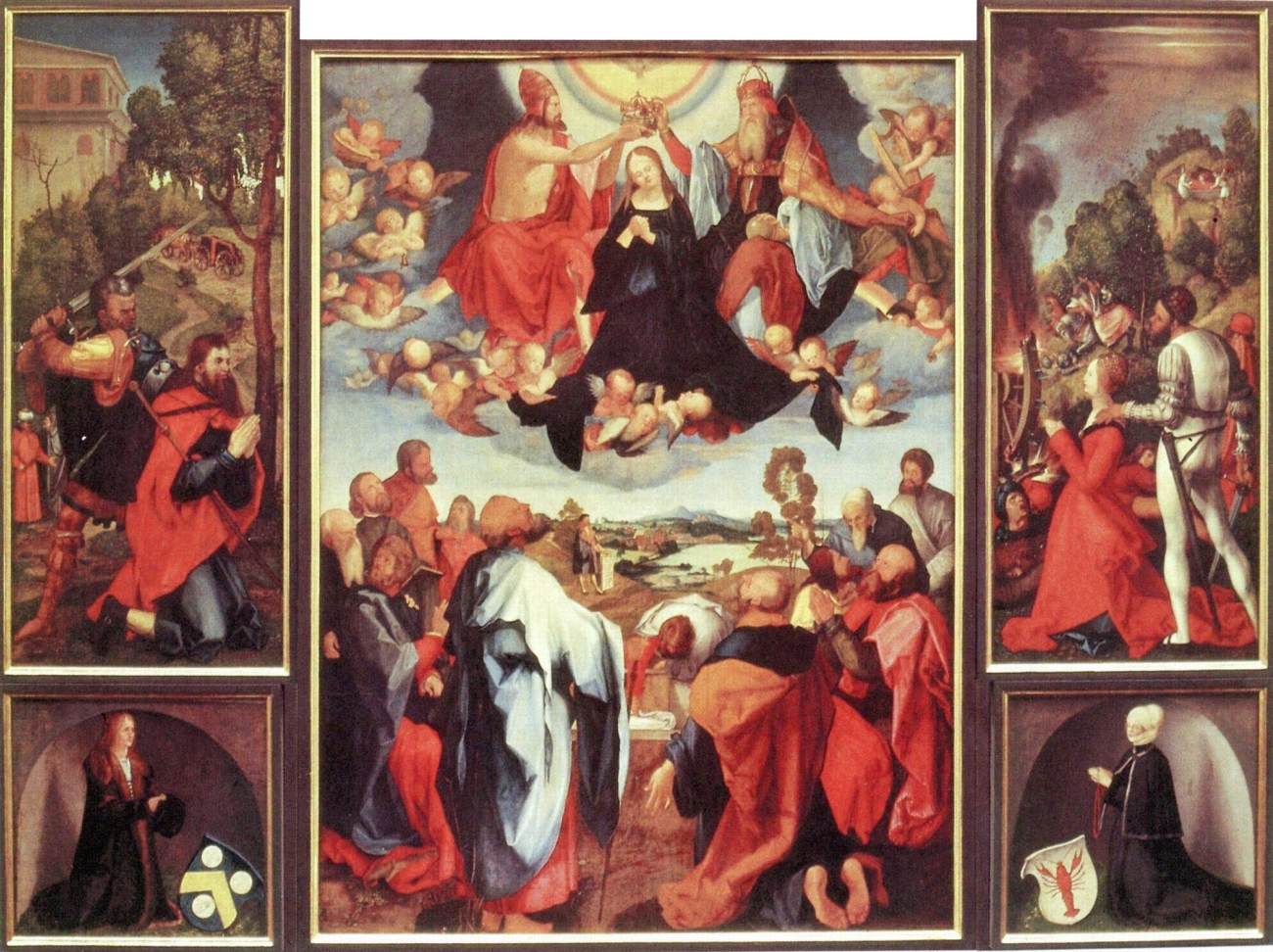
03 — ARTWORK
Heller Altarpiece (copy)
- MEDIUM
- Tempera on wood, 190 x 260 cm
- TYPE
- Religious
PALETTE
HOVER OR TAP A SWATCH FOR NAME, SHARE AND HEX. SAMPLED FROM THE IMAGE — INDICATIVE, NOT A PIGMENT ANALYSIS.
DEVELOPMENT BUILD — NOT FOR PUBLIC USE. CONTRIBUTE ON GITHUB.
03 — ARTWORK
PALETTE
HOVER OR TAP A SWATCH FOR NAME, SHARE AND HEX. SAMPLED FROM THE IMAGE — INDICATIVE, NOT A PIGMENT ANALYSIS.
COMMENTARY
UNDERLINED TERMS ARE DEFINED IN THE GLOSSARY.
This altarpieceA picture or sculpture that stands on or is set up behind an altar. The term reredos is used for an ornamental screen or partition, not directly attached to the altar table but affixed to the wall behind it. A diptych is an altarpiece consisting of two panels, a triptych one of three panels, and a polyptych one of four or more panels. From the 14th to 16th century, the altarpiece was one of the most important commissions in European art; it was through the altarpiece that some of the most decisive developments in painting and sculpture came about. was commissioned by Jakob Heller (1460-1522), a wealthy merchant, member of the town council, and mayor of Frankfurt, either before or after Dürer's second trip to Italy. Only the central element depicting the Assumption and Coronation of the Virgin was executed by Dürer himself. The altarpiece was destroyed by a fire in the residence of Duke Maximilian of Bavaria in Munich. Fortunately, a copy of the work, executed c. 1614 by Jobst Harrich of Nuremberg (c. 1580-1617) survived.
The theme of the assumption and of the coronation of the Madonna was familiar in Nuremberg painting of the fifteenth century. But Dürer gives it a particular Renaissance interpretation. The doubting St Thomas bows over to the inside of the emptied sarcophagusA coffin or tomb, made of stone, wood or terracotta, and sometimes (especially among the Greeks and Romans) carved with inscriptions and reliefs. in the foreground and clings to the linens that wrapped the body of the Madonna. He demonstrates the difficulty he has in convincing himself that the assumption is truly happening. His lowered head is painted by Dürer in a sharp foreshortening.
The other apostles are standing or kneeling around the sarcophagus. St Peter and St Paul, in the foreground, turn their backs to the observer opening the view onto St Thomas and the landscape behind the group. In the center-ground of the landscape, Dürer stands as usual with the explicative tablet and his gaze fixed straight ahead. The background presses into the far distance, toward a lake enclosed by hills, peppered with buildings. A broad and tranquil landscape contrasts with the monumental, concentrated and restless group of apostles. While the doubting St Thomas is still looking for proof of the Assumption, the other apostles, arranged in an ascending semicircle to the left and right, have already recognized it. In the sky, in a semicircle of clouds, accompanied and held by a flock of cherubs, the Madonna rises toward the Eternal Father and Jesus Christ, as they wait to crown her. The faces and gestures of the men express an endless bewilderment at the sight of the miracle that is unfolding before their eyes. The variety and vigour that distinguishes the apostles, who disagree among themselves, is opposed to the monumentality of the isolated group in the foreground, consisting of the princes of the apostles, St Peter and St Paul. Each detail of the panelTerm in painting for a support of wood, metal, or other rigid substance, as distinct from canvas. Until the adoption of canvas in the 15th century nearly all the movable paintings of Europe were executed on wood, and even up to the beginning of the 17th century it is probable that as much painting was done on the one support as on the other. Painters who worked on a small scale often used copper panels (Elsheimer is a leading example), and in the colonial art of South America copper and tin and even lead and zinc were used. On a larger scale, slate has occasionally been used as a support, notably by Rubens for his altarpiece for Sta Maria in Vallicella (the Chiesa Nuova) in Rome; the picture he originally painted was said to reflect the light unpleasantly and slate was used for the replacement to produce a more matt finish. For wood panels the Italian masters of the Renaissance preferred white poplar, while oak was the most common wood used in northern Europe. Many other types were used, however; analysis of the contents of art galleries has yielded a long list, including beech, cedar, chestnut, fir, larch, linden, mahogany, olive, and walnut. In the 20th century cedar, teak, and dark walnut are favourites, and modern painters have also used plywood, fibre-board, and other synthetic materials as supports. - for example, the bare feet of St Peter, precluding a Caravaggio - has been carefully studied. Eighteen preparatory drawings that still exist demonstrate this. They are in pencil on paper, with an azure, green background. The famous Hands in Prayer also is part of these drawings.
The entire episode was conceived with an unusual grandiosity and an intimate participation. Dürer expresses this in the vigour of the colours and, most of all, in the spaciousness and wealth of the clothes. It is modeled on a Raphael citation - twelve years his younger - and his Coronation of the Madonna, painted in 1502-03 and ordered by Alessandra degli Oddi for the chapela small separate place for worship, either part of a large church or a separate building. of the Oddi in the church of Saint Francis in Perugia. In Dürer's panel, everything is more complex and splendid, but the comparison of the two paintings is nonetheless interesting. Dürer had an opportunity to see the Raphaelesque painting while in Italy. If the commission for the painting was assigned him by Jakob Heller before his first trip to Italy, one cannot consider the Raphaelesque echo to be accidental.
@online{wga-r37fb60a9b96bfe,
  author       = {Krén, Emil and Marx, Daniel},
  title        = {Heller Altarpiece (copy) by DÜRER, Albrecht},
  organization = {{Web Gallery of Art}},
  date         = {2026-09-13},
  url          = {https://beta.wga.hu/artists/drer-albrecht-r9b10ff91cb62c2/heller-altarpiece-copy-r37fb60a9b96bfe},
  urldate      = {2026-09-13},
  langid       = {english}
}
ACCESSED 2026-09-13. REPLACE THE AUTHOR FIELD WITH THE COMMENTARY AUTHOR WHERE ONE IS NAMED.


