03 — ARTWORK
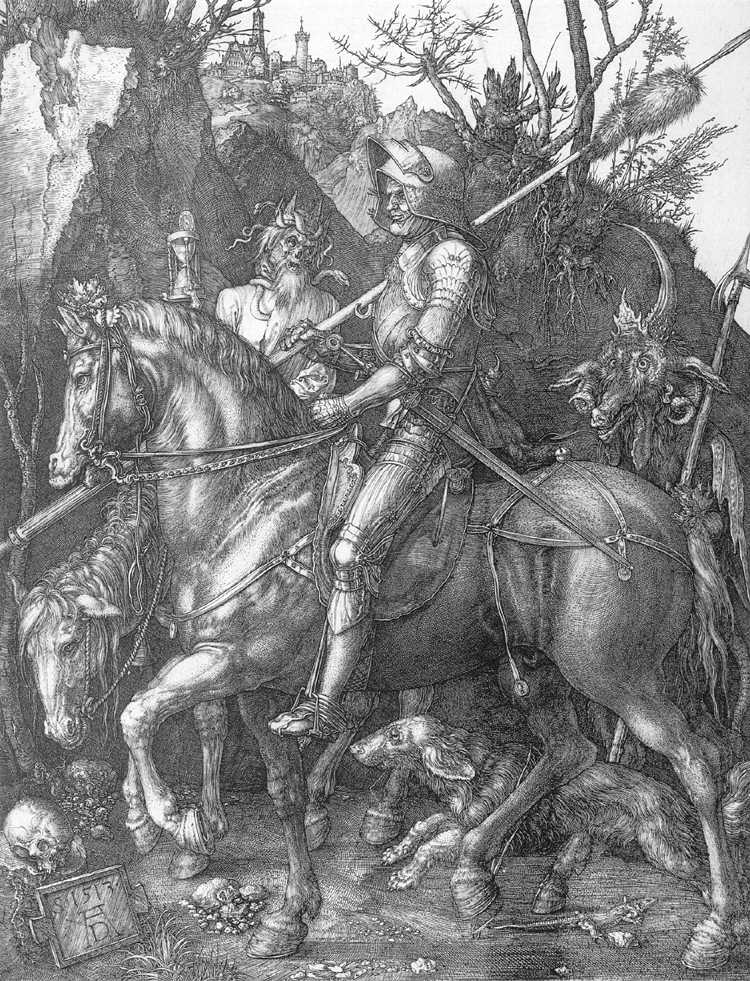
Knight, Death and the Devil
- MEDIUM
- Engraving, 245 x 188 mm
- TYPE
- Mythological
PALETTE
HOVER OR TAP A SWATCH FOR NAME, SHARE AND HEX. SAMPLED FROM THE IMAGE — INDICATIVE, NOT A PIGMENT ANALYSIS.
DEVELOPMENT BUILD — NOT FOR PUBLIC USE. CONTRIBUTE ON GITHUB.
CURRENT LOCATION · Staatliche Kunsthalle
03 — ARTWORK
PALETTE
HOVER OR TAP A SWATCH FOR NAME, SHARE AND HEX. SAMPLED FROM THE IMAGE — INDICATIVE, NOT A PIGMENT ANALYSIS.
COMMENTARY
UNDERLINED TERMS ARE DEFINED IN THE GLOSSARY.
During 1513 and 1514 Dürer created the greatest of his copperplate engravings: the Knight, St Jerome in His Study, and Melencolia I - all of approximately the same size. The extensive, complex, and often contradictory literature concerning these three engravings deals largely with their enigmatic, allusive, iconographic details. Although repeatedly contested, it probably must be accepted that the engravings were intended to be interpreted together. There is general agreement, however, that Dürer, in these three master engravings, wished to raise his artistic intensity to the highest level, which he succeeded in doing. Finished form and richness of conception and mood merge into a whole of classicalRelating to the culture of ancient Greece and Rome (classical Antiquity). The classical world played a profoundly important role in the Renaissance, with Italian scholars, writers, and artists seeing their own period as the rebirth (the "renaissance") of classical values after the Middle Ages. The classical world was considered the golden age for the arts, literature, philosophy, and politics. Concepts of the classical, however, changed greatly from one period to the next. Roman literature provided the starting point in the 14th century, scholars patiently finding, editing and translating a wide range of texts. In the 15th century Greek literature, philosophy and art - together with the close study of the remains of Roman buildings and sculptures-expanded the concept of the classical and ensured it remained a vital source of ideas and inspiration. perfection.
Knight, Death and the Devil, also known as The Rider, represents an allegoryA work of art which represents some abstract quality or idea, either by means of a single figure (personification) or by grouping objects and figures together. Renaissance allegories make frequent allusions both to both Greek and Roman legends and literature, and also to the wealth of Christian allegorical stories and symbols developed during the Middle Ages. on Christian salvation. Unflustered either by Death who is standing in front of him with his hour-glass, or by the Devil behind him, an armoured knight is riding along a narrow defile, accompanied by his loyal hound. This represents the steady route of the faithful, through all of life's injustice, to God who is symbolized by the castle in the background. The dog symbolizes faith, and the lizard religious zeal. The horse and rider, like other preliminary studies made by Dürer, are derived from the canon of proportions drawn up by Leonardo da Vinci. <P> <TABLE ALIGN=LEFT CELLPADDING=5 BORDER=1 WIDTH=320 BGCOLOR="#99CCCC"> <TR VALIGN=MIDDLE><TD><IMG SRC="/support/gif/listen.gif" BORDER=0 VALIGN=MIDDLE> Suggested listening (streaming mp3, 13 minutes):<BR><A HREF="#" onClick="w=window.open ('/music1/18_cent/boccherini_symphony.html', 'newWin', 'scrollbars=yes,status=no,dependent=yes,screenX=0,screenY=0,width=350,height=350');w.opener=this;w.focus();return true"><B>Luigi Boccherini: Symphony in D minor (The House of the Devil)</B></A> </TD></TR></TABLE>
@online{wga-r77c3ad219ebee9,
  author       = {Krén, Emil and Marx, Daniel},
  title        = {Knight, Death and the Devil by DÜRER, Albrecht},
  organization = {{Web Gallery of Art}},
  date         = {2026-09-13},
  url          = {https://beta.wga.hu/artists/drer-albrecht-r9b10ff91cb62c2/knight-death-and-the-devil-r77c3ad219ebee9},
  urldate      = {2026-09-13},
  langid       = {english}
}
ACCESSED 2026-09-13. REPLACE THE AUTHOR FIELD WITH THE COMMENTARY AUTHOR WHERE ONE IS NAMED.


