03 — ARTWORK
Portrait of Bernhard von Reesen
- MEDIUM
- Oil on oak panel, 45,4 x 31,5 cm
- TYPE
- Portrait
PALETTE
HOVER OR TAP A SWATCH FOR NAME, SHARE AND HEX. SAMPLED FROM THE IMAGE — INDICATIVE, NOT A PIGMENT ANALYSIS.
DEVELOPMENT BUILD — NOT FOR PUBLIC USE. CONTRIBUTE ON GITHUB.
CURRENT LOCATION · Gemäldegalerie
03 — ARTWORK
PALETTE
HOVER OR TAP A SWATCH FOR NAME, SHARE AND HEX. SAMPLED FROM THE IMAGE — INDICATIVE, NOT A PIGMENT ANALYSIS.
COMMENTARY
UNDERLINED TERMS ARE DEFINED IN THE GLOSSARY.
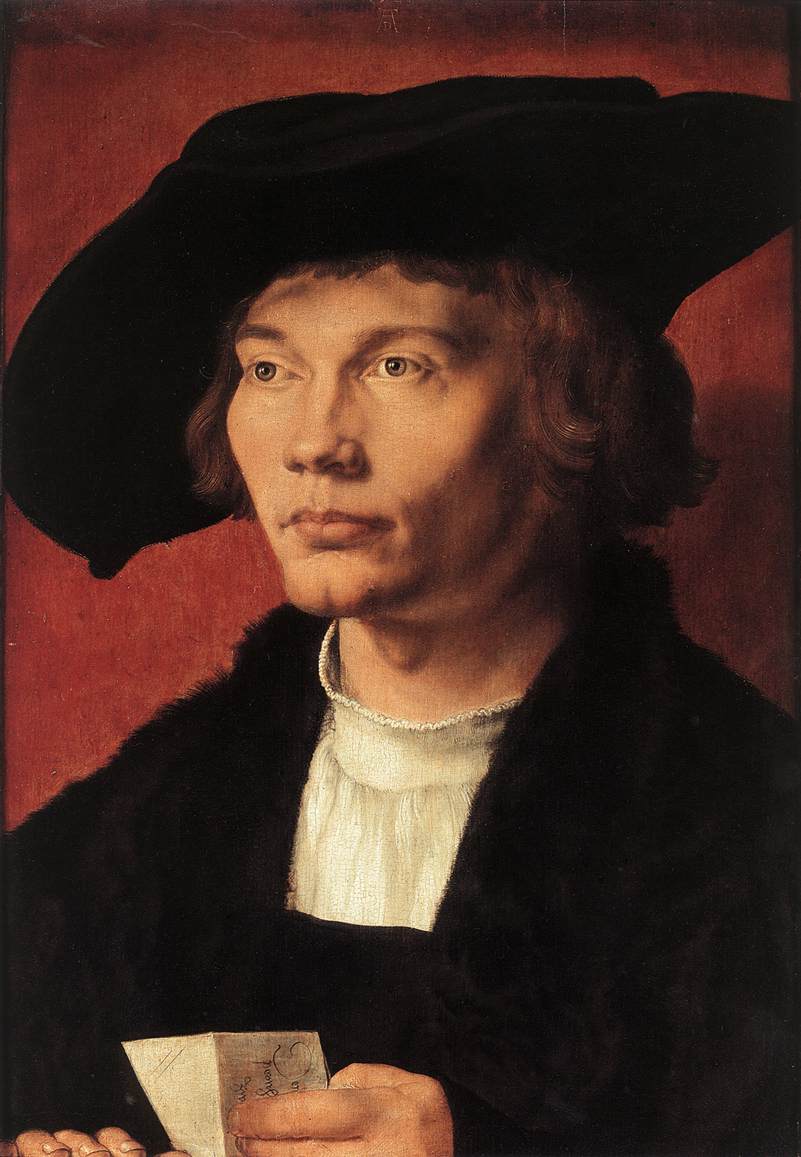
The man in the portraitThe Roman portrait bust survived in the form of life-sized reliquaries of saints, but it was in 15th century Florence that the individual features and character of a contemporary sitter were accurately recorded by sculptors such as Donatello, Desiderio da Settignano, Mino da Fiesole and the Rossellino. A similar degree of realism occurs in 15th century tomb sculpture. The equestrian portrait, based on antique statues such as the Marcus Aurelius monument (Rome, Campidoglio), was revived in the 14th century. Two examples in fresco are Simone Martini's Guidoriccio (c. 1328; Siena, Palazzo Pubblico) and the posthumous portrait of Sir John Hawkwood (1436; Florence, Cathedral) by Uccello, which gives the illusion of a 3-dimensional statue seen from below. The Venetian Republic ordered imposing monuments from Donatello (1447; Gattarnelata, Padua) and Verrocchio (14799; Colleoni, Venice), whilst other statesmen ordered their own images to be erected in public places, directly relating themselves to the military heroes of ancient Rome. Another form of political portraiture derived from antiquity was the commemorative portrait medal designed by artists such as Pisanello. The carved or painted profile portrait became popular in the 1450s. The realism of the clear, flattened image, painted under the influence of Flemish examples by the Pollaiuolo brothers, Piero della Francesca and Botticelli, was superseded by the three-quarter and frontal portrait, psychologically more complex, such as Leonardo's enigmatic Mona Lisa (Paris, Louvre) with her momentary smile or Andrea del Sarto's arresting Portrait of a Man (London, National Gallery). The 16th century portrait became generalized, Lotto's Andrea Odoni (1527; Royal Collection) being an idealized concept of a collector rather than an individual. Group portraits, decorating whole rooms, include the narrative scenes of the Gonzaga court painted by Mantegna (completed 1474; Mantua, Palazzo Ducale) and the elaborate schemes commissioned by the Farnese family in Rome from Vasari (1546; Palazzo della Cancelleria) and Salviati (after 1553; Palazzo Farnese). Portraits were also incorporated into religious narratives, as in Ghirlandaio's fresco cycle painted for Giovanni Tornabuoni in S. Maria Novella, Florence (1486-90). holds a message on which the first few letters of his name can be read `P[or B]ernh', the rest being hidden by the fingers of his left hand. This is almost certainly the painting to which Dürer refers in his Antwerp diary in late March 1521, recording that he had `made a portrait of Bernhart von Resten in oils' for which he had been paid eight florins. Dürer's reference is probably to Bernhard von Reesen (1491-1521), a Danzig merchant whose family had important business links with Antwerp. His name suggests that his family originated from Rees, a town on the Lower Rhine 100 miles east of Antwerp.
Dürer's tight composition cuts off the two edges of Reesen's hat, emphasizing his brightly lit face. The dark clothing and hat also draw attention to his features - his pronounced cheekbones, forceful chin and youthful expression. His eyes stare out into the distance. Reesen, who was 30 when he was painted, died from the plaguePlague, which had been extinct in Italy from the 8th century, returned along eastern trade routes to strike the peninsula, and thereafter all Europe, in October 1347. During 1348 the Black Death, comprising the bubonic and still more deadly septicaemic and pneumonic forms of the disease, swept town and countryside in a series of attacks whose horror was strikingly portrayed by Boccaccio in his preface to the Decameron. Thenceforward, though in less widespread, more sporadic outbreaks, plague recurred periodically until the 18th century. Thirty per cent of the population of Venice died in the outbreak of 1575-7, for instance, which was commemorated by Palladio's church of the Redentore. Preventive measures included the boarding up of infected families, the isolation of sufferers in plague hospitals, the burning of 'infected' clothing, but none worked or mitigated the feeling of hopelessness. The plague's social effects are an object of controversy. It seems probable, however, that during the second half of the 14th century plague reduced the population of Italy by a half and at certain centres, such as Florence and Genoa, sharply accentuated an economic depression which had already set in during the 1340s. In the 15th century, despite regional variations, it is unlikely that population began to rise significantly before the 1470s. Large claims have been made in the field of the arts and of human sensibility for the influence of plague. In Florence and Siena from 1348 to 1380, religious feeling and the art which mirrors it seem to assume more sombre forms and to reflect less the human and more the divine, transcendent and threatening aspects of faith. Yet the black rat and its plague-bearing flea could find a more hospitable environment in the hovels of the poor than in the stone-built houses of wealthy patrons of the arts (who, moreover, were often able to remove themselves from areas where plague had broken out). For this reason, perhaps, it is difficult to find, outside Tuscany, evidence of cultural change which could be attributed to plague, and in the Italy of the 15th and 16th centuries the main effect of the disease in art is to be found only in the frequent portrayal of the plague saints, Rocco and Sebastian. It is none the less interesting to recall that it was against a stark background of continual menace from plague that the human achievements of the Renaissance came into being. just a few months later in October 1521.
The well-preserved state allows for a full appreciation, from a formal point of view and a pictorial one, the mastery of the painter. He gives the thirty-year-old subject an intense physical and spiritual charm. This work further demonstrates the extraordinary span of Dürer's portraiture up until his final years.
@online{wga-rc09b42907370e5,
  author       = {Krén, Emil and Marx, Daniel},
  title        = {Portrait of Bernhard von Reesen by DÜRER, Albrecht},
  organization = {{Web Gallery of Art}},
  date         = {2026-09-14},
  url          = {https://beta.wga.hu/artists/drer-albrecht-r9b10ff91cb62c2/portrait-of-bernhard-von-reesen-rc09b42907370e5},
  urldate      = {2026-09-14},
  langid       = {english}
}
ACCESSED 2026-09-14. REPLACE THE AUTHOR FIELD WITH THE COMMENTARY AUTHOR WHERE ONE IS NAMED.