03 — ARTWORK
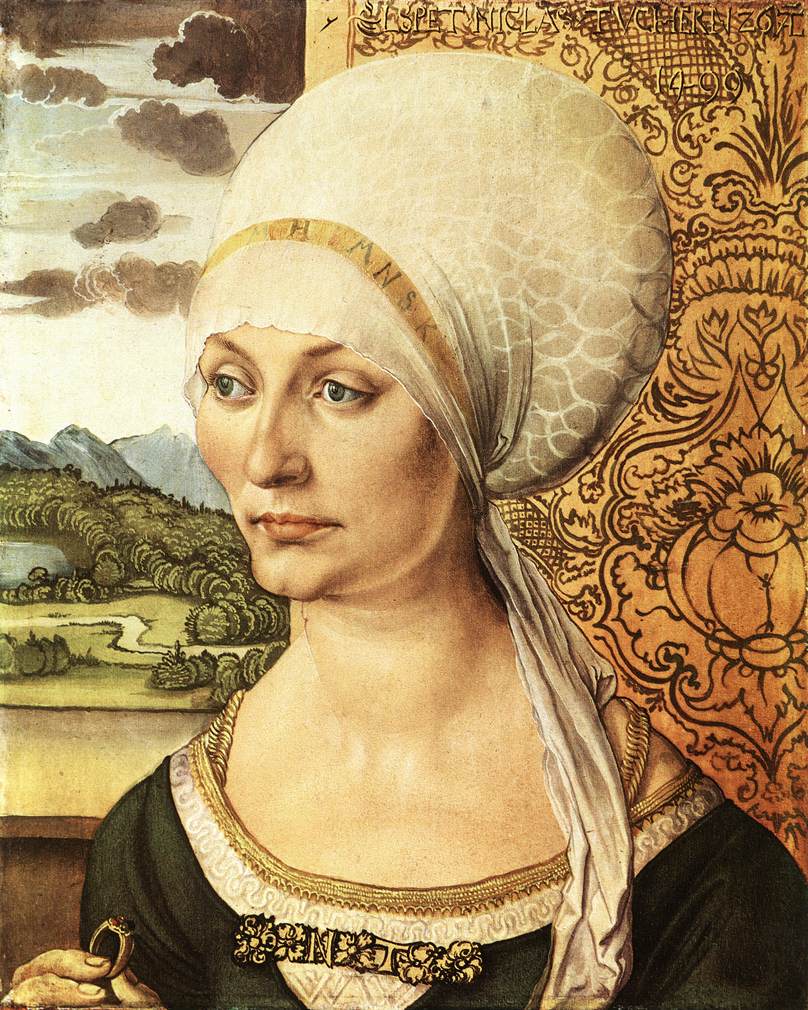
Portrait of Elsbeth Tucher
- MEDIUM
- Oil on wood, 29 x 23 cm
- TYPE
- Portrait
PALETTE
HOVER OR TAP A SWATCH FOR NAME, SHARE AND HEX. SAMPLED FROM THE IMAGE — INDICATIVE, NOT A PIGMENT ANALYSIS.
DEVELOPMENT BUILD — NOT FOR PUBLIC USE. CONTRIBUTE ON GITHUB.
03 — ARTWORK
PALETTE
HOVER OR TAP A SWATCH FOR NAME, SHARE AND HEX. SAMPLED FROM THE IMAGE — INDICATIVE, NOT A PIGMENT ANALYSIS.
COMMENTARY
UNDERLINED TERMS ARE DEFINED IN THE GLOSSARY.
Elsbeth Tucher (née Pusch) is portrayed against an ornate brocade hanging. At the top of the panelTerm in painting for a support of wood, metal, or other rigid substance, as distinct from canvas. Until the adoption of canvas in the 15th century nearly all the movable paintings of Europe were executed on wood, and even up to the beginning of the 17th century it is probable that as much painting was done on the one support as on the other. Painters who worked on a small scale often used copper panels (Elsheimer is a leading example), and in the colonial art of South America copper and tin and even lead and zinc were used. On a larger scale, slate has occasionally been used as a support, notably by Rubens for his altarpiece for Sta Maria in Vallicella (the Chiesa Nuova) in Rome; the picture he originally painted was said to reflect the light unpleasantly and slate was used for the replacement to produce a more matt finish. For wood panels the Italian masters of the Renaissance preferred white poplar, while oak was the most common wood used in northern Europe. Many other types were used, however; analysis of the contents of art galleries has yielded a long list, including beech, cedar, chestnut, fir, larch, linden, mahogany, olive, and walnut. In the 20th century cedar, teak, and dark walnut are favourites, and modern painters have also used plywood, fibre-board, and other synthetic materials as supports. is the inscription, `Elsbeth Niclas Tucher at 26 years 1499'. This is the right wing of a diptychin medieval art a picture, often an altarpiece, consisting of two folding wings without a fixed central area., but the left wing portraying her husband Niclas is missing. Elsbeth holds her wedding ring and the clasp of her blouse is formed with the initials NT, presumably a gift from her husband. The initials WW worked into her blouse and the mysterious letters MHIMNSK on the band over her voluminous headscarf have so far defied interpretation. Just visible on her shoulders is a gold necklace, evidence of her social standing. Above the parapet on the left of the panel is a landscape, with a wood-fringed lake leading to distant mountains, set beneath a stormy sky.
Dürer also painted matching portraits of the brother of Niclas, Hans Tucher and his wife Felicitas (née Rieter). In this diptych, it is the husband who holds a ring and his wife a flower.
@online{wga-r69d158ef843c15,
  author       = {Krén, Emil and Marx, Daniel},
  title        = {Portrait of Elsbeth Tucher by DÜRER, Albrecht},
  organization = {{Web Gallery of Art}},
  date         = {2026-09-13},
  url          = {https://beta.wga.hu/artists/drer-albrecht-r9b10ff91cb62c2/portrait-of-elsbeth-tucher-r69d158ef843c15},
  urldate      = {2026-09-13},
  langid       = {english}
}
ACCESSED 2026-09-13. REPLACE THE AUTHOR FIELD WITH THE COMMENTARY AUTHOR WHERE ONE IS NAMED.


