03 — ARTWORK
Self-Portrait at 26
- MEDIUM
- Oil on panel, 52 x 41 cm
- TYPE
- Portrait
PALETTE
HOVER OR TAP A SWATCH FOR NAME, SHARE AND HEX. SAMPLED FROM THE IMAGE — INDICATIVE, NOT A PIGMENT ANALYSIS.
DEVELOPMENT BUILD — NOT FOR PUBLIC USE. CONTRIBUTE ON GITHUB.
CURRENT LOCATION · Museo del Prado
03 — ARTWORK
PALETTE
HOVER OR TAP A SWATCH FOR NAME, SHARE AND HEX. SAMPLED FROM THE IMAGE — INDICATIVE, NOT A PIGMENT ANALYSIS.
COMMENTARY
UNDERLINED TERMS ARE DEFINED IN THE GLOSSARY.
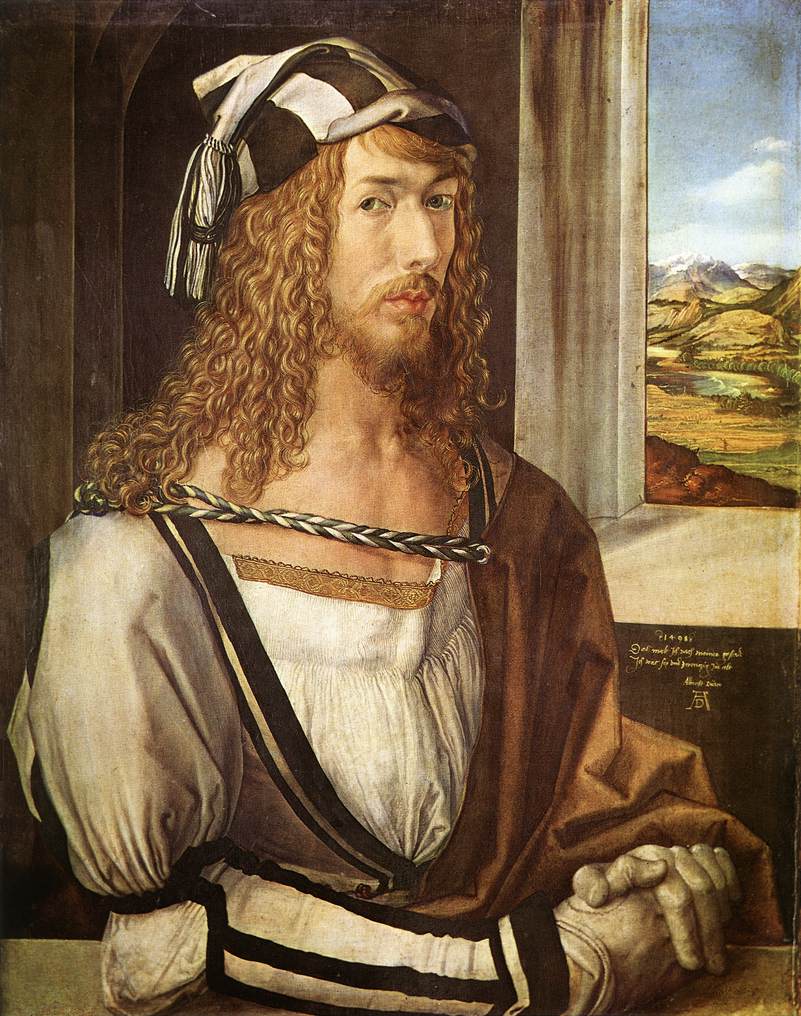
This self portraitThe Roman portrait bust survived in the form of life-sized reliquaries of saints, but it was in 15th century Florence that the individual features and character of a contemporary sitter were accurately recorded by sculptors such as Donatello, Desiderio da Settignano, Mino da Fiesole and the Rossellino. A similar degree of realism occurs in 15th century tomb sculpture. The equestrian portrait, based on antique statues such as the Marcus Aurelius monument (Rome, Campidoglio), was revived in the 14th century. Two examples in fresco are Simone Martini's Guidoriccio (c. 1328; Siena, Palazzo Pubblico) and the posthumous portrait of Sir John Hawkwood (1436; Florence, Cathedral) by Uccello, which gives the illusion of a 3-dimensional statue seen from below. The Venetian Republic ordered imposing monuments from Donatello (1447; Gattarnelata, Padua) and Verrocchio (14799; Colleoni, Venice), whilst other statesmen ordered their own images to be erected in public places, directly relating themselves to the military heroes of ancient Rome. Another form of political portraiture derived from antiquity was the commemorative portrait medal designed by artists such as Pisanello. The carved or painted profile portrait became popular in the 1450s. The realism of the clear, flattened image, painted under the influence of Flemish examples by the Pollaiuolo brothers, Piero della Francesca and Botticelli, was superseded by the three-quarter and frontal portrait, psychologically more complex, such as Leonardo's enigmatic Mona Lisa (Paris, Louvre) with her momentary smile or Andrea del Sarto's arresting Portrait of a Man (London, National Gallery). The 16th century portrait became generalized, Lotto's Andrea Odoni (1527; Royal Collection) being an idealized concept of a collector rather than an individual. Group portraits, decorating whole rooms, include the narrative scenes of the Gonzaga court painted by Mantegna (completed 1474; Mantua, Palazzo Ducale) and the elaborate schemes commissioned by the Farnese family in Rome from Vasari (1546; Palazzo della Cancelleria) and Salviati (after 1553; Palazzo Farnese). Portraits were also incorporated into religious narratives, as in Ghirlandaio's fresco cycle painted for Giovanni Tornabuoni in S. Maria Novella, Florence (1486-90). is dated 1498 and inscribed: `I have thus painted myself. I was 26 years old. Albrecht Dürer.' Since the artist turned 27 on the 21 May, the picture must date from the beginning of the year. The artist's pose is self confident, showing him standing upright and turning slightly to lean his right arm on a ledge. Dürer's figure fills the picture, with his hat almost touching the top. His face and neck glow from the light streaming into the room and his long curly hair is painstakingly depicted. Unlike his earlier self portrait, he now has a proper beard, which was then unusual among young men. Nine years later Dürer wrote an ironic poem in which he described himself as `the painter with the hairy beard'.
The artist's clothing is flamboyantstyle flamboyant (French), the last major style of French Gothic architecture, so called because of its highly elaborate "flame-like" tracery. It followed the Rayonnant.. His elegant jacket is edged with black and beneath this he wears a white, pleated shirt, embroidered along the neckline. His jaunty hat is striped, to match the jacket. Over his left shoulder hangs a light-brown cloak, tied around his neck with a twisted cord. He wears fine kid gloves.
Inside the room is a tall archway, partly framing Dürer's head, and to the right a window opens out onto an exquisite landscape. Green fields give way to a tree-ringed lake and beyond are snow-capped mountains, probably a reminder of Dürer's journey over the Alps three years earlier. Depicting a distant landscape, viewed through a window, was a device borrowed from Netherlandish portraiture.
The Germans still tended to consider the artist as a craftsman, as had been the conventional view during the Middle Ages. This was bitterly unacceptable to Dürer, whose second Self-Portrait (out of three) shows him as slender and aristocratic, a haughty and foppish youth, ringletted and impassive. His stylish and expensive costume indicates, like the dramatic mountain view through the window (implying wider horizons), that he considers himself no mere limited provincial. What Dürer insists on above all else is his dignity, and this was a quality that he allowed to others too.
This picture was acquired by Charles I of England and later bought by Philip IV of Spain.
@online{wga-r3420e34b30ebe9,
  author       = {Krén, Emil and Marx, Daniel},
  title        = {Self-Portrait at 26 by DÜRER, Albrecht},
  organization = {{Web Gallery of Art}},
  date         = {2026-09-13},
  url          = {https://beta.wga.hu/artists/drer-albrecht-r9b10ff91cb62c2/self-portrait-at-26-r3420e34b30ebe9},
  urldate      = {2026-09-13},
  langid       = {english}
}
ACCESSED 2026-09-13. REPLACE THE AUTHOR FIELD WITH THE COMMENTARY AUTHOR WHERE ONE IS NAMED.


