03 — ARTWORK
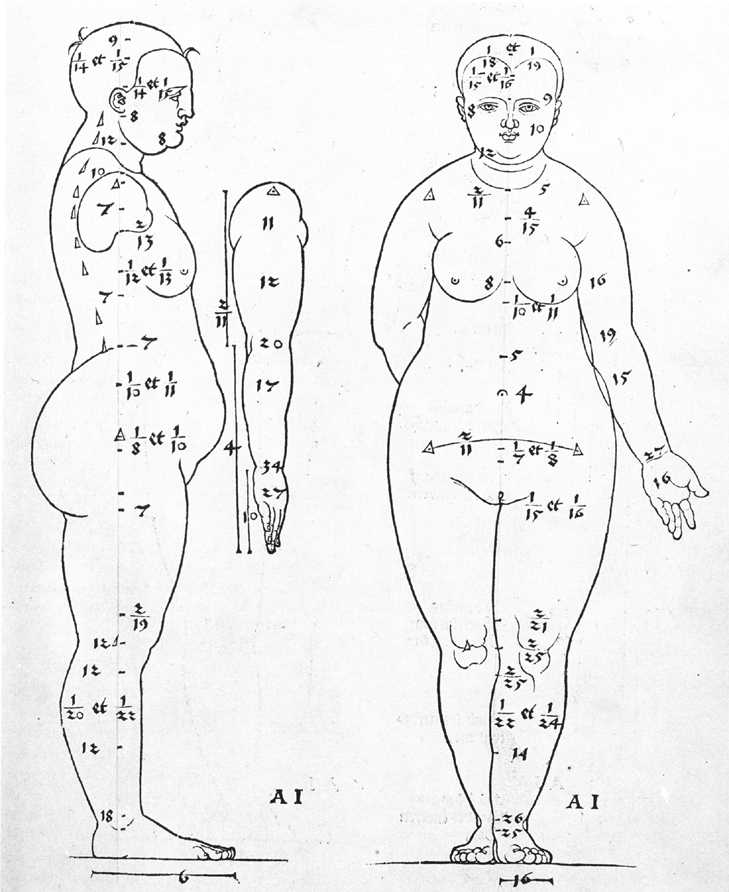
Side and frontal view of the female head type 7
- MEDIUM
- Woodcut
- TYPE
- Other
PALETTE
HOVER OR TAP A SWATCH FOR NAME, SHARE AND HEX. SAMPLED FROM THE IMAGE — INDICATIVE, NOT A PIGMENT ANALYSIS.
DEVELOPMENT BUILD — NOT FOR PUBLIC USE. CONTRIBUTE ON GITHUB.
CURRENT LOCATION · Staatsbibliothek (Bamberg)
03 — ARTWORK
PALETTE
HOVER OR TAP A SWATCH FOR NAME, SHARE AND HEX. SAMPLED FROM THE IMAGE — INDICATIVE, NOT A PIGMENT ANALYSIS.
COMMENTARY
UNDERLINED TERMS ARE DEFINED IN THE GLOSSARY.
During his final years Dürer endeavoured to support practice with theory. He had already prepared the first two volumes of his treatise on proportions before his journey to the Netherlands, and he continued working on them after his return. Due to the numerous geometrical drawings and illustrations needed to serve his didactic purposes, and the necessary study of classicalRelating to the culture of ancient Greece and Rome (classical Antiquity). The classical world played a profoundly important role in the Renaissance, with Italian scholars, writers, and artists seeing their own period as the rebirth (the "renaissance") of classical values after the Middle Ages. The classical world was considered the golden age for the arts, literature, philosophy, and politics. Concepts of the classical, however, changed greatly from one period to the next. Roman literature provided the starting point in the 14th century, scholars patiently finding, editing and translating a wide range of texts. In the 15th century Greek literature, philosophy and art - together with the close study of the remains of Roman buildings and sculptures-expanded the concept of the classical and ensured it remained a vital source of ideas and inspiration. sources, the completion of the work on proportions was delayed. Since his first stay in Venice, Dürer had worked on the theory of the ideal human proportions. Dürer linked the depiction of body types with differing proportions to the teaching of the four humours, and as such was the first to indicate the connection between build and character. The first volume dealt with basic geometrical terms such as the point and line, the second dealt with surfaces and bodies, and the third and fourth volumes were dedicated to both the ideal depiction of bodies and the construction of columns, letters and sundials. In the appendix, the reader, artist and craftsman can find a short treatise on perspectiveThe method of representing three-dimensional objects on a flat surface. Perspective gives a picture a sense of depth. The most important form of perspective in the Renaissance was linear perspective (first formulated by the architect Brunelleschi in the early 15th century), in which the real or suggested lines of objects converge on a vanishing point on the horizon, often in the middle of the composition (centralized perspective). The first artist to make a systematic use of linear perspective was Masaccio, and its principles were set out by the architect Alberti in a book published in 1436. The use of linear perspective had a profound effect on the development of Western art and remained unchallenged until the 20th century. and instructions for the use of drawing equipment. The treatise on proportions was published posthumously by Willibald Pirckheimer and Dürer's wife Agnes.
The picture shows an illustration from the Four Books on Human Proportions, Book I, published posthumously by Willibald Pirckheimer and Dürer's wife Agnes.
The insights regarding measure and numbers which Dürer had gained from his lifelong study of the ideal proportions of the human body was summarized in his Four Books on Human Proportions. The head was used as the comparative yardstick for measuring the other parts of the body.
@online{wga-ra26188404b638b,
  author       = {Krén, Emil and Marx, Daniel},
  title        = {Side and frontal view of the female head type 7 by DÜRER, Albrecht},
  organization = {{Web Gallery of Art}},
  date         = {2026-09-13},
  url          = {https://beta.wga.hu/artists/drer-albrecht-r9b10ff91cb62c2/side-and-frontal-view-of-the-female-head-type-7-ra26188404b638b},
  urldate      = {2026-09-13},
  langid       = {english}
}
ACCESSED 2026-09-13. REPLACE THE AUTHOR FIELD WITH THE COMMENTARY AUTHOR WHERE ONE IS NAMED.