03 — ARTWORK
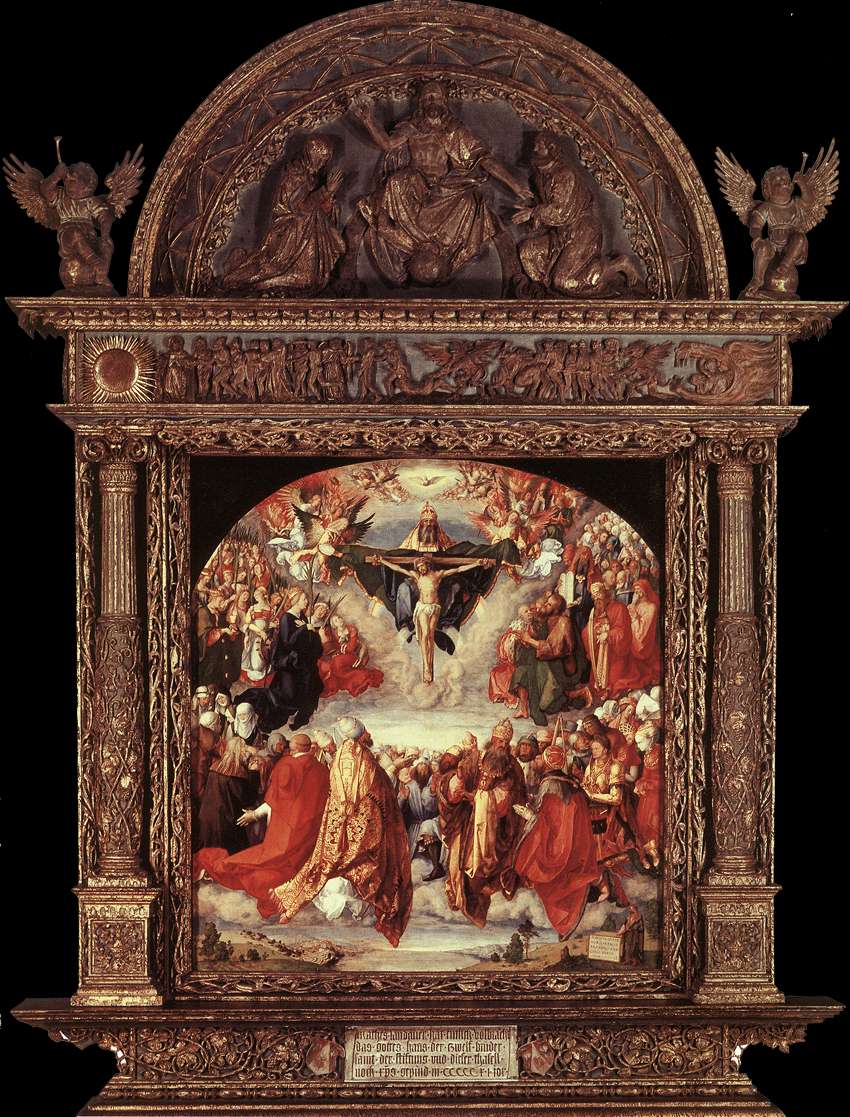
The Adoration of the Holy Trinity (Landauer Altar)
- MEDIUM
- Oil on lindenwood, 135 x 123,4 cm
- TYPE
- Religious
PALETTE
HOVER OR TAP A SWATCH FOR NAME, SHARE AND HEX. SAMPLED FROM THE IMAGE — INDICATIVE, NOT A PIGMENT ANALYSIS.
DEVELOPMENT BUILD — NOT FOR PUBLIC USE. CONTRIBUTE ON GITHUB.
CURRENT LOCATION · Kunsthistorisches Museum
03 — ARTWORK
PALETTE
HOVER OR TAP A SWATCH FOR NAME, SHARE AND HEX. SAMPLED FROM THE IMAGE — INDICATIVE, NOT A PIGMENT ANALYSIS.
COMMENTARY
UNDERLINED TERMS ARE DEFINED IN THE GLOSSARY.
This work was commissioned by the Nuremberg metal trader Matthäus Landauer. Also known as the Landauer AltarpieceA picture or sculpture that stands on or is set up behind an altar. The term reredos is used for an ornamental screen or partition, not directly attached to the altar table but affixed to the wall behind it. A diptych is an altarpiece consisting of two panels, a triptych one of three panels, and a polyptych one of four or more panels. From the 14th to 16th century, the altarpiece was one of the most important commissions in European art; it was through the altarpiece that some of the most decisive developments in painting and sculpture came about., it was ordered for the chapela small separate place for worship, either part of a large church or a separate building. of the Twelve-Brothers House, which he endowed for a dozen impoverished artisans.
In the centre of the painted panelTerm in painting for a support of wood, metal, or other rigid substance, as distinct from canvas. Until the adoption of canvas in the 15th century nearly all the movable paintings of Europe were executed on wood, and even up to the beginning of the 17th century it is probable that as much painting was done on the one support as on the other. Painters who worked on a small scale often used copper panels (Elsheimer is a leading example), and in the colonial art of South America copper and tin and even lead and zinc were used. On a larger scale, slate has occasionally been used as a support, notably by Rubens for his altarpiece for Sta Maria in Vallicella (the Chiesa Nuova) in Rome; the picture he originally painted was said to reflect the light unpleasantly and slate was used for the replacement to produce a more matt finish. For wood panels the Italian masters of the Renaissance preferred white poplar, while oak was the most common wood used in northern Europe. Many other types were used, however; analysis of the contents of art galleries has yielded a long list, including beech, cedar, chestnut, fir, larch, linden, mahogany, olive, and walnut. In the 20th century cedar, teak, and dark walnut are favourites, and modern painters have also used plywood, fibre-board, and other synthetic materials as supports. at the top is the Trinityin Christianity, the term used for the existence of one God in three persons: the Father, the Son and the Holy Spirit.. God the Father is shown as emperor, holding Christ on the Cross and surmounted by the dove of the Holy Ghost. Around the figure of God are two rings of angels. Below them, to the right, are Old Testament figures and, to the left, followers of Christ bearing palm branches. Nearer the basemolded foot of a pillar or column providing the transition from the plinth to the shaft. of the picture are the slightly larger figures of the living, led by the Pope (with a blue tiara) and the Emperor (with a golden crown). The grey-haired figure of Matthäus Landauer, the donora patron who commissioned a work of art for a church. Donors sometimes had their portraits included in the work they were donating as a sign of piety., is depicted on the left, being welcomed into the throng by the outstretched hand of a cardinal.
The landscape at the bottom of the panel stretches into the far distance. A lone figure stands on the land - the artist, who has depicted the earthly community being reunited with the realm of heaven. His hand rests on a panel which is inscribed: `Albrecht Dürer of Nuremberg made this 1511 years after the Virgin.'
Dürer also designed an ornate frame for the altarpiece. An early drawing for the frame and panel is dated 1508 and shows that they were a carefully designed ensembleA combining of several media grouped together to form a composite art work. Chapels were among the most notable Renaissance ensembles, sometimes combining panel painting, fresco, sculpture, and architecture.. The frame still survives in the Germanisches Nationalmuseum, Nuremberg, although unfortunately it has long been separated from the painting. (The frame shown in the reproduction is an exact replica of the original.) Made of carved and painted wood, the top of the frame has a sculpted depiction of the Last Judgment, with God enthroned and surrounded by the kneeling figures of the Virgin and John the Baptist. An inscription on the base of the frame records: `Matthäus Landauer has finally completed the house of worship of the Twelve Bretheren including the donation of this panel. After Christ's birth, the year 1511.' Dürer's workshop also designed stained-glass windows for the Twelve-Brothers Chapel, but these were removed in 1810 and were destroyed in Berlin during the Second World War.
@online{wga-r85e1d9ad77d8a3,
  author       = {Krén, Emil and Marx, Daniel},
  title        = {The Adoration of the Holy Trinity (Landauer Altar) by DÜRER, Albrecht},
  organization = {{Web Gallery of Art}},
  date         = {2026-09-13},
  url          = {https://beta.wga.hu/artists/drer-albrecht-r9b10ff91cb62c2/the-adoration-of-the-holy-trinity-landauer-altar-r85e1d9ad77d8a3},
  urldate      = {2026-09-13},
  langid       = {english}
}
ACCESSED 2026-09-13. REPLACE THE AUTHOR FIELD WITH THE COMMENTARY AUTHOR WHERE ONE IS NAMED.


