03 — ARTWORK
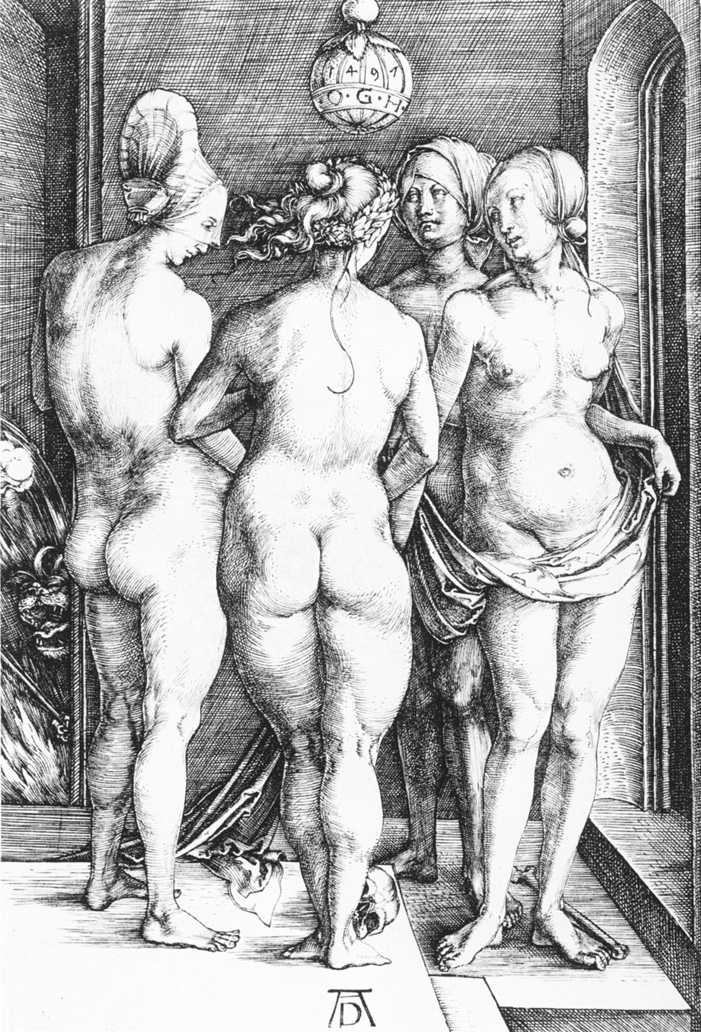
The Four Witches
- MEDIUM
- Engraving, 190 x 131 mm
- TYPE
- Mythological
PALETTE
HOVER OR TAP A SWATCH FOR NAME, SHARE AND HEX. SAMPLED FROM THE IMAGE — INDICATIVE, NOT A PIGMENT ANALYSIS.
DEVELOPMENT BUILD — NOT FOR PUBLIC USE. CONTRIBUTE ON GITHUB.
CURRENT LOCATION · Germanisches Nationalmuseum
03 — ARTWORK
PALETTE
HOVER OR TAP A SWATCH FOR NAME, SHARE AND HEX. SAMPLED FROM THE IMAGE — INDICATIVE, NOT A PIGMENT ANALYSIS.
COMMENTARY
UNDERLINED TERMS ARE DEFINED IN THE GLOSSARY.
This EngravingA print made from a metal plate that has had a design cut into it with a sharp point. Ink is smeared over the plate and then wiped off, the ink remaining in the etched lines being transferred when the plate is pressed very firmly onto a sheet of paper. is an example of the ambiguous meaning of those Dürer's works that combine the heathen and classicalRelating to the culture of ancient Greece and Rome (classical Antiquity). The classical world played a profoundly important role in the Renaissance, with Italian scholars, writers, and artists seeing their own period as the rebirth (the "renaissance") of classical values after the Middle Ages. The classical world was considered the golden age for the arts, literature, philosophy, and politics. Concepts of the classical, however, changed greatly from one period to the next. Roman literature provided the starting point in the 14th century, scholars patiently finding, editing and translating a wide range of texts. In the 15th century Greek literature, philosophy and art - together with the close study of the remains of Roman buildings and sculptures-expanded the concept of the classical and ensured it remained a vital source of ideas and inspiration. with the Renaissance ideals of thought. In a small confined space; four female nudes are standing together conspiratorially. The floor beneath their feet has steps at different levels. The wall opens up to the left, and the Devil in the shape of a horned monster is peering out. The door opening to the right is shown by the skull and bones lying on the floor to be the gateway to Death. The group of women, which is derived formally from a classical marbleloosely applied to any hard limestone that can be sawn into thin slabs and will take a good polish so that it is suitable for decorative work; more strictly, it refers to metamorphosed limestones whose structure has been recrystallized by heat or pressure. Marbles are widely disseminated and occur in a great variety of colours and patterns, but certain types have been particularly prized by sculptors. The most famous of Greek white marbles in the ancient world was the close-grained Pentelic, which was quarried at Mount Pentelicon in Attica. The Elgin Marbles are carved in Pentelic. Widely used also were the somewhat coarser-grained translucent white marbles from the Aegean islands of Paros and Naxos. Parian marble was used for the celebrated Mausoleum at Halicarnassus. The pure white Carrara marble, quarried at Massa, Carrara, and Pietra Santa in Tuscany from the 3rd century BC, is the most famous of all sculptors' stones. It was used for the Apollo Belvedere, and was much favoured in the Renaissance, particularly by Michelangelo, who often visited the quarries to select material for his work. Neoclassical sculptors also favoured Carrara marble because of its ability to take a smooth, sleek surface, but it can look rather 'dead' compared with some of the finest Greek marbles. group of the Three Graces, have been interpreted in different ways, amongst others as the three goddesses who judged Paris together with the goddess of Discord, or as four witches.
This is the only one of Dürer's engravings before 1503 bearing a date. For this reason it has been presumed to denote an actual event. The devil lurking in the background and the skull and bone on the floor preclude the suggestion that the Three Graces or Discord and the Three Fates are pictured in this engraving. It seems more likely that the girl wearing the wreath is being initiated by three matrons or witches. In 1484, Pope Innocent VIII had issued his encyclical Summis Desiderantes, which described witchcraft in vivid terms, particularly the existence of devils taking the shape of women. Men who had intercourse with these she-devils became afflicted with sickness, pains and impotence. In 1486 in Cologne, Jacob Sprenger had published his vicious book Malleus maleficarum (Hammer for witches), a guide for witch-hunters; women in particular, including midwives and even nuns, were termed susceptible to devilish deeds. This book went through at least sixteen editions in Germany alone, eleven in France and six in England, the last in 1669. Dürer's prints may well be connected with one of these editions.
The letters "OGH" have still not found a satisfactory explanation. They have been variously interpreted to mean "Oh Gott hüte" (Oh God Forbid), "Obsidium Generis Humani" (Ambush against the human race) or Ordo Graciarum Horarumque" (Order of the Graces and Hours). The fruit is a pomegranate, a symbol of fertility.
@online{wga-rb4aac422c14a86,
  author       = {Krén, Emil and Marx, Daniel},
  title        = {The Four Witches by DÜRER, Albrecht},
  organization = {{Web Gallery of Art}},
  date         = {2026-09-13},
  url          = {https://beta.wga.hu/artists/drer-albrecht-r9b10ff91cb62c2/the-four-witches-rb4aac422c14a86},
  urldate      = {2026-09-13},
  langid       = {english}
}
ACCESSED 2026-09-13. REPLACE THE AUTHOR FIELD WITH THE COMMENTARY AUTHOR WHERE ONE IS NAMED.


