03 — ARTWORK
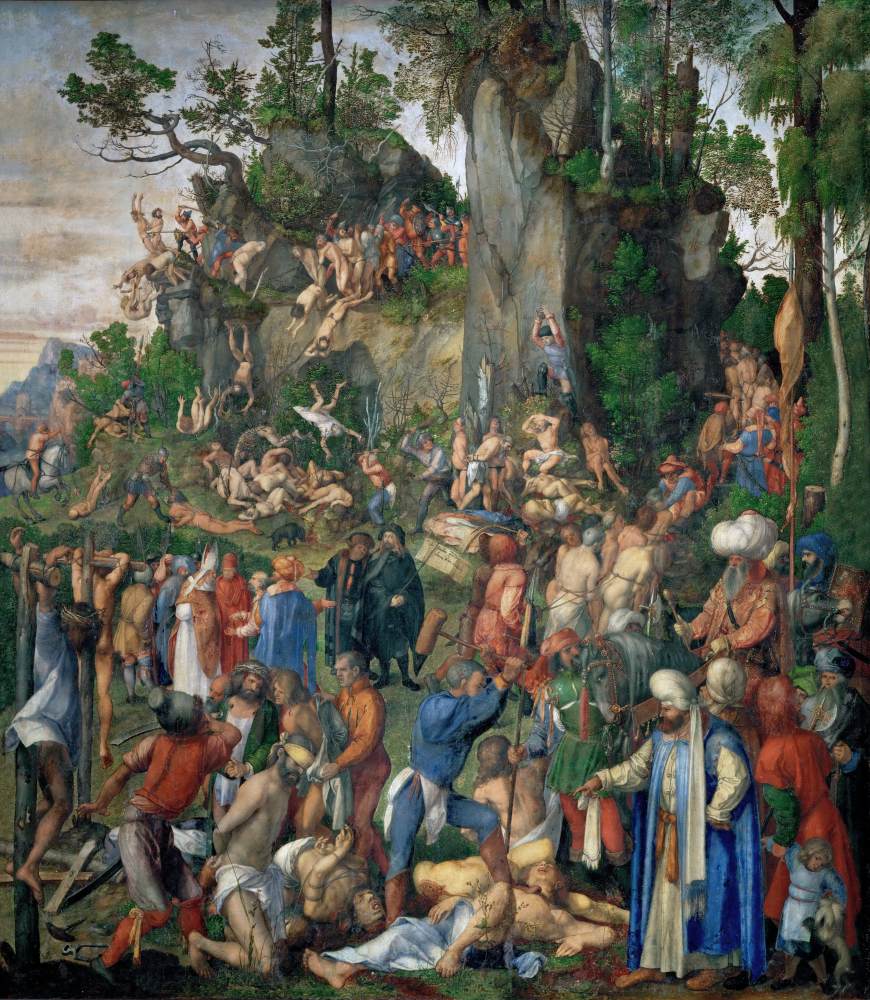
The Martyrdom of the Ten Thousand
- MEDIUM
- Oil on canvas transferred from panel, 99 x 87 cm
- TYPE
- Religious
PALETTE
HOVER OR TAP A SWATCH FOR NAME, SHARE AND HEX. SAMPLED FROM THE IMAGE — INDICATIVE, NOT A PIGMENT ANALYSIS.
DEVELOPMENT BUILD — NOT FOR PUBLIC USE. CONTRIBUTE ON GITHUB.
CURRENT LOCATION · Kunsthistorisches Museum
03 — ARTWORK
PALETTE
HOVER OR TAP A SWATCH FOR NAME, SHARE AND HEX. SAMPLED FROM THE IMAGE — INDICATIVE, NOT A PIGMENT ANALYSIS.
COMMENTARY
UNDERLINED TERMS ARE DEFINED IN THE GLOSSARY.
The altarpieceA picture or sculpture that stands on or is set up behind an altar. The term reredos is used for an ornamental screen or partition, not directly attached to the altar table but affixed to the wall behind it. A diptych is an altarpiece consisting of two panels, a triptych one of three panels, and a polyptych one of four or more panels. From the 14th to 16th century, the altarpiece was one of the most important commissions in European art; it was through the altarpiece that some of the most decisive developments in painting and sculpture came about. depicts the legend of the ten thousand Christians who were martyred on Mount Ararat, in a massacre perpetrated by the Persian King Saporat on the command of the Roman Emperors Hadrian and Antonius. Dürer had depicted this massacre a decade earlier in a woodcutA print made from a wood block. The design is drawn on a smooth block of wood and then cut out, leaving the design standing up in relief the design to be printed. The person who carved the woodcut often worked to a design by another artist.. The painting was commissioned by Frederick the Wise, who owned relics from the massacre, and it was placed in the relica part of the body of a saint, or some item connected with a saint, the object of particular veneration. chamber of his palace church in Wittenberg. Although Dürer had never before tackled a painting with so many figures, he succeeded in integrating them into a flowing composition using vibrant colour.
Dürer's gruesome scene depicts scores of Christians meeting a violent death in a rocky landscape, providing a veritable compendium of tortures and killings. The oriental potentate in the blue cloak and turban who is directing the action in the lower right corner of the picture, would in Dürer's time have been perceived as a reference to the threat of Turkish invasion, because of the seizure of Constantinople in 1453. In the centre of the painting is the rather incongruous figure of the artist, holding a staff with the inscription: 'This work was done in the year 1508 by Albrecht Dürer, German.' The man walking with him through this scene of carnage is probably the scholar Konrad Celtis, a friend of Dürer's who had died just before the painting was completed.
@online{wga-r5dcd9f05084119,
  author       = {Krén, Emil and Marx, Daniel},
  title        = {The Martyrdom of the Ten Thousand by DÜRER, Albrecht},
  organization = {{Web Gallery of Art}},
  date         = {2026-09-14},
  url          = {https://beta.wga.hu/artists/drer-albrecht-r9b10ff91cb62c2/the-martyrdom-of-the-ten-thousand-r5dcd9f05084119},
  urldate      = {2026-09-14},
  langid       = {english}
}
ACCESSED 2026-09-14. REPLACE THE AUTHOR FIELD WITH THE COMMENTARY AUTHOR WHERE ONE IS NAMED.


