03 — ARTWORK
The Sea Monster
- MEDIUM
- Engraving, 246 x 147 mm
- TYPE
- Other
PALETTE
HOVER OR TAP A SWATCH FOR NAME, SHARE AND HEX. SAMPLED FROM THE IMAGE — INDICATIVE, NOT A PIGMENT ANALYSIS.
DEVELOPMENT BUILD — NOT FOR PUBLIC USE. CONTRIBUTE ON GITHUB.
CURRENT LOCATION · Metropolitan Museum of Art
03 — ARTWORK
PALETTE
HOVER OR TAP A SWATCH FOR NAME, SHARE AND HEX. SAMPLED FROM THE IMAGE — INDICATIVE, NOT A PIGMENT ANALYSIS.
COMMENTARY
UNDERLINED TERMS ARE DEFINED IN THE GLOSSARY.
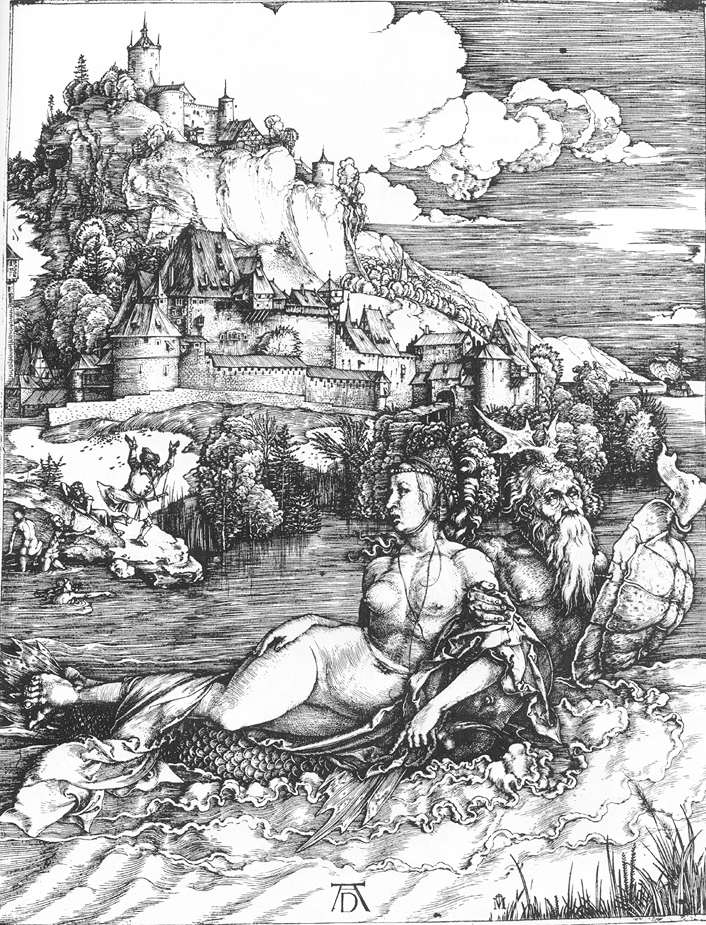
The Sea Monster c. 1498 EngravingA print made from a metal plate that has had a design cut into it with a sharp point. Ink is smeared over the plate and then wiped off, the ink remaining in the etched lines being transferred when the plate is pressed very firmly onto a sheet of paper., 246 x 147 mm Metropolitan Museum of Art, New York
This print is mentioned by Dürer in his diary under the date November 24, 1520: "At Antwerp I sold two `Adam and Eve,' one `Sea Monster', one `St Jerome,' one `Knight,' etc." It has been variously described as Abduction of Amymone, Glaucus and Scylla, Nessus and Deianira, The Rape of Theolinda and Perimele and Achelous. The suggestion that the subject is probably a folk tale of the Adriatic coast of Italy seems the most plausible.
Dürer loved a good tale, especially if it included weird elements. It has been suggested that Dürer heard some current story about the rape of a young girl by a monster who came out of the sea. Fascinated by various elements suggested by ancient tales, he mingled them in this scene.
The magnificent, shapely young woman who had apparently been bathing with her friends (who now seek shelter on the far bank) is being carried off by a strange, bearded creature, half human, half fish. She does not seem too reluctant to leave family and friends; nor does the sea monster appear evil in fact, he hardly seems to notice his voluptuous cargo. The rest of the scene shows nature at its most serene. Elaborate buildings nestle on the hillside or are perched on the heights. In the foreground Dürer creates an arabesque of small waves, and completes it with a charming rendering of grasses growing on the shore.
The female figure is the core of the composition. The maritime abduction simply serves to legitimise her nudity. Surely based on an Italian model. The surrounding fairy tale was obviously tailored to serve Dürer's purpose. The audacious, diagonally descending line of the background is unprecedented. No other engraving of this time has the decorative beauty of this one or the effectiveness of its black and white. Like so many of Dürer's works, this picture, once viewed, is not readily forgotten.
@online{wga-reb18d4558b1253,
  author       = {Krén, Emil and Marx, Daniel},
  title        = {The Sea Monster by DÜRER, Albrecht},
  organization = {{Web Gallery of Art}},
  date         = {2026-09-14},
  url          = {https://beta.wga.hu/artists/drer-albrecht-r9b10ff91cb62c2/the-sea-monster-reb18d4558b1253},
  urldate      = {2026-09-14},
  langid       = {english}
}
ACCESSED 2026-09-14. REPLACE THE AUTHOR FIELD WITH THE COMMENTARY AUTHOR WHERE ONE IS NAMED.


