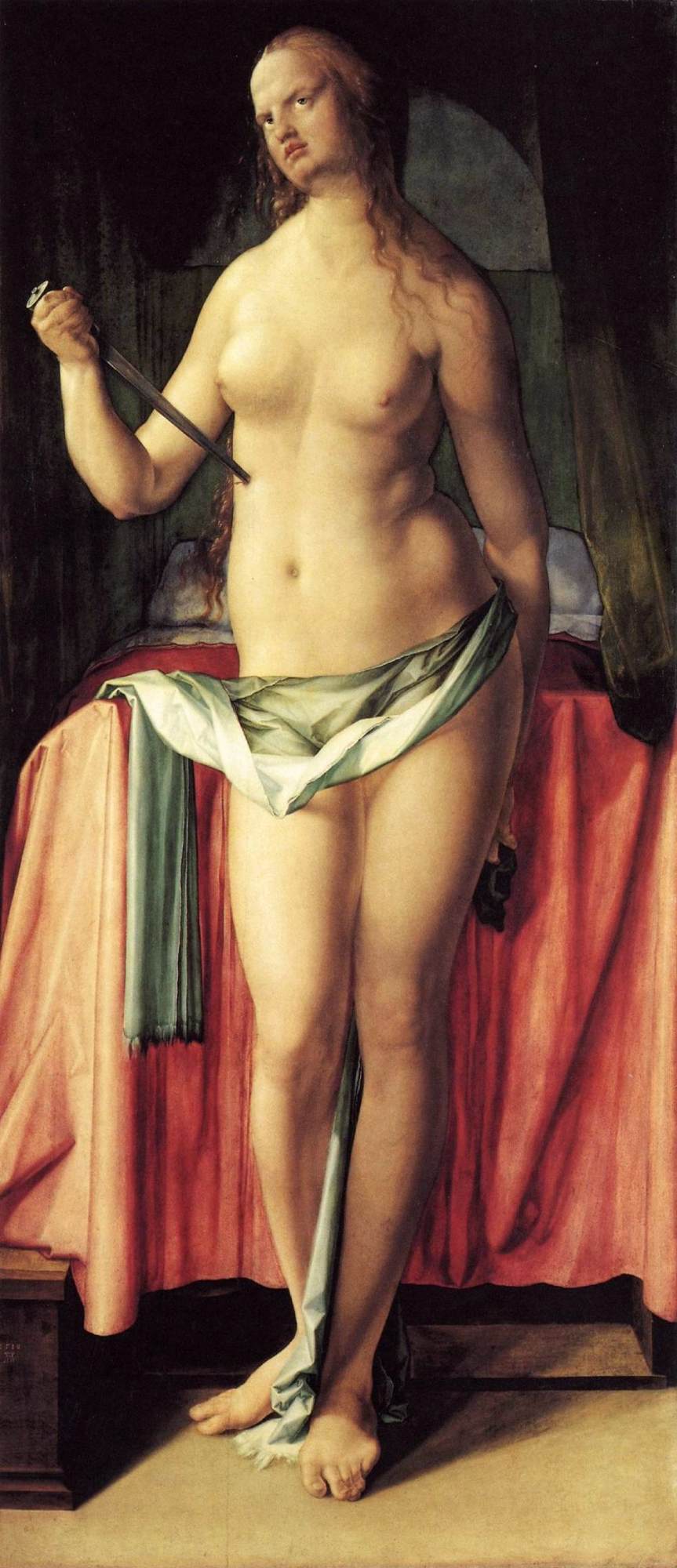
03 — ARTWORK
The Suicide of Lucretia
- MEDIUM
- Oil on lime panel, 168 x 75 cm
- TYPE
- Mythological
PALETTE
HOVER OR TAP A SWATCH FOR NAME, SHARE AND HEX. SAMPLED FROM THE IMAGE — INDICATIVE, NOT A PIGMENT ANALYSIS.
DEVELOPMENT BUILD — NOT FOR PUBLIC USE. CONTRIBUTE ON GITHUB.
CURRENT LOCATION · Alte Pinakothek
03 — ARTWORK
PALETTE
HOVER OR TAP A SWATCH FOR NAME, SHARE AND HEX. SAMPLED FROM THE IMAGE — INDICATIVE, NOT A PIGMENT ANALYSIS.
COMMENTARY
UNDERLINED TERMS ARE DEFINED IN THE GLOSSARY.
This panelTerm in painting for a support of wood, metal, or other rigid substance, as distinct from canvas. Until the adoption of canvas in the 15th century nearly all the movable paintings of Europe were executed on wood, and even up to the beginning of the 17th century it is probable that as much painting was done on the one support as on the other. Painters who worked on a small scale often used copper panels (Elsheimer is a leading example), and in the colonial art of South America copper and tin and even lead and zinc were used. On a larger scale, slate has occasionally been used as a support, notably by Rubens for his altarpiece for Sta Maria in Vallicella (the Chiesa Nuova) in Rome; the picture he originally painted was said to reflect the light unpleasantly and slate was used for the replacement to produce a more matt finish. For wood panels the Italian masters of the Renaissance preferred white poplar, while oak was the most common wood used in northern Europe. Many other types were used, however; analysis of the contents of art galleries has yielded a long list, including beech, cedar, chestnut, fir, larch, linden, mahogany, olive, and walnut. In the 20th century cedar, teak, and dark walnut are favourites, and modern painters have also used plywood, fibre-board, and other synthetic materials as supports. is mentioned in the inventory, dated 1598, of the Kunstkammer of Munich. The cloth around the hips was presumably expanded upward around 1600. The opinion that the Lucretia, all things considered, was "Dürer's most unpopular work," is undoubtedly widely shared.
Because of many discrepancies and discordances in the proportions and in the expression of the figure, Anzelewsky defines it as "a parody rather than an exaltation of the classicalRelating to the culture of ancient Greece and Rome (classical Antiquity). The classical world played a profoundly important role in the Renaissance, with Italian scholars, writers, and artists seeing their own period as the rebirth (the "renaissance") of classical values after the Middle Ages. The classical world was considered the golden age for the arts, literature, philosophy, and politics. Concepts of the classical, however, changed greatly from one period to the next. Roman literature provided the starting point in the 14th century, scholars patiently finding, editing and translating a wide range of texts. In the 15th century Greek literature, philosophy and art - together with the close study of the remains of Roman buildings and sculptures-expanded the concept of the classical and ensured it remained a vital source of ideas and inspiration. feminine figure." The theme takes its origin from a Roman story that narrates how Lucretia, the virtuous wife of Lucius Tarquinius Collatinus, is dishonoured by Sextus, son of Tarquinius the Superb. She then takes her own life out of shame.
The Lucretia of Dürer's painting does not pierce her heart. The artist thus follows one tradition, spread by Italian painters like Francesco Francia and adopted before him by Lucas Cranach as well. But all these represented the woman in a three-quarter profile, and they never set her in her own bedroom. The blood spouting from the wound is rather slight and does not stain the bridal bed, which remains neat and clean and undisturbed. This certainly indicates that the insult suffered is only exterior and has not contaminated the intimate purity of the chaste matron. There is one markedly commonplace and bourgeois detail in the scene, which must create the sense of a heroic-pathetic atmosphere: the presence of a night vase under the bed. The brush strokes are extraordinarily fine; the colours used for the drapes and the fabrics are predominantly various shades of red, blue, and green. Dürer made use of drawings that go back to 1508 for this painting.
@online{wga-rd2442724df47c1,
  author       = {Krén, Emil and Marx, Daniel},
  title        = {The Suicide of Lucretia by DÜRER, Albrecht},
  organization = {{Web Gallery of Art}},
  date         = {2026-09-13},
  url          = {https://beta.wga.hu/artists/drer-albrecht-r9b10ff91cb62c2/the-suicide-of-lucretia-rd2442724df47c1},
  urldate      = {2026-09-13},
  langid       = {english}
}
ACCESSED 2026-09-13. REPLACE THE AUTHOR FIELD WITH THE COMMENTARY AUTHOR WHERE ONE IS NAMED.