03 — ARTWORK
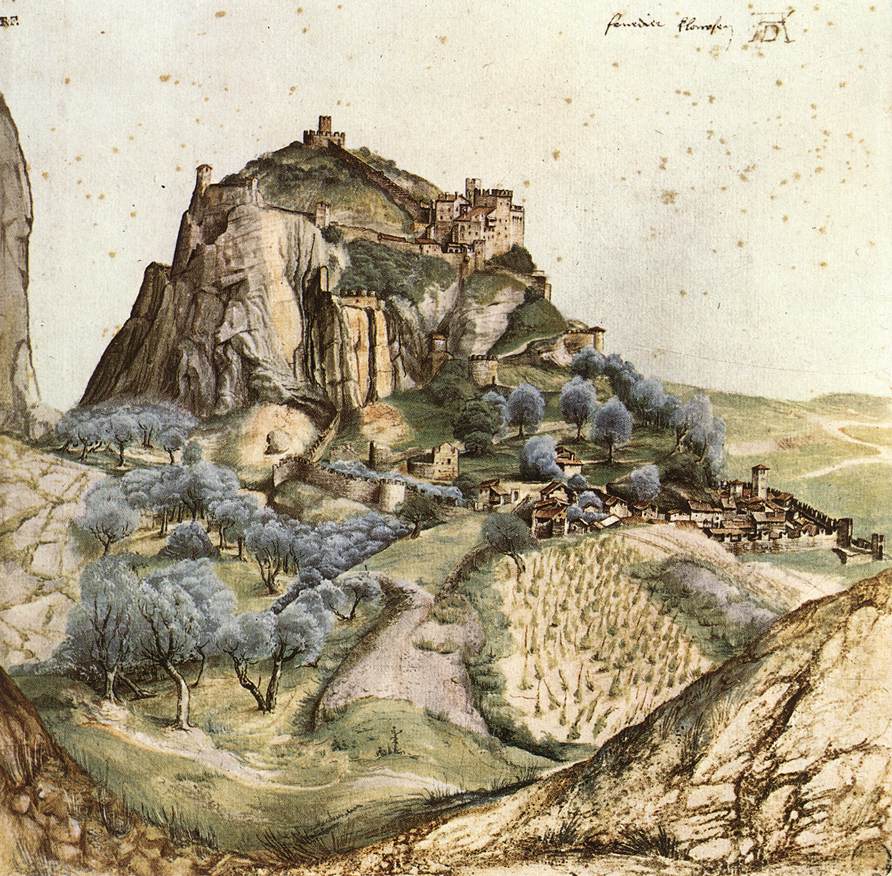
View of Arco
- MEDIUM
- Watercolour and gouache on paper, 221 x 221 mm
- TYPE
- Landscape
PALETTE
HOVER OR TAP A SWATCH FOR NAME, SHARE AND HEX. SAMPLED FROM THE IMAGE — INDICATIVE, NOT A PIGMENT ANALYSIS.
DEVELOPMENT BUILD — NOT FOR PUBLIC USE. CONTRIBUTE ON GITHUB.
03 — ARTWORK
PALETTE
HOVER OR TAP A SWATCH FOR NAME, SHARE AND HEX. SAMPLED FROM THE IMAGE — INDICATIVE, NOT A PIGMENT ANALYSIS.
COMMENTARY
UNDERLINED TERMS ARE DEFINED IN THE GLOSSARY.
The Italian town of Arco nestles below a dramatic hilltop castle, near the northern shore of Lake Garda. This watercolourPigment ground in gum, usually gum arabic, and applied with brush and water to a painting surface, usually paper; the term also denotes a work of art executed in this medium. The pigment is ordinarily transparent but can be made opaque by mixing with a whiting and in this form is known as body colour, or gouache; it can also be mixed with casein, a phosphoprotein of milk. Watercolour compares in range and variety with any other painting method. Transparent watercolour allows for a freshness and luminosity in its washes and for a deft calligraphic brushwork that makes it a most alluring medium. There is one basic difference between transparent watercolour and all other heavy painting mediums - its transparency. The oil painter can paint one opaque colour over another until he has achieved his desired result. The whites are created with opaque white. The watercolourist's approach is the opposite. In essence, instead of building up he leaves out. The white paper creates the whites. The darkest accents may be placed on the paper with the pigment as it comes out of the tube or with very little water mixed with it. Otherwise the colours are diluted with water. The more water in the wash, the more the paper affects the colours; for example, vermilion, a warm red, will gradually turn into a cool pink as it is thinned with more water. The dry-brush technique - the use of the brush containing pigment but little water, dragged over the rough surface of the paper - creates various granular effects similar to those of crayon drawing. Whole compositions can be made in this way. This technique also may be used over dull washes to enliven them., inscribed `Venetian Outpost', was done on Dürer's return journey from Venice in 1495 and the vegetation suggests it is the late spring. Arco lies six miles west of the main route over the Alps, which runs north from Verona and over the Brenner Pass to Innsbruck.
Close to the sandy foreground is an olive grove and a vineyard. Beyond the vineyard, to the right, lies the walled town of Arco whose fortifications snake up the steep hillside to the twelfth-century castle. view of Arco is a very carefully arranged composition, created at the expense of a certain degree of topographical truth. The narrow section of sheer rock face on the far left of the composition could not have been seen from the spot where the view was painted. Dürer also omitted the mountains behind the fortified hill to increase the drama of the setting. The painting's delicate colours - greens, browns and greys - make it one of the artist's most successful watercolours.
One of the curiosities of View of Arco is the hidden image of a scowling man which can be seen on the left side of the hill. Running almost the entire height of the cliffs, the profile of the man's face looks leftwards and his pointed nose is particularly prominent. The rocks which compose his face are slightly lighter in tone than the surrounding cliffs, emphasizing the shape. Although initially it may be difficult to spot the hidden face, once seen it is unmistakable.
@online{wga-r17134d636706e1,
  author       = {Krén, Emil and Marx, Daniel},
  title        = {View of Arco by DÜRER, Albrecht},
  organization = {{Web Gallery of Art}},
  date         = {2026-09-13},
  url          = {https://beta.wga.hu/artists/drer-albrecht-r9b10ff91cb62c2/view-of-arco-r17134d636706e1},
  urldate      = {2026-09-13},
  langid       = {english}
}
ACCESSED 2026-09-13. REPLACE THE AUTHOR FIELD WITH THE COMMENTARY AUTHOR WHERE ONE IS NAMED.


