03 — ARTWORK
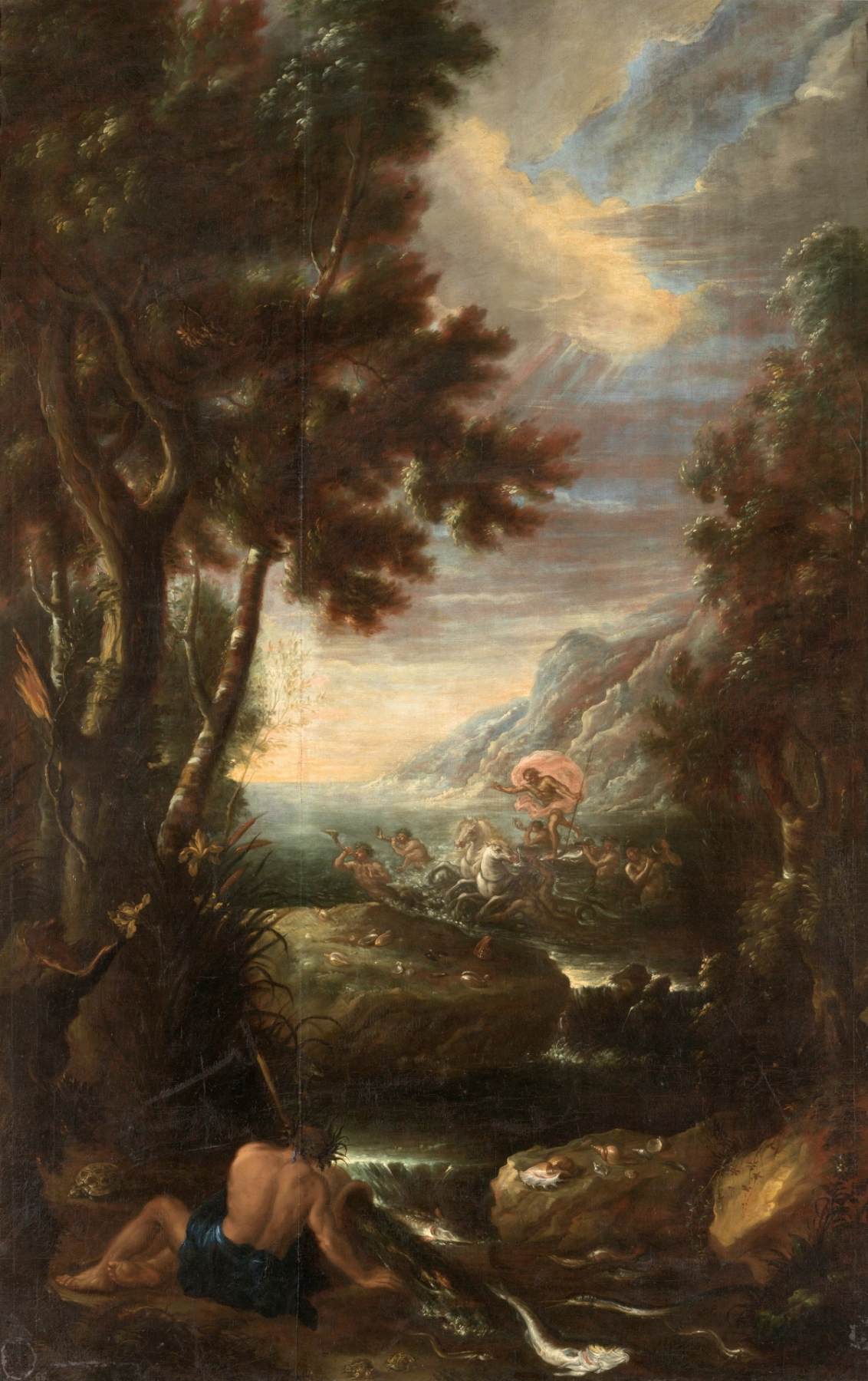
Allegory of Water
EZQUERRA, Jerónimo Antonio · 1700 →
- MEDIUM
- Oil on canvas, 248 x 160 cm
- TYPE
- Mythological
PALETTE
HOVER OR TAP A SWATCH FOR NAME, SHARE AND HEX. SAMPLED FROM THE IMAGE — INDICATIVE, NOT A PIGMENT ANALYSIS.
DEVELOPMENT BUILD — NOT FOR PUBLIC USE. CONTRIBUTE ON GITHUB.
CURRENT LOCATION · Museo del Prado
03 — ARTWORK
EZQUERRA, Jerónimo Antonio · 1700 →
PALETTE
HOVER OR TAP A SWATCH FOR NAME, SHARE AND HEX. SAMPLED FROM THE IMAGE — INDICATIVE, NOT A PIGMENT ANALYSIS.
COMMENTARY
UNDERLINED TERMS ARE DEFINED IN THE GLOSSARY.
This painting belongs to the series The Four Elements painted in the early eighteenth century for the Buen Retiro Palace in Madrid. The series consists of Air (by Palomino), Water (by Ezquerra), Earth (by Vaccaro) and Fire (by Palomino).
This wooded landscape with the ocean in the background is the setting for a group of maritime allegories. In the foreground, a male figure next to some rapids personifies one of the great rivers that exist in Nature, as was the customary representation during the ClassicalRelating to the culture of ancient Greece and Rome (classical Antiquity). The classical world played a profoundly important role in the Renaissance, with Italian scholars, writers, and artists seeing their own period as the rebirth (the "renaissance") of classical values after the Middle Ages. The classical world was considered the golden age for the arts, literature, philosophy, and politics. Concepts of the classical, however, changed greatly from one period to the next. Roman literature provided the starting point in the 14th century, scholars patiently finding, editing and translating a wide range of texts. In the 15th century Greek literature, philosophy and art - together with the close study of the remains of Roman buildings and sculptures-expanded the concept of the classical and ensured it remained a vital source of ideas and inspiration. period. Various elements and animals related to water, such as turtles and seashells, are visible beside him. In the background, Neptune, king of the sea, rides a carriage pulled by sea horses and lead by tritons blowing their concha semi-circular apse, usually surmounted by a half-dome. shells. He carries his traditional trident. This completes the symbolic view of all waters, both sweet and salty, from rivers and seas.
This painting clearly shows how Ezquerra's style was influenced by the Venetians, especially in the fluid technique and intense colors, which he learned by studying paintings from that Italian school in the Spanish Royal Collection.
@online{wga-r3d401d541bf1bf,
  author       = {Krén, Emil and Marx, Daniel},
  title        = {Allegory of Water by EZQUERRA, Jerónimo Antonio},
  organization = {{Web Gallery of Art}},
  date         = {2026-09-14},
  url          = {https://beta.wga.hu/artists/ezquerra-jernimo-antonio-r37f17636efb65a/allegory-of-water-r3d401d541bf1bf},
  urldate      = {2026-09-14},
  langid       = {english}
}
ACCESSED 2026-09-14. REPLACE THE AUTHOR FIELD WITH THE COMMENTARY AUTHOR WHERE ONE IS NAMED.


