03 — ARTWORK
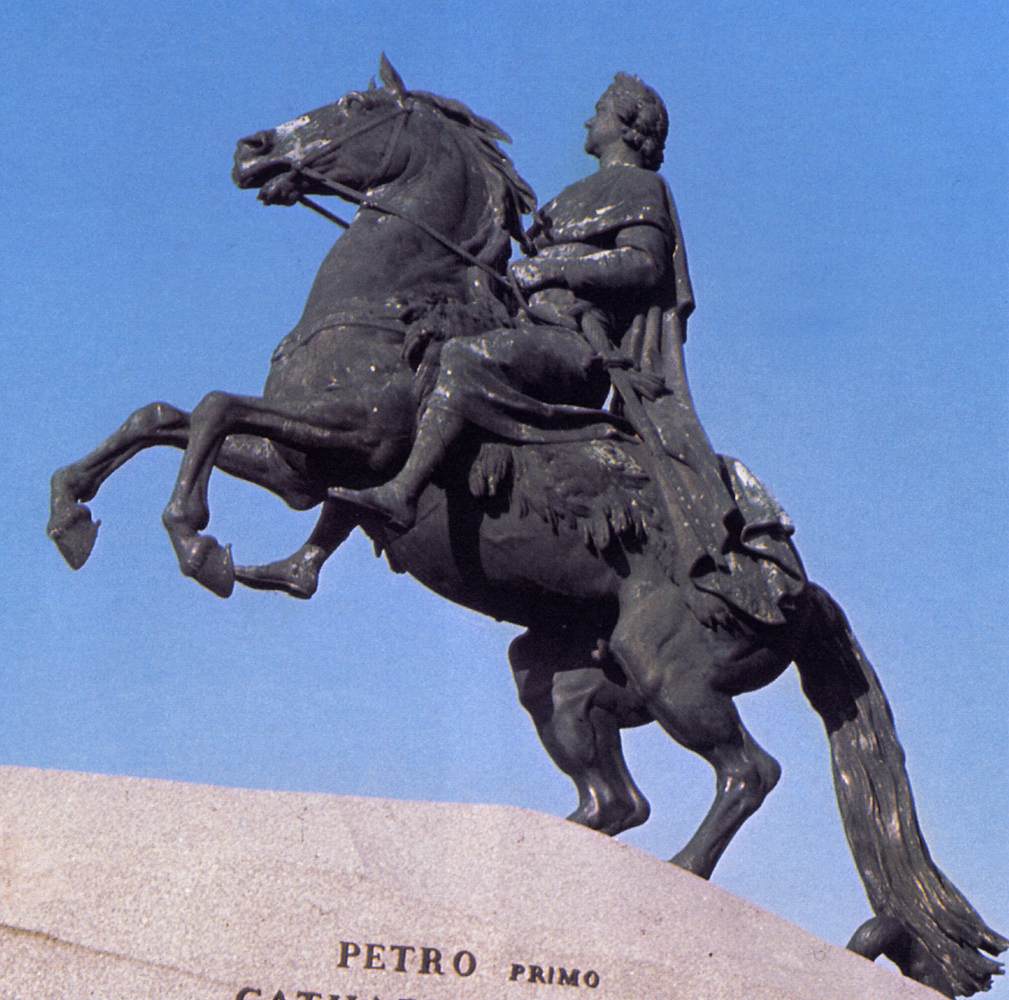
Monument to Peter the Great
FALCONET, Étienne-Maurice · 1777 →
- MEDIUM
- Bronze
- TYPE
- Portrait
PALETTE
HOVER OR TAP A SWATCH FOR NAME, SHARE AND HEX. SAMPLED FROM THE IMAGE — INDICATIVE, NOT A PIGMENT ANALYSIS.
DEVELOPMENT BUILD — NOT FOR PUBLIC USE. CONTRIBUTE ON GITHUB.
CURRENT LOCATION · Saint Petersburg
03 — ARTWORK
FALCONET, Étienne-Maurice · 1777 →
PALETTE
HOVER OR TAP A SWATCH FOR NAME, SHARE AND HEX. SAMPLED FROM THE IMAGE — INDICATIVE, NOT A PIGMENT ANALYSIS.
COMMENTARY
UNDERLINED TERMS ARE DEFINED IN THE GLOSSARY.
In 1766 Diderot managed to get Falconet invited to Russia, where he stayed until 1779, working on one of the most amazing monuments of the century - the equestrian statue of Peter the Great in Saint Petersburg. Perched on an enormous block of stone pointing toward the Neva like a ship's prow, the bucking horse, reined in by the impassive rider, represents a great moment in statuary. Although the "bronzeAn alloy of copper (usually about 90 per cent) and tin, often also containing small amounts of other metals such as lead or zinc. Since antiquity it has been the metal most commonly used in cast sculpture because of its strength, durability, and the fact that it is easily workable - both hot and cold - by a variety of processes. It is easier to cast than copper because it has a lower melting-point, and its great tensile strength makes possible the protrusion of unsupported parts - an advantage over marble sculpture. The colour of bronze is affected by the proportion of tin or other metals present, varying from silverish to a rich, coppery red, and its surface beauty can be enhanced when it acquires a patina. rider" was a standard equestrian figure found in every European capitalThe head or crowning feature of a column or pillar. Structurally, capitals broaden the area of a column so that it can more easily bear the weight of the arch or entablature it supports., based on antiquethe classical age of Greece and Rome began with the Greek migrations of the 2nd millennium BC, and ended in the West in 476 AD with the deposition of the Roman emperor Romulus Augustulus (c. 475 AD); in the East it ended in 529 AD when the Platonic Academy was closed by Justinian (482 - 565 AD). models and regularly reinvigorated since the Renaissance, Falconet's remains the boldest example, with a power that conveys a hint of RomanticismA term loosely applied to literary and artistic movements of the late 18th and 19th centuries. Resulting in part from the libertarian and egalitarian ideals of the French Revolution, the romantic movements had in common only a revolt against the prescribed rules of classicism. The basic aims of romanticism were various: a return to nature and to belief in the goodness of humanity; the rediscovery of the artist as a supremely individual creator; the development of nationalistic pride; and the exaltation of the senses and emotions over reason and intellect. In addition, romanticism was a philosophical revolt against rationalism..
@online{wga-r4018398f66df60,
  author       = {Krén, Emil and Marx, Daniel},
  title        = {Monument to Peter the Great by FALCONET, Étienne-Maurice},
  organization = {{Web Gallery of Art}},
  date         = {2026-09-13},
  url          = {https://beta.wga.hu/artists/falconet-tienne-maurice-rab9618ac7294cd/monument-to-peter-the-great-r4018398f66df60},
  urldate      = {2026-09-13},
  langid       = {english}
}
ACCESSED 2026-09-13. REPLACE THE AUTHOR FIELD WITH THE COMMENTARY AUTHOR WHERE ONE IS NAMED.


