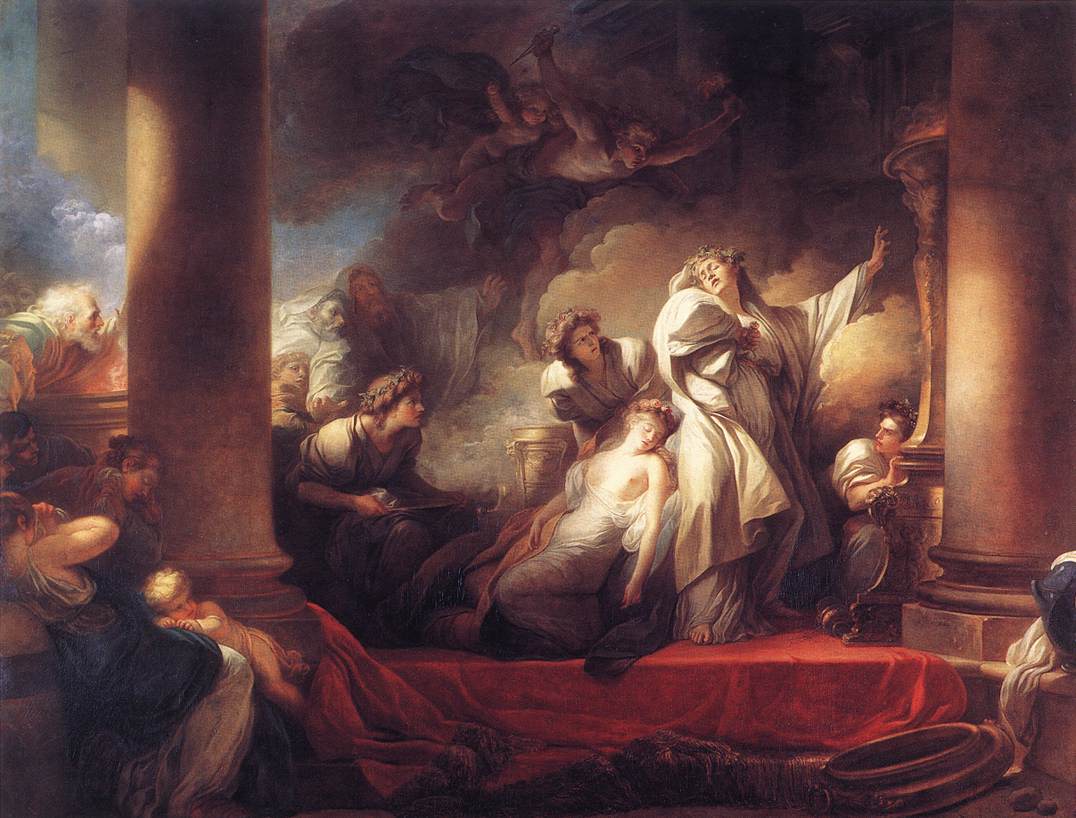
The picture shows a tapestryAs historical climatologists have not shown that Renaissance Italian winters and springs were warmer than they are now, it is puzzling that Italy did not fabricate tapestries to decorate and draught-proof the stony rooms of its palaces until 1545, when Cosimo I set up a manufactory in Florence. To hardiness or stinginess (tapestry was by far the most expensive form of wall decoration) we owe the existence of such secular frescoed decorative schemes as the labours of the months in the castle at Trent (c. 1407), the Arthurian scenes of Pisanello and the courtly ones of Mantegna in the Ducal Palace of Mantua, the delicious calendar fantasies of Cossa and others in the Palazzo Schifanoia in Ferrara - and, doubtless, many others that await liberation from whitewash or later panelling. These are all in situations where northern patrons would have used tapestries. These were imported, chiefly from Flanders, into Italy. The influence of their hunting and ceremonial scenes in particular registered on Italian 'gothic' painting or illumination and stained glass, and in literature. But the Italians did not make them. The most famous of all 'Italian' tapestries, those for the Sistine Chapel designed by Raphael, were made in Brussels from the full-scale coloured patterns, or cartoons, now in the Victoria and Albert Museum, London. Nor is it clear whether imported tapestries were used habitually or simply to add grandeur to special occasions. Even when Cosimo's manufactory was in being, and working from designs by court artists of the calibre of Bronzino, Salviati and Allori, his own headquarters, the Palace of the Signoria (now the Palazzo Vecchio), was being decorated with frescoes. The subject is underexplored. cartoonA full-scale preparatory drawing for a painting, tapestry, or fresco. In fresco painting, the design was transferred to the wall by making small holes along the contour lines and then powdering them with charcoal in order to leave an outline on the surface to be painted. In the 19th centurry designs submitted in a competition for frescos in the Houses of Parliament in London were parodied in the magazine Punch. From this the word has acquired its most common meaning today - a humorous drawing or parody. for the Gobelin factory. The tapestry was never executed. It was thanks to this painting that Fragonard was accepted by the Académie as a 'history painter'. He was soon to abandon this type of subject-matter and devote himself to the pleasant, often frivolous paintings for which he is famous.
When Fragonard tackled the history picture - a rare occasion - it, like his other paintings, was animated by love. The large Corésus sacrificing himself to save Callirhoé, shown at the SalonIn the French language of the 18th and 19th centuries it designated an actual exhibition space, as well as the academic art exhibitions staged in the Salon d'Apollon of the Louvre since 1667. From 1737, the exhibitions took place biennially and, after the French Revolution, annually in the Salon Carré of the Louvre in Paris. Towards the end of the 19th century the official Salon jury was dissolved in order to make way for a committee of state-approved artists, i.e. former Salon members, who created the highly influential Société des Artistes Français. of 1765, is Fragonard's effort to combine his own tendencies with academic requirements. It is not surprising that he exhibited there only once afterwards; this sort of machine was replaced by brilliant, witty decorations, positive riots of cupids and bathers, kissing lips and torn clothes, which always express love in action. The Corésus is negative love, sublimeTerm that came into general use in the 18th century to denote a new aesthetic concept that was held to be distinct from the beautiful and the Picturesque and was associated with ideas of awe and vastness. The outstanding work on the concept of the Sublime in English was Edmund Burke's A Philosophical Enquiry into the Origin of our Ideas of the Sublime and Beautiful (1757). This book was one of the first to realize (in contrast with the emphasis on clarity and precision during the Age of Enlightenment) the power of suggestiveness to stimulate imagination. The cult of the Sublime had varied expressions in the visual arts, notably the taste for the 'savage' landscapes of Salvator Rosa and the popularity among painters of subjects from Homer, John Milton, and Ossian (the legendary Gaelic warrior and bard, whose verses - actually fabrications - were published in the 1760s to great acclaim). The vogue for the Sublime, with that for the Picturesque, helped shape the attitudes that led to Romanticism. self-sacrifice, and in effect useless passionThe events leading up to Good Friday, beginning with Christ's arrest and ending with his burial. Portrayals of the Passion, which focus on the Suffering Christ, include depictions of Judas betraying Christ with a kiss, Peter cutting off Malchus's ear, the crown of thorns, and so on.. Fragonard docs his best to excite the composition, sending waves of smoky clouds and excited winged figures to fill the space between the two pillars not occupied by the strangely feminine priest and the swooning heroine - herself almost as if ravished by love. Perhaps hints from Boucher and Tiepolo worked on Fragonard to emulate the high style for which he was not suited. His geniusin classical Rome, a person's invisible tutelary god. In art from the classical period onwards, the low-ranking god was depicted as a winged, usually childish figure. lay in aiming lower, from an academic standpoint, in being more rational and natural - that is, by being more witty, mischievous, and relaxed.
But in 1765 this was not yet apparent, though perhaps suspected. The whole, high, rococoA style of design, painting, and architecture dominating the 18th century, often considered the last stage of the Baroque. Developing in the Paris townhouses of the French aristocracy at the turn of the 18th century, Rococo was elegant and ornately decorative, its mood lighthearted and witty. Louis XV furniture, richly decorated with organic forms, is a typical product. Leading exponents of the Rococo sryle included the French painters Antoine Watteau (1684-1721) and Jean-Honoré Fragonard (1732-1806), and the German architect Johann Balthasar Neumann (1687-1753). Rococo gave way to Neo-classicism. fabric was toppling. For a moment the painter of the Corésus seemed the man who might keeptall, strong tower in medieval castles, used as an observation post and last refuge for those living in the castle, an, unlike the donjon, not designed for permanent habitation. it still upright. The picture itself was thought by Diderot to have attracted attention less by its own merits than by the need in France to find a successor to the established Carle van Loo and the supposedly promising Deshays, both of whom died that year. Boucher's talent had patently declined. Great painters, Diderot wrote in the same context, 'sont aujourd'hui fort rares en Italie', and the only person he could think of comparing with Fragonard was Mengs. At Venice, Gian Antonio Guardi was dead; Tiepolo was self exiled in Spain; Pittoni, last of the generation of talented practitioners still in the city, was to die in 1768.