03 — ARTWORK
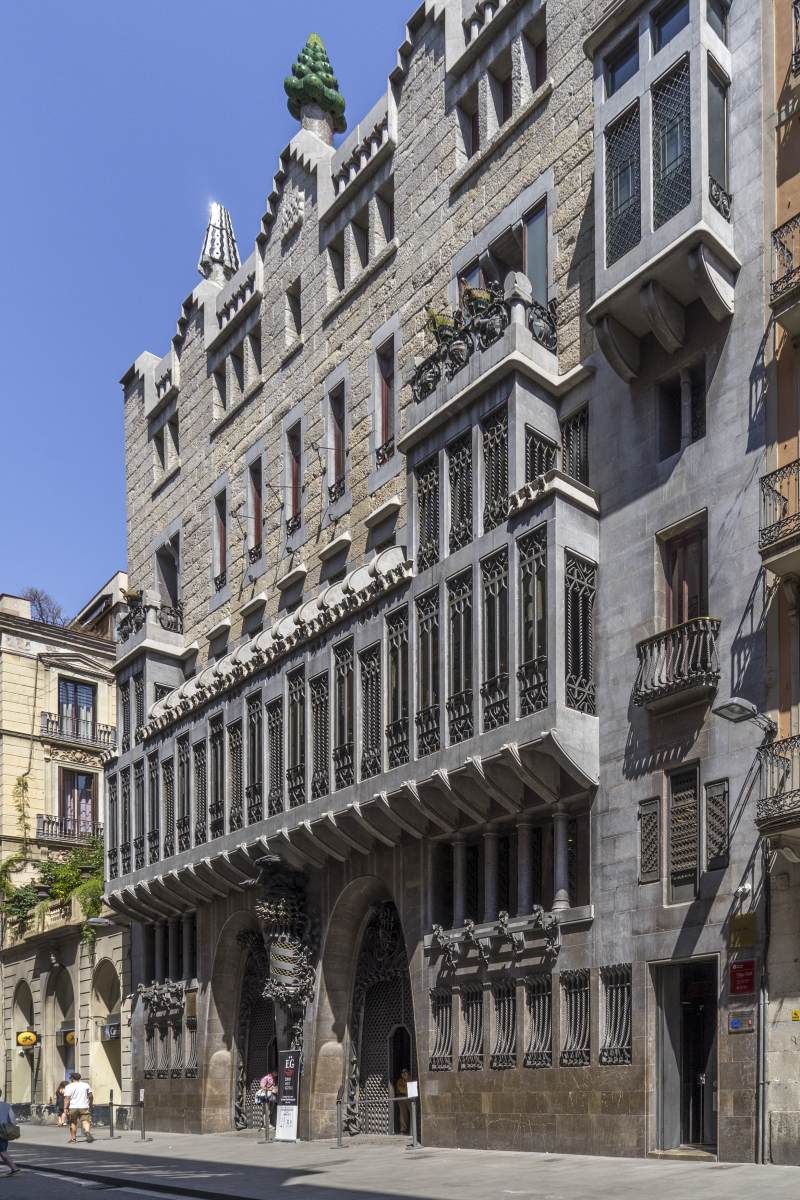
Palau Güell: façade
- MEDIUM
- Photo
- TYPE
- Other
PALETTE
HOVER OR TAP A SWATCH FOR NAME, SHARE AND HEX. SAMPLED FROM THE IMAGE — INDICATIVE, NOT A PIGMENT ANALYSIS.
DEVELOPMENT BUILD — NOT FOR PUBLIC USE. CONTRIBUTE ON GITHUB.
03 — ARTWORK
PALETTE
HOVER OR TAP A SWATCH FOR NAME, SHARE AND HEX. SAMPLED FROM THE IMAGE — INDICATIVE, NOT A PIGMENT ANALYSIS.
COMMENTARY
UNDERLINED TERMS ARE DEFINED IN THE GLOSSARY.
Gaudí's first major building commission for the Palau Güell came from his sponsor and later close friend, Count Eusebio Güell, a much-travelled patron of arts. On his business trips to England, Güell had come into contact with William Morris and had put together an extensive library of contemporary writings on art theory, which Gaudi often consulted.
The Palau Güell, a grey marbleloosely applied to any hard limestone that can be sawn into thin slabs and will take a good polish so that it is suitable for decorative work; more strictly, it refers to metamorphosed limestones whose structure has been recrystallized by heat or pressure. Marbles are widely disseminated and occur in a great variety of colours and patterns, but certain types have been particularly prized by sculptors. The most famous of Greek white marbles in the ancient world was the close-grained Pentelic, which was quarried at Mount Pentelicon in Attica. The Elgin Marbles are carved in Pentelic. Widely used also were the somewhat coarser-grained translucent white marbles from the Aegean islands of Paros and Naxos. Parian marble was used for the celebrated Mausoleum at Halicarnassus. The pure white Carrara marble, quarried at Massa, Carrara, and Pietra Santa in Tuscany from the 3rd century BC, is the most famous of all sculptors' stones. It was used for the Apollo Belvedere, and was much favoured in the Renaissance, particularly by Michelangelo, who often visited the quarries to select material for his work. Neoclassical sculptors also favoured Carrara marble because of its ability to take a smooth, sleek surface, but it can look rather 'dead' compared with some of the finest Greek marbles. urban building of six storeys, presents a relatively simple façadethe front or principal face of a building, especially one elaborately constructed; a blind façade is a façade that is purely decorative and does not relate to the structure of the building. to the street, but the twin parabolic arches at the entrance and the baya vaulted division of a nave, aisle, choir, or transept along its longitudinal axis. windows, particularly at the rear, have a wealth of wrought-iron ornament. Together with the furniture designed for the Güells, this is among the earliest manifestations of the incipient Catalan Modernisme, the regional tendency related to Art Nouveau. There is also a series of sculpted roof elements behind the symmetrical parapet gables. The internal areas were unified around a magnificent central space covered with a parabolic vaultA roof or ceiling whose structure is based on the arch. There are a wide range of forms, including the barrel (or tunnel) vault, formed by a continuous semi-circular arch; the groin vault, formed when two barrel vaults intersect; and the rib vault, consistong of a framework of diagonal ribs supporting interlocking arches. The development of the various forms was of great structural and aesthetic importance in the development of church architecture during the Middle Ages., naturally lit from above through parabolic arches in the octagonal, pinnacled cupolaIn architecture, a small dome, usually one set on a much larger dome or on a roof; a semi-circular vault..
With the Palau Güell, structure and decoration began to fuse - a feature that later became characteristic of his principal works. Gaudí made use of the varied decorative opportunities of structural iron in all their abundance. In addition, he employed flattened brick vaults of Byzantine derivation that even today are copybook examples of stereotomy.
@online{wga-r044bdc4d637c76,
  author       = {Krén, Emil and Marx, Daniel},
  title        = {Palau Güell: façade by GAUDÍ, Antoni},
  organization = {{Web Gallery of Art}},
  date         = {2026-09-13},
  url          = {https://beta.wga.hu/artists/gaud-antoni-r62d04c2fe2eba9/palau-gell-faade-r044bdc4d637c76},
  urldate      = {2026-09-13},
  langid       = {english}
}
ACCESSED 2026-09-13. REPLACE THE AUTHOR FIELD WITH THE COMMENTARY AUTHOR WHERE ONE IS NAMED.


