03 — ARTWORK
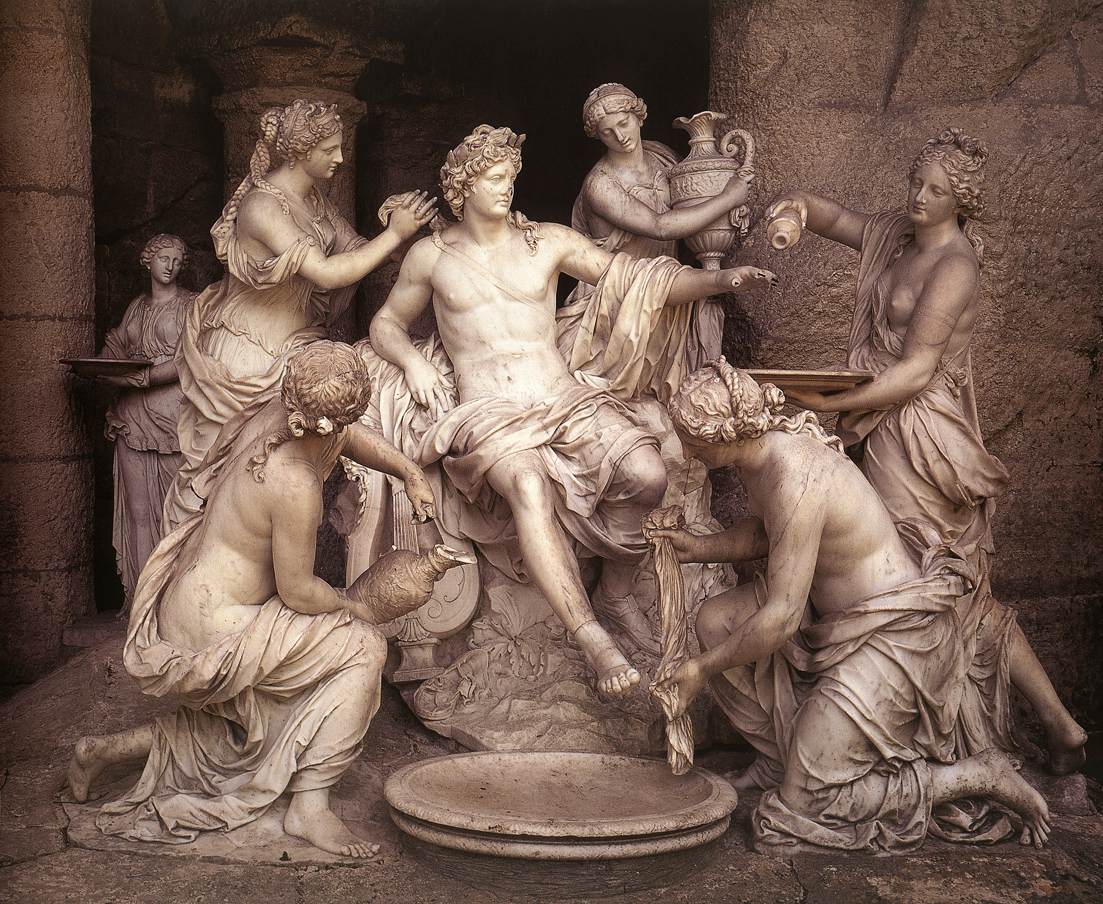
Apollon and the Nymphs
- MEDIUM
- Marble
- TYPE
- Mythological
PALETTE
HOVER OR TAP A SWATCH FOR NAME, SHARE AND HEX. SAMPLED FROM THE IMAGE — INDICATIVE, NOT A PIGMENT ANALYSIS.
DEVELOPMENT BUILD — NOT FOR PUBLIC USE. CONTRIBUTE ON GITHUB.
03 — ARTWORK
PALETTE
HOVER OR TAP A SWATCH FOR NAME, SHARE AND HEX. SAMPLED FROM THE IMAGE — INDICATIVE, NOT A PIGMENT ANALYSIS.
COMMENTARY
UNDERLINED TERMS ARE DEFINED IN THE GLOSSARY.
Girardon was a close collaborator of Le Brun and embodied in his works the classicalRelating to the culture of ancient Greece and Rome (classical Antiquity). The classical world played a profoundly important role in the Renaissance, with Italian scholars, writers, and artists seeing their own period as the rebirth (the "renaissance") of classical values after the Middle Ages. The classical world was considered the golden age for the arts, literature, philosophy, and politics. Concepts of the classical, however, changed greatly from one period to the next. Roman literature provided the starting point in the 14th century, scholars patiently finding, editing and translating a wide range of texts. In the 15th century Greek literature, philosophy and art - together with the close study of the remains of Roman buildings and sculptures-expanded the concept of the classical and ensured it remained a vital source of ideas and inspiration. theories of the Academy. From 1663 onwards he played a part in the decoration of the royal palaces, and in 1666 he received the commission on which his fame principally rests, the group of Apollo and the Nymphs of Thetis for the grotto of Thetis at Versailles.
It is hard now to judge this work because not only was it placed in the late eighteenth century in a new 'picturesqueTerm covering a set of attitudes towards landscape, both real and painted, that flourished in the late 18th and early 19th centuries. It indicated an aesthetic approach that found pleasure in roughness and irregularity, and an attempt was made to establish it as a critical category between the 'beautiful' and the 'Sublime'. Picturesque scenes were thus neither serene (like the beautiful) nor awe-inspiring (like the Sublime), but full of variety, curious details, and interesting textures — medieval ruins were quintessentially Picturesque. Natural scenery tended to be judged in terms of how closely it approximated to the paintings of favoured artists such as Gaspard Dughet, and in 1801 the Supplement to Samuel Johnson's Dictionary by George Mason defined 'Picturesque as: 'what pleases the eye; remarkable for singularity; striking the imagination with the force of painting; to be expressed in painting; affording a good subject for a landscape; proper to take a landscape from.' The Picturesque Tour in search of suitable subjects was a feature of English landscape painting of the period, exemplified, for example, in the work of Girtin and (early in his career) of Turner, and the Picturesque generated a large literary output; much of it was pedantic and obsessive and it became a popular subject for satire.' setting of rocks and ruins designed by Hubert Robert, but the arrangement of the figures in the group was altered. An <a onclick="return OpenOther('/html/l/le_pautr/jean/thetis.html')" href="/html/l/le_pautr/jean/thetis.html">engravingA print made from a metal plate that has had a design cut into it with a sharp point. Ink is smeared over the plate and then wiped off, the ink remaining in the etched lines being transferred when the plate is pressed very firmly onto a sheet of paper. by Le Pautre</A> shows the original disposition of the group in an enclosed niche, which was flanked by two other similar niches containing the horses of Apollo carved by Guérin and the Marsy brothers. This idea of continuing the action through several different parts of the building and so linking them up is a BaroqueThe period in art history from about 1600 to about 1750. In this sense the term covers a wide range of styles and artists. In painting and sculpture there were three main forms of Baroque: (1) sumptuous display, a style associated with the Catholic Counter Reformation and the absolutist courts of Europe (Bernini, Rubens); (2) dramatic realism (Caravaggio); and (3) everyday realism, a development seen in particular in Holland (Rembrandt, Vermeer). In architecture, there was an emphasis on expressiveness and grandeur, achieved through scale, the dramatic use of light and shadow, and increasingly elaborate decoration. In a more limited sense the term Baroque often refers to the first of these categories. The development of the Baroque reflects the period's religious tensions (Catholic versus Protestant); a new and more expansive world view based on science and exploration; and the growth of absolutist monarchies. device.
Girardon's group is the most purely classical work in French seventeenth-century sculpture. The direct inspiration of Hellenistic work is strikingly evident in the types, the modelling of the nude and the treatment of the draperies, and can be accounted for by the fact that the artist paid a special visit to Rome during the execution of the group in order to refresh his memory of ancient sculpture there.
The main problem which faced Girardon, however, was not the treatment of the individual figures, but the manner of linking them into a coherent group. Antiquity provided no model to guide him here, thus Girardon used as source the paintings of Poussin.
@online{wga-r6d8475e1abba07,
  author       = {Krén, Emil and Marx, Daniel},
  title        = {Apollon and the Nymphs by GIRARDON, François},
  organization = {{Web Gallery of Art}},
  date         = {2026-09-09},
  url          = {https://beta.wga.hu/artists/girardon-franois-r77c7d9106ee47f/apollon-and-the-nymphs-r6d8475e1abba07},
  urldate      = {2026-09-09},
  langid       = {english}
}
ACCESSED 2026-09-09. REPLACE THE AUTHOR FIELD WITH THE COMMENTARY AUTHOR WHERE ONE IS NAMED.


