03 — ARTWORK
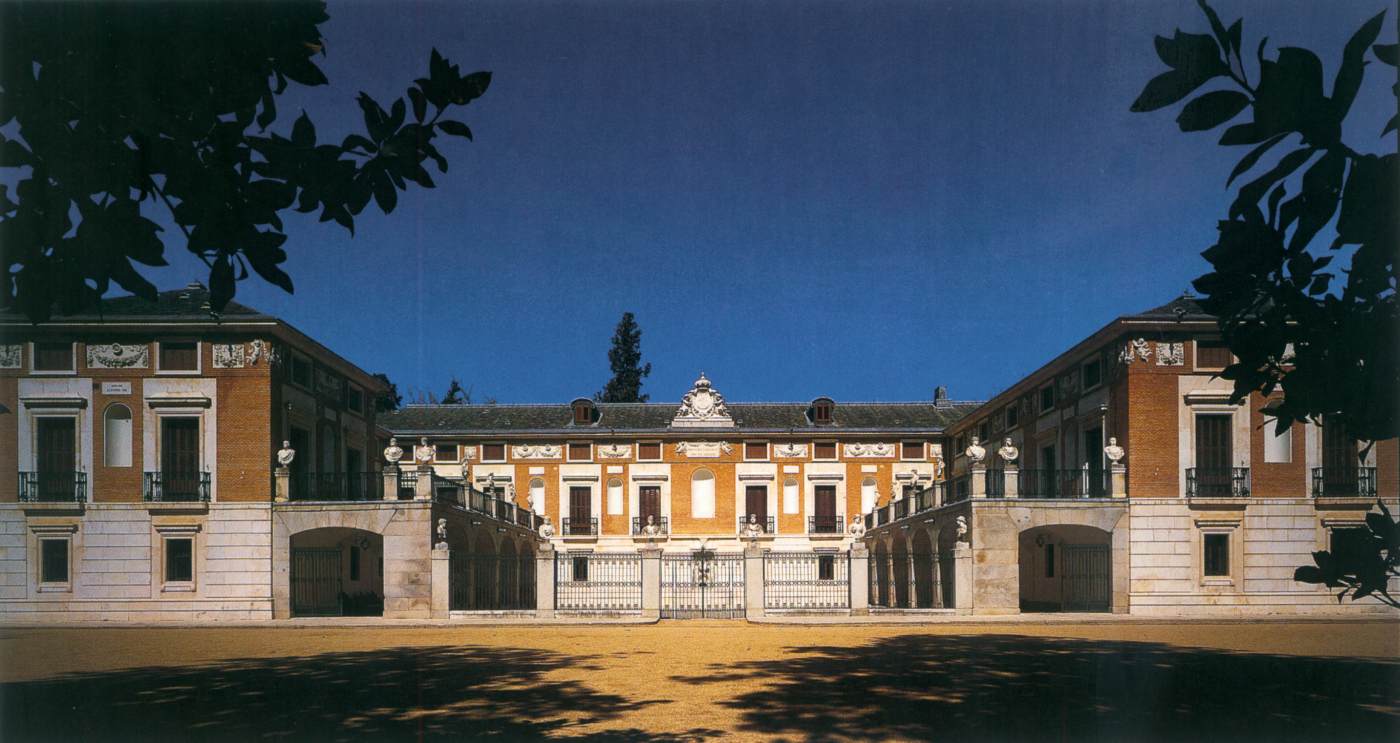
General view
GONZÁLEZ VELÁZQUEZ, Isidro · 1803 →
- MEDIUM
- Photo
- TYPE
- Other
PALETTE
HOVER OR TAP A SWATCH FOR NAME, SHARE AND HEX. SAMPLED FROM THE IMAGE — INDICATIVE, NOT A PIGMENT ANALYSIS.
DEVELOPMENT BUILD — NOT FOR PUBLIC USE. CONTRIBUTE ON GITHUB.
03 — ARTWORK
GONZÁLEZ VELÁZQUEZ, Isidro · 1803 →
PALETTE
HOVER OR TAP A SWATCH FOR NAME, SHARE AND HEX. SAMPLED FROM THE IMAGE — INDICATIVE, NOT A PIGMENT ANALYSIS.
COMMENTARY
UNDERLINED TERMS ARE DEFINED IN THE GLOSSARY.
The Bourbons expanded the extensive gardens and palace complex in Aranjuez on numerous occasions, adapting them to the needs of the court. In the eastern part of the park Charles IV had a pleasure palace built at a place where, in 1792, he had come across a modest farmhouse while out hunting. The building, the Casa del Labrador, is among the most beautiful works of NeoclassicismA style in European art and architecture from the mid 18th century until the end of the 19th century. Based as it was on the use of ancient Greek and Roman models and motifs, its development was greatly influenced by the excavations at Pompeii and Herculaneum, and by the theories of the German art historian Johann Joachim Winckelmann (1717-1768). Intellectually and politically it was closely linked to the Enlightenment's rejection of the aristocratic frivolity of Rococo, the style of the Ancien Régime. Among Neoclassicism's leading figures were the French painter Jacques-Louis David (1744-1825), the German painter Anton Raffael Mengs (1728-1729), and the Italian sculptor Antonio Canova (1757-1822). in Spain. In the hands of Isidro González Velázquez, who transformed designs prepared by Juan de Villanueva, the resulting structure was anything but a simple hut, becoming instead a Roman villaa residence in the country (in Italy); villas acquired palace-like characteristics from the Renaissance onwards. built to the most exacting standards.
The main transverse section is formed from a plinthsquare or rectangular section forming part of the base of a pillar, column, or statue., main floor and attic, and is adjoined by similarly designed wings, which enclose a small courtyard. The contrast of light-coloured stonework and red brick animates the façades, but the real charm of the building is provided by its mock antiquethe classical age of Greece and Rome began with the Greek migrations of the 2nd millennium BC, and ended in the West in 476 AD with the deposition of the Roman emperor Romulus Augustulus (c. 475 AD); in the East it ended in 529 AD when the Platonic Academy was closed by Justinian (482 - 565 AD). décor and antiquarian furnishings. Niches for sculptures are built into the façades, while busts of Roman emperors decorate the balustrades and fences.
@online{wga-r3cde12a2439a0b,
  author       = {Krén, Emil and Marx, Daniel},
  title        = {General view by GONZÁLEZ VELÁZQUEZ, Isidro},
  organization = {{Web Gallery of Art}},
  date         = {2026-09-09},
  url          = {https://beta.wga.hu/artists/gonzlez-velzquez-isidro-rf355e98e69954f/general-view-r3cde12a2439a0b},
  urldate      = {2026-09-09},
  langid       = {english}
}
ACCESSED 2026-09-09. REPLACE THE AUTHOR FIELD WITH THE COMMENTARY AUTHOR WHERE ONE IS NAMED.
The archive catalogues no further works by this artist.
TRY SAME COLLECTION →
