03 — ARTWORK
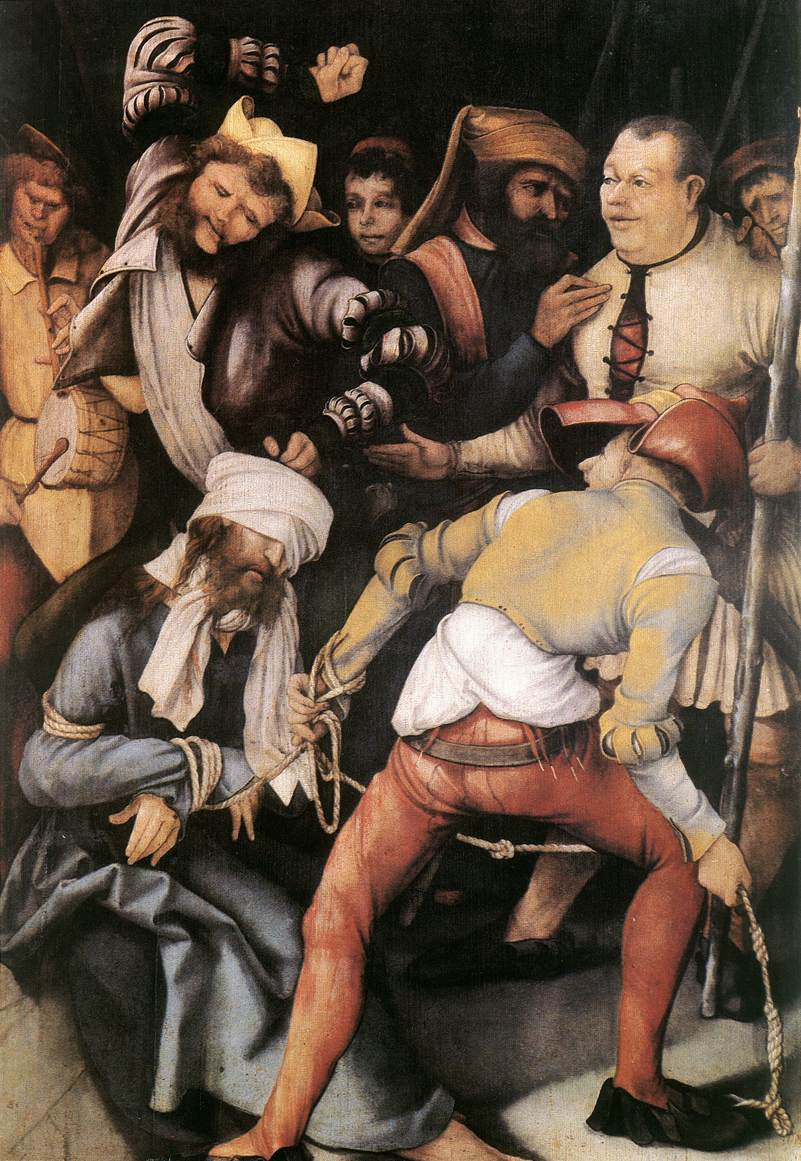
The Mocking of Christ
- MEDIUM
- Oil on pine panel, 109 x 73,5 cm
- TYPE
- Religious
PALETTE
HOVER OR TAP A SWATCH FOR NAME, SHARE AND HEX. SAMPLED FROM THE IMAGE — INDICATIVE, NOT A PIGMENT ANALYSIS.
DEVELOPMENT BUILD — NOT FOR PUBLIC USE. CONTRIBUTE ON GITHUB.
03 — ARTWORK
PALETTE
HOVER OR TAP A SWATCH FOR NAME, SHARE AND HEX. SAMPLED FROM THE IMAGE — INDICATIVE, NOT A PIGMENT ANALYSIS.
COMMENTARY
UNDERLINED TERMS ARE DEFINED IN THE GLOSSARY.
Grünewald's earliest datable work is the Mocking of Christ, a colourful, vehemently expressive painting demonstrating his ability to create dazzling light effects. The painting depicts Christ blindfolded and being beaten by a band of grotesque men. The figures are thick-bodied, soft, and fleshy, done in a manner suggestive of the Italian High Renaissance. Elements of the work also show Grünewald's assimilation of Dürer, specifically his Apocalypsethe Revelation of St John, the last book of the New Testament. The wrath of God descending upon the earth is depicted in three visions; in the form of terrible natural catastrophes, in the battle between the forces and good and evil, and in the union of a new Heaven and new Earth in the Heavenly Jerusalem. The announcement of the Second Coming of Christ at the end of the world was intended to console the persecuted Christians and also prepare them for the horrors connected with the event. series. Different from High Renaissance idealism and humanismphilosophical movement which started in Italy in the mid-14th century, and which drew on antiquity to make man the focal point. In humanism, the formative spiritual attitude of the Renaissance, the emancipation of man from God took place. It went hand in hand with a search for new insights into the spiritual and scientific workings of this world. The humanists paid particular attention to the rediscovery and nurture of the Greek and Latin languages and literature. To this day the term denotes the supposedly ideal combination of education based on classical erudition and humanity based on observation of reality., however, are Grünewald's uses of figural distortion to portray violence and tragedy, thin fluttering drapery, highly contrasting areas of light and shadow, and unusually stark and iridescent colour. It is these elements, already in evidence in this early work, that Grünewald was to develop into the masterful, individualistic style most fully realized in his Isenheim AltarpieceA picture or sculpture that stands on or is set up behind an altar. The term reredos is used for an ornamental screen or partition, not directly attached to the altar table but affixed to the wall behind it. A diptych is an altarpiece consisting of two panels, a triptych one of three panels, and a polyptych one of four or more panels. From the 14th to 16th century, the altarpiece was one of the most important commissions in European art; it was through the altarpiece that some of the most decisive developments in painting and sculpture came about..
@online{wga-ra18254dd7db9a1,
  author       = {Krén, Emil and Marx, Daniel},
  title        = {The Mocking of Christ by GRÜNEWALD, Matthias},
  organization = {{Web Gallery of Art}},
  date         = {2026-09-13},
  url          = {https://beta.wga.hu/artists/grnewald-matthias-rce8b9a63e07c0d/the-mocking-of-christ-ra18254dd7db9a1},
  urldate      = {2026-09-13},
  langid       = {english}
}
ACCESSED 2026-09-13. REPLACE THE AUTHOR FIELD WITH THE COMMENTARY AUTHOR WHERE ONE IS NAMED.


