03 — ARTWORK
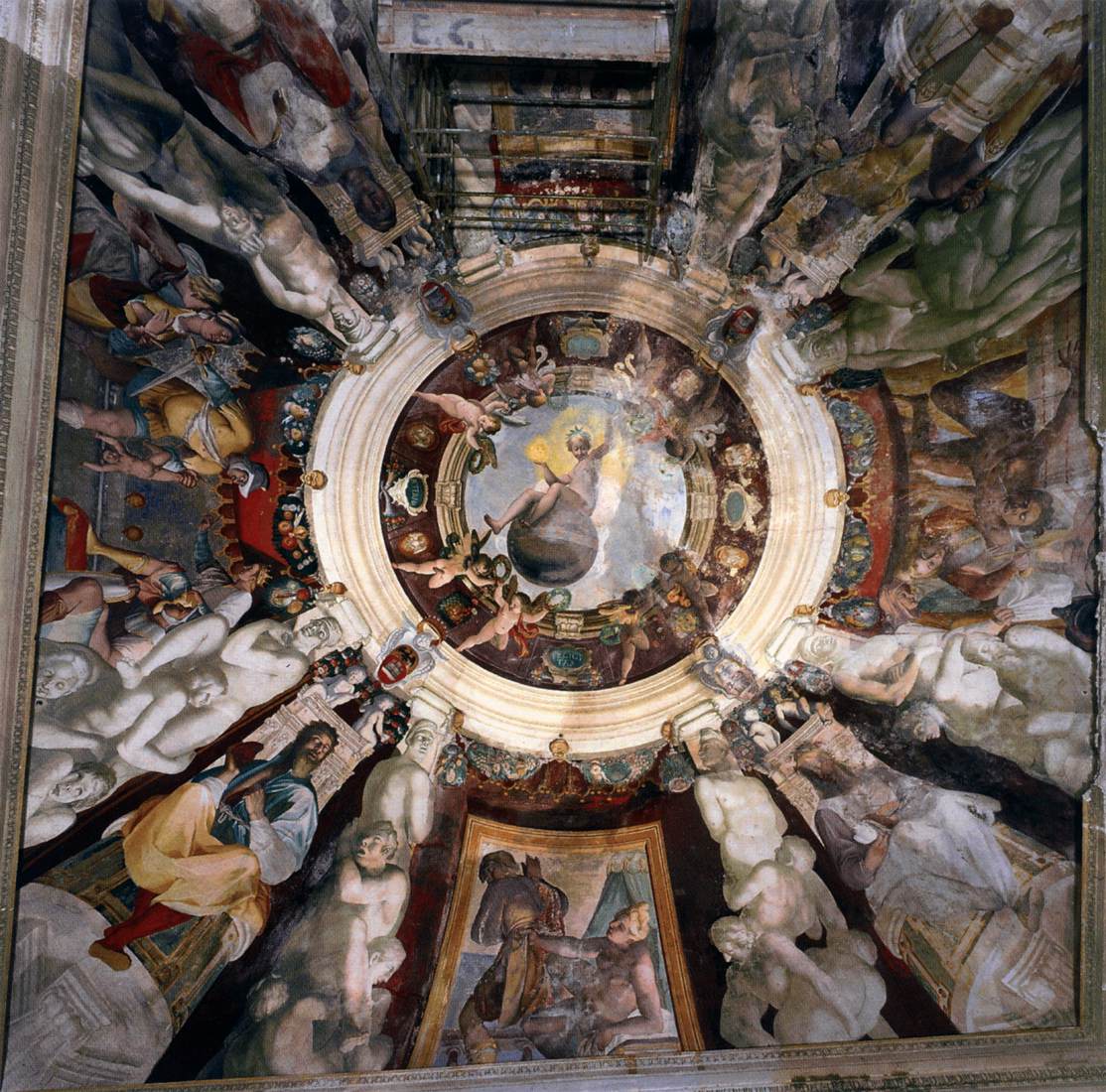
Allegory of Felicità Eterna
- MEDIUM
- Fresco
- TYPE
- Mythological
PALETTE
HOVER OR TAP A SWATCH FOR NAME, SHARE AND HEX. SAMPLED FROM THE IMAGE — INDICATIVE, NOT A PIGMENT ANALYSIS.
DEVELOPMENT BUILD — NOT FOR PUBLIC USE. CONTRIBUTE ON GITHUB.
CURRENT LOCATION · Palazzo Odescalchi Giustiniani
03 — ARTWORK
PALETTE
HOVER OR TAP A SWATCH FOR NAME, SHARE AND HEX. SAMPLED FROM THE IMAGE — INDICATIVE, NOT A PIGMENT ANALYSIS.
COMMENTARY
UNDERLINED TERMS ARE DEFINED IN THE GLOSSARY.
Vincenzo Giustiniani (1564-1637) was one of the most brilliant, and knowledgeable lovers of art in early seventeenth-century Rome. He assembled a renowned collection of roughly 1.800 works of classicalRelating to the culture of ancient Greece and Rome (classical Antiquity). The classical world played a profoundly important role in the Renaissance, with Italian scholars, writers, and artists seeing their own period as the rebirth (the "renaissance") of classical values after the Middle Ages. The classical world was considered the golden age for the arts, literature, philosophy, and politics. Concepts of the classical, however, changed greatly from one period to the next. Roman literature provided the starting point in the 14th century, scholars patiently finding, editing and translating a wide range of texts. In the 15th century Greek literature, philosophy and art - together with the close study of the remains of Roman buildings and sculptures-expanded the concept of the classical and ensured it remained a vital source of ideas and inspiration. sculpture and 600 paintings, among them eleven of Caravaggio's most important works. He purchased a villaa residence in the country (in Italy); villas acquired palace-like characteristics from the Renaissance onwards. at Bassano Romano in 1595 which was then thoroughly remodeled and enlarged. The artists who painted there between 1595 and 1604 all worked in the Mannerist style.
The north wing of the enlarged palace was erected in 1607-09 and the painted decoration was accomplished in 1609-10. There are three rooms in the north wing, the SalaHall, large room. della Felicità Eterna (painted by Paolo Guidotti in 1610), the Sala di Diana (painted by Domenichino in 1609) and the Galleria (painted by Francesco Albani and assistants in 1609-10).
In the Sala della Felicità Eterna the ceiling is devoted to eternal happiness. It was painted by Paolo Guidotti, an eccentric who combined MannerismA movement in Italian art from about 1520 to 1600. Developing out of the Renaissance, Mannerism rejected Renaissance balance and harmony in favor of emotional intensity and ambiguity. In Mannerist painting, this was expressed mainly through severe distortions of perspective and scale; complex and crowded compositions; strong, sometimes harsh or discordant colors; and elongated figures in exaggerated poses. In architecture, there was a playful exaggeration of Renaissance forms (largely in scale and proportion) and the greater use of bizarre decoration. Mannerism gave way to the Baroque. Leading Mannerists include Pontormo, Bronzino, Parmigianino, El Greco and Tintoretto. and naturalismGeneric term for scientific positions supported by natural insights. In fine arts and literature between approximately 1870 and 1900, Naturalism tried to reproduce the reality comprehended through sensory experience as realistically as possible, i.e. without idealising the object, but with scientific precision. In contrast to Realism, which was also based on the accurate description of natural occurrences, Naturalism concerns itself with the sensual dimensions of observation, whereby questions of morality and social criticism come to the fore. The spokesman for literary Naturalism was Emile Zola, who believed the artistic methods provided evidence of human existence. in a way that was both original and bizarre. The pictorial program celebrates the virtues of the villa's owner and his wife by way of personifications and Old Testament scenes.
The archive catalogues no further works by this artist.
TRY SAME COLLECTION →@online{wga-r198a0baff870cc,
author = {Krén, Emil and Marx, Daniel},
title = {Allegory of Felicità Eterna by GUIDOTTI, Paolo},
organization = {{Web Gallery of Art}},
date = {2026-09-14},
url = {https://beta.wga.hu/artists/guidotti-paolo-r11a1ee0fad17c9/allegory-of-felicit-eterna-r198a0baff870cc},
urldate = {2026-09-14},
langid = {english}
}ACCESSED 2026-09-14. REPLACE THE AUTHOR FIELD WITH THE COMMENTARY AUTHOR WHERE ONE IS NAMED.