03 — ARTWORK
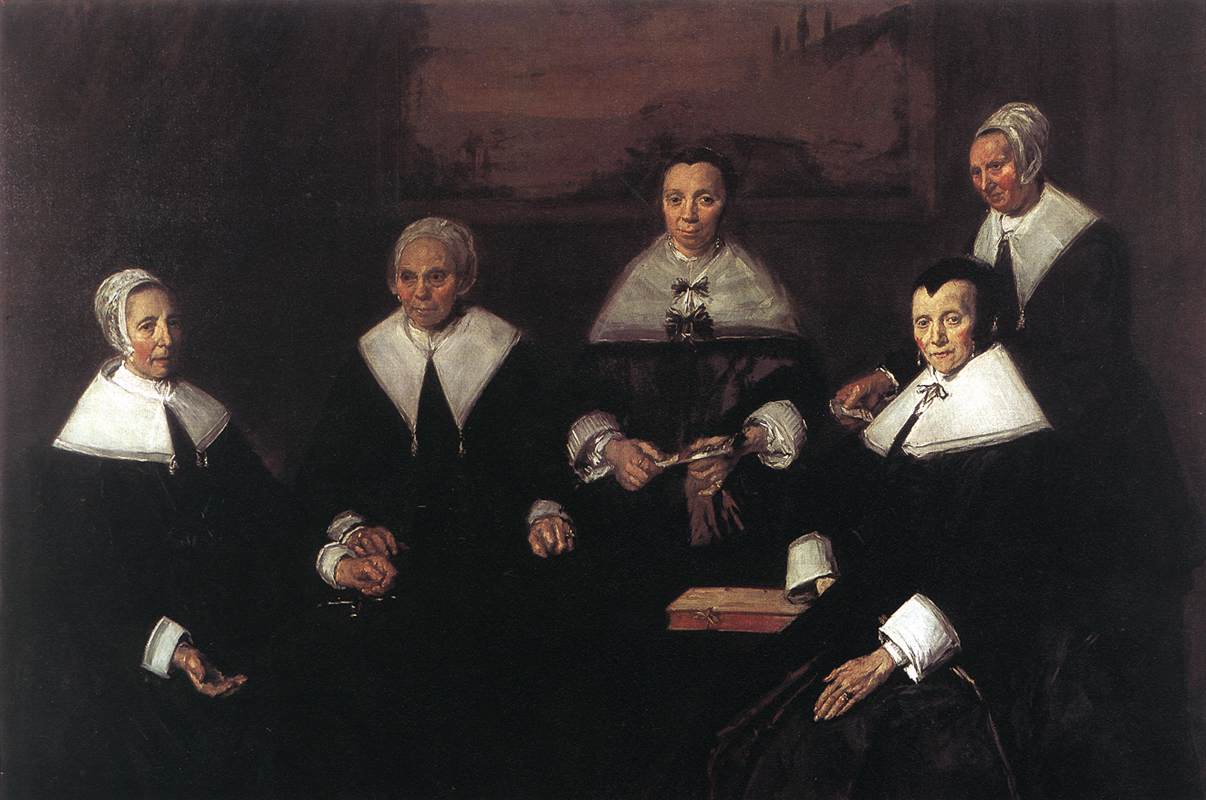
Regentesses of the Old Men's Almshouse
- MEDIUM
- Oil on canvas, 172,5 x 256 cm
- TYPE
- Portrait
PALETTE
HOVER OR TAP A SWATCH FOR NAME, SHARE AND HEX. SAMPLED FROM THE IMAGE — INDICATIVE, NOT A PIGMENT ANALYSIS.
DEVELOPMENT BUILD — NOT FOR PUBLIC USE. CONTRIBUTE ON GITHUB.
03 — ARTWORK
PALETTE
HOVER OR TAP A SWATCH FOR NAME, SHARE AND HEX. SAMPLED FROM THE IMAGE — INDICATIVE, NOT A PIGMENT ANALYSIS.
COMMENTARY
UNDERLINED TERMS ARE DEFINED IN THE GLOSSARY.
The two large format group portraits of the Regents and Regentesses of the Old Men's Almshouse in Haarlem are not only one of the last major work by this artist who ranks beside Rembrandt as the greatest of all portraitThe Roman portrait bust survived in the form of life-sized reliquaries of saints, but it was in 15th century Florence that the individual features and character of a contemporary sitter were accurately recorded by sculptors such as Donatello, Desiderio da Settignano, Mino da Fiesole and the Rossellino. A similar degree of realism occurs in 15th century tomb sculpture. The equestrian portrait, based on antique statues such as the Marcus Aurelius monument (Rome, Campidoglio), was revived in the 14th century. Two examples in fresco are Simone Martini's Guidoriccio (c. 1328; Siena, Palazzo Pubblico) and the posthumous portrait of Sir John Hawkwood (1436; Florence, Cathedral) by Uccello, which gives the illusion of a 3-dimensional statue seen from below. The Venetian Republic ordered imposing monuments from Donatello (1447; Gattarnelata, Padua) and Verrocchio (14799; Colleoni, Venice), whilst other statesmen ordered their own images to be erected in public places, directly relating themselves to the military heroes of ancient Rome. Another form of political portraiture derived from antiquity was the commemorative portrait medal designed by artists such as Pisanello. The carved or painted profile portrait became popular in the 1450s. The realism of the clear, flattened image, painted under the influence of Flemish examples by the Pollaiuolo brothers, Piero della Francesca and Botticelli, was superseded by the three-quarter and frontal portrait, psychologically more complex, such as Leonardo's enigmatic Mona Lisa (Paris, Louvre) with her momentary smile or Andrea del Sarto's arresting Portrait of a Man (London, National Gallery). The 16th century portrait became generalized, Lotto's Andrea Odoni (1527; Royal Collection) being an idealized concept of a collector rather than an individual. Group portraits, decorating whole rooms, include the narrative scenes of the Gonzaga court painted by Mantegna (completed 1474; Mantua, Palazzo Ducale) and the elaborate schemes commissioned by the Farnese family in Rome from Vasari (1546; Palazzo della Cancelleria) and Salviati (after 1553; Palazzo Farnese). Portraits were also incorporated into religious narratives, as in Ghirlandaio's fresco cycle painted for Giovanni Tornabuoni in S. Maria Novella, Florence (1486-90). painters, they are also the last historically significant examples of this genreIn a broad sense, the term is used to mean a particular branch or category of art; landscape and portraiture, for example, are genres of painting, and the essay and the short story are genres of literature..
Whereas Hals previously presented individual gestures, attitudes and poses in a ceremonial and more than momentary context, here he isolates the individual parts and the individuals themselves. The faces above the white collars seem to float against the dark ground of a room that is difficult to distinguish. The "breakdown" of the figurative corresponds to the brushwork whose ductus is no longer fluid, but broken so that it seems to crumble into particles of colour. Here and there, a shimmer of red flares up through the black like the final glimmer of dying embers in the ashes.
Whereas the iconographyThe systematic study and identification of the subject-matter and symbolism of art works, as opposed to their style; the set of symbolic forms on which a given work is based. Originally, the study and identification of classical portraits. Renaissance art drew heavily on two iconographical traditions: Christianity, and ancient Greek and Roman art, thought and literature. of vanitasA painting (or element in painting) that acts as a reminder of the inevitabiliry of death, and the pointlessness of earthly ambitions and achievements. Common vanitas-symbols include skulls, guttering candles, hour-glasses and clocks, overturned vessels, and even flowers (which will soon fade). The vanitas theme became popular during the Baroque, with the vanitas still life flourishing in Dutch art. and the theme of transience were previously expressed through specific symbols in Dutch painting, we now find that the most vigorous genre of all - the group portrait - has also been imbued with the concept of mortality. Old age and death seem to menace, where once there was activity and sociability.
@online{wga-r5da5b2b829ac0d,
  author       = {Krén, Emil and Marx, Daniel},
  title        = {Regentesses of the Old Men's Almshouse by HALS, Frans},
  organization = {{Web Gallery of Art}},
  date         = {2026-09-09},
  url          = {https://beta.wga.hu/artists/hals-frans-r70576a8b6d10d2/regentesses-of-the-old-mens-almshouse-r5da5b2b829ac0d},
  urldate      = {2026-09-09},
  langid       = {english}
}
ACCESSED 2026-09-09. REPLACE THE AUTHOR FIELD WITH THE COMMENTARY AUTHOR WHERE ONE IS NAMED.


