03 — ARTWORK
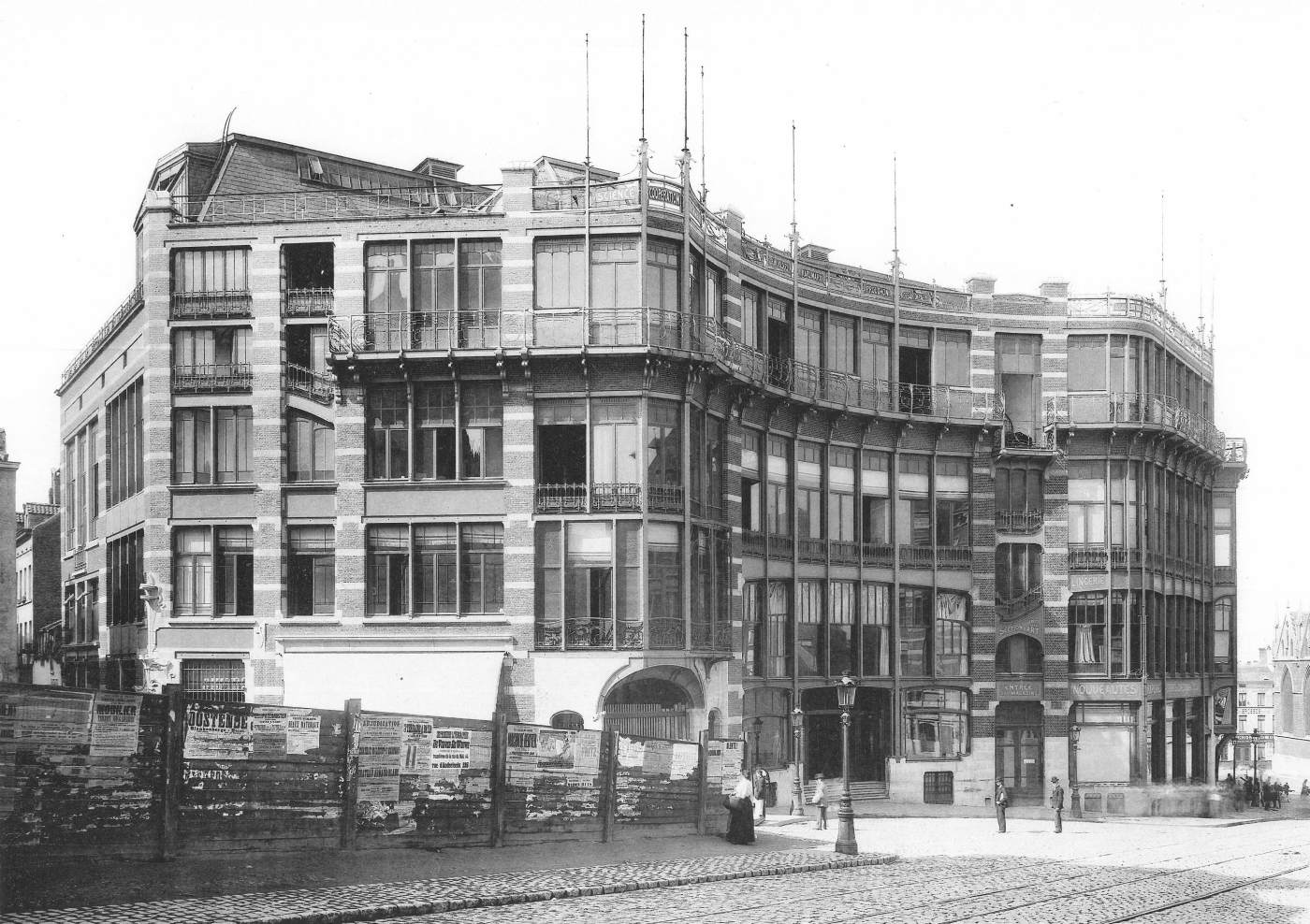
Maison du Peuple: façade
- MEDIUM
- Photo
- TYPE
- Other
PALETTE
HOVER OR TAP A SWATCH FOR NAME, SHARE AND HEX. SAMPLED FROM THE IMAGE — INDICATIVE, NOT A PIGMENT ANALYSIS.
DEVELOPMENT BUILD — NOT FOR PUBLIC USE. CONTRIBUTE ON GITHUB.
03 — ARTWORK
PALETTE
HOVER OR TAP A SWATCH FOR NAME, SHARE AND HEX. SAMPLED FROM THE IMAGE — INDICATIVE, NOT A PIGMENT ANALYSIS.
COMMENTARY
UNDERLINED TERMS ARE DEFINED IN THE GLOSSARY.
Horta also produced some non-residential buildings in Brussels that incorporated features of Art Nouveau design, notably the Maison du Peuple (1895-89; destroyed 1964) and the department store A l'Innovation (1901; destroyed 1966).
The Maison du Peuple was intended as the headquarters of the recently established Belgian Socialist Party. It was largely financed by the Solvay Company, Armand Solvay being a close friend of the militant socialist Emile Vandervelde. The building's design, with curved and angled façades, clearly reflected its irregular, partly curved site fronting onto two radial streets. The Maison du Peuple has been referred to as the Art Nouveau version of American office buildings designed by Louis Sullivan; instead of being clad in stone or terracottaUnglazed fired clay. It is used for architectural features and ornaments, vessels, and sculptures., as in the USA. However, here the iron frame was exposed, with masonry cladding used only for the end bays and around the entrance. At the top of the building, inside the high mansard roof, was an auditorium featuring Horta's most successful attempt to combine the ornamental and the structural use of iron: his exposed framework of trussed metal columns angled upwards from the floor to continue as beams across the ceiling, incorporating graceful curves and ornamental elements.
In 1899, the finished building was not only Horta's masterpieceA term now loosely applied to the finest work by a particular artist or to any work of art of acknowledged greatness or of preeminence in its field. Originally it meant the piece of work by which a craftsman, having finished his training, gained the rank of'master' in his guild. but also a chef-d'oeuvreThe complete body of works created by an artist. of modernism. The monument built in red brick, white cast iron and glass offered large rooms filled with natural light. Horta achieved to build his masterpiece on a narrow and steep plot. The multifunctional building included a restaurant and several shops, as well as a clinic, a library, offices, meeting rooms, and a large, 2000-seat auditorium. This building represents a milestone in the evolution of Horta's work; the façadethe front or principal face of a building, especially one elaborately constructed; a blind façade is a façade that is purely decorative and does not relate to the structure of the building. had fewer visible Art Nouveau decorative elements. Though still present, he progressively abandoned the curves and vegetal-inspired decorative elements for sober lines showing off the modern materials. The Maison du Peuple was the Workers' Party landmark. It brought art, space, and light to workers, two elements missing from their homes.
@online{wga-r7c0e941ab9767b,
  author       = {Krén, Emil and Marx, Daniel},
  title        = {Maison du Peuple: façade by HORTA, Victor},
  organization = {{Web Gallery of Art}},
  date         = {2026-09-12},
  url          = {https://beta.wga.hu/artists/horta-victor-r80286e06445cf6/maison-du-peuple-faade-r7c0e941ab9767b},
  urldate      = {2026-09-12},
  langid       = {english}
}
ACCESSED 2026-09-12. REPLACE THE AUTHOR FIELD WITH THE COMMENTARY AUTHOR WHERE ONE IS NAMED.


