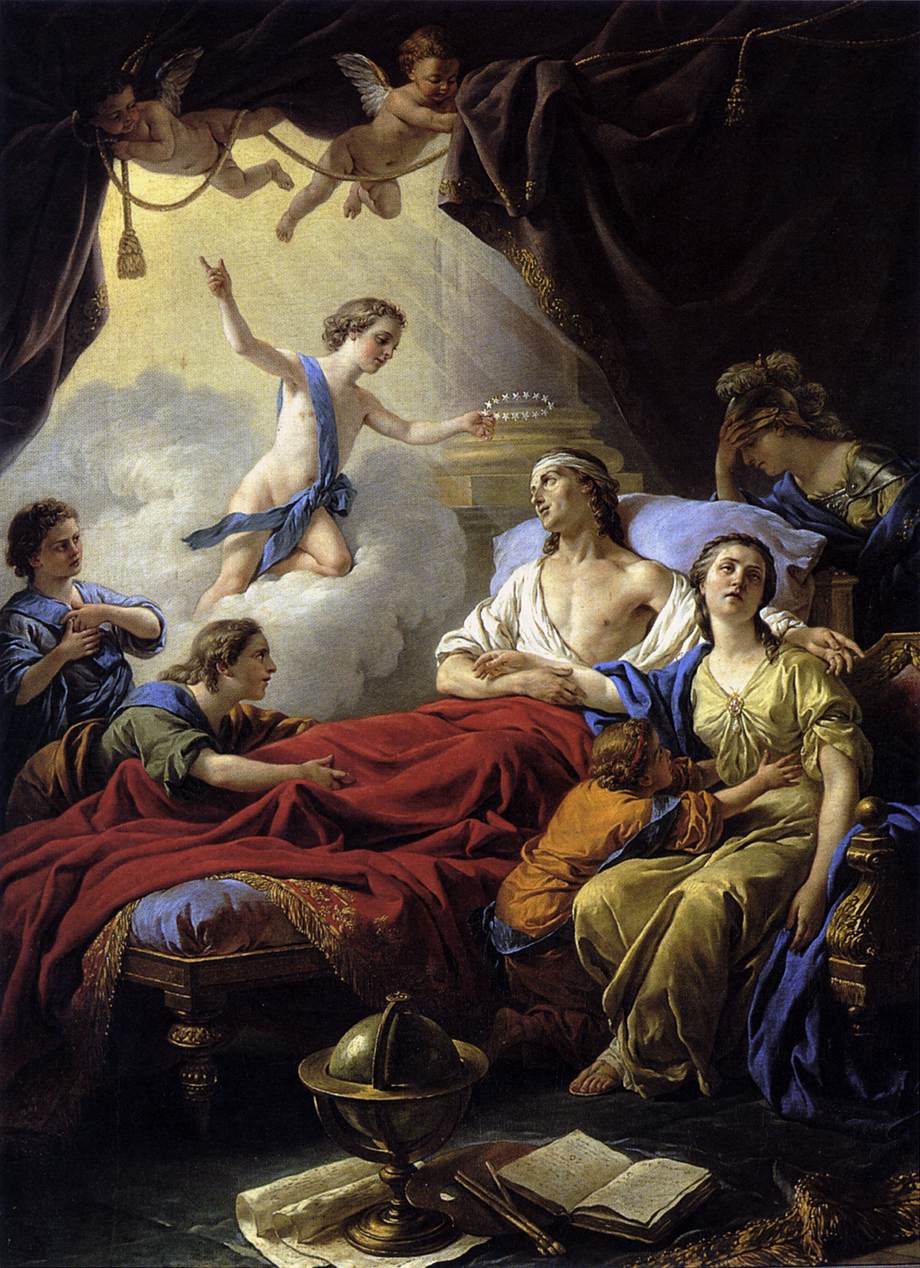
Legranée received several royal commissions in a busy life. In the AllegoryA work of art which represents some abstract quality or idea, either by means of a single figure (personification) or by grouping objects and figures together. Renaissance allegories make frequent allusions both to both Greek and Roman legends and literature, and also to the wealth of Christian allegorical stories and symbols developed during the Middle Ages. on the Death of the Dauphin the figures are not strictly allegorical, apart from the sorrowing France behind the bed, for they represent the dauphine and the couple's sons (including the dead one who appears with a crown of stars for his dying father), the effect is of allegory rather than fact. And the idiom in which the picture is painted is certainly classicalRelating to the culture of ancient Greece and Rome (classical Antiquity). The classical world played a profoundly important role in the Renaissance, with Italian scholars, writers, and artists seeing their own period as the rebirth (the "renaissance") of classical values after the Middle Ages. The classical world was considered the golden age for the arts, literature, philosophy, and politics. Concepts of the classical, however, changed greatly from one period to the next. Roman literature provided the starting point in the 14th century, scholars patiently finding, editing and translating a wide range of texts. In the 15th century Greek literature, philosophy and art - together with the close study of the remains of Roman buildings and sculptures-expanded the concept of the classical and ensured it remained a vital source of ideas and inspiration., much as interpreted by Batoni, though critics of the day it suggested Guido Reni.