03 — ARTWORK
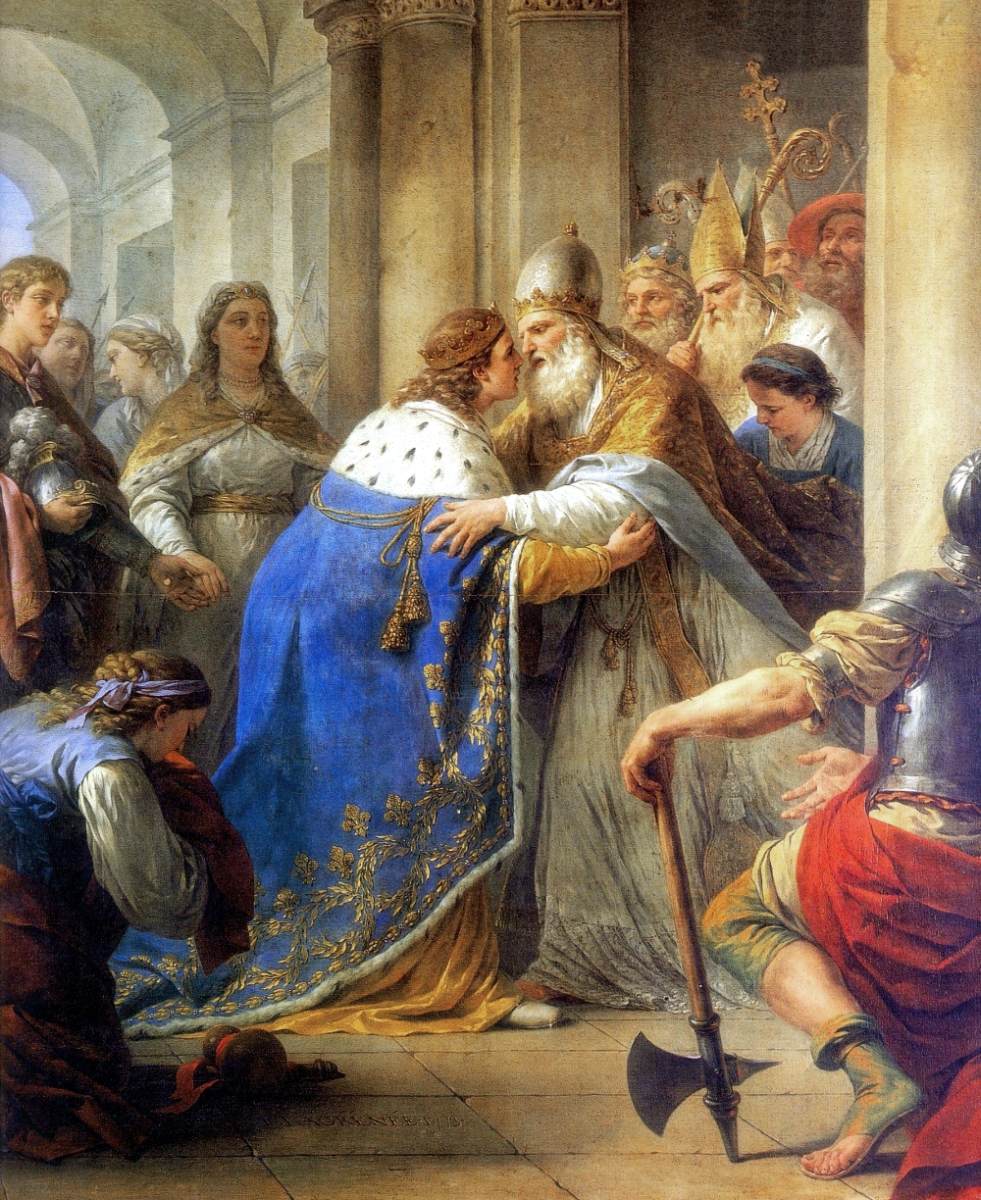
Meeting between Innocent IV and Saint Louis
LAGRENÉE, Louis-Jean-François · 1773 →
- MEDIUM
- Oil on canvas
- TYPE
- Historical
PALETTE
HOVER OR TAP A SWATCH FOR NAME, SHARE AND HEX. SAMPLED FROM THE IMAGE — INDICATIVE, NOT A PIGMENT ANALYSIS.
DEVELOPMENT BUILD — NOT FOR PUBLIC USE. CONTRIBUTE ON GITHUB.
CURRENT LOCATION · École Militaire
03 — ARTWORK
LAGRENÉE, Louis-Jean-François · 1773 →
PALETTE
HOVER OR TAP A SWATCH FOR NAME, SHARE AND HEX. SAMPLED FROM THE IMAGE — INDICATIVE, NOT A PIGMENT ANALYSIS.
COMMENTARY
UNDERLINED TERMS ARE DEFINED IN THE GLOSSARY.
Louis-Jean-François Lagrenée trained under Carle van Loo and was drawn to the work of Joseph-Marie Vien, with whom he participated in the cycle of history paintings for the chapela small separate place for worship, either part of a large church or a separate building. of the École Militaire. When Lagrenée exhibited his canvasA woven cloth used as a support for painting. The best-quality canvas is made of linen; other materials used are cotton, hemp, and jute. It is now so familiar a material that the word 'canvas' has become almost a synonym for an oil painting, but it was not until around 1500 that it began to rival the wooden panel (which was more expensive and took longer to prepare) as the standard support for movable paintings (the transition came later in Northern Europe than in Italy). Canvas is not suitable for painting on until it has been coated with a ground, which isolates the fabric from the paint; otherwise it will absorb too much paint, only very rough effects will be obtainable, and parts of the fabric may be rotted by the pigments. It must also be made taut on a stretcher or by some other means. at the SalonIn the French language of the 18th and 19th centuries it designated an actual exhibition space, as well as the academic art exhibitions staged in the Salon d'Apollon of the Louvre since 1667. From 1737, the exhibitions took place biennially and, after the French Revolution, annually in the Salon Carré of the Louvre in Paris. Towards the end of the 19th century the official Salon jury was dissolved in order to make way for a committee of state-approved artists, i.e. former Salon members, who created the highly influential Société des Artistes Français. of 1773, it started a heated newspaper review by Du Pont de Nemours, who criticised its absence of unity, anachronism, and lack of a military scene; it was the vigour of a hero, not the affectations of a saint, that was required.
@online{wga-r9dfbff04457d67,
  author       = {Krén, Emil and Marx, Daniel},
  title        = {Meeting between Innocent IV and Saint Louis by LAGRENÉE, Louis-Jean-François},
  organization = {{Web Gallery of Art}},
  date         = {2026-09-14},
  url          = {https://beta.wga.hu/artists/lagrene-louis-jean-franois-rc50822b2aed775/meeting-between-innocent-iv-and-saint-louis-r9dfbff04457d67},
  urldate      = {2026-09-14},
  langid       = {english}
}
ACCESSED 2026-09-14. REPLACE THE AUTHOR FIELD WITH THE COMMENTARY AUTHOR WHERE ONE IS NAMED.


