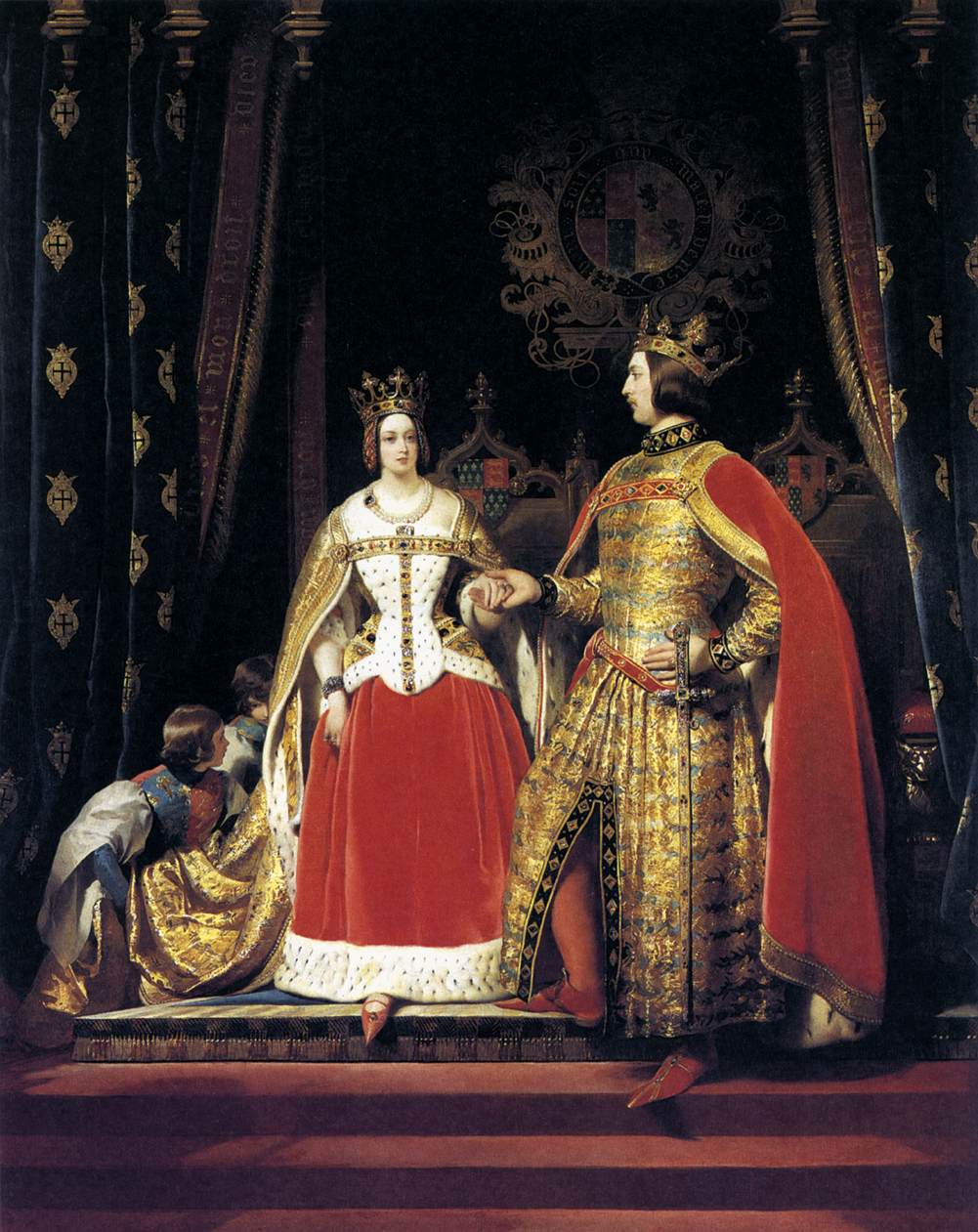
Three fancy-dress balls were held at Buckingham Palace by Queen Victoria and Prince Albert, each in a different style. At the first on 12 May 1842 the principal figures appeared as Edward III (1312-77) and Queen Philippa (1314?-69). The second, on 6 June 1845, was in early Georgian dress and the third, on 13 June 1851, in the style of the Restoration.
Landseer has painted Queen Victoria and Prince Albert in the Throne Room on the occasion of the fancy-dress ball of 1842, standing beneath a specially designed GothicGothic, which may well have originated with Alberti as a derogatory term and which certainly corresponds to Vasari's 'maniera tedesca' ('German style'), is properly the descriptive term for an artistic style which achieved its first full flowering in the Ile de France and the surrounding areas in the period between c. 1200 and c. 1270, and which then spread throughout northern Europe. It is characterized by the hitherto unprecedented integration of the arts of sculpture, painting, stained glass and architecture which is epitomized in the great cathedrals of Chartres, Amiens, and Reims or in the Sainte Chapelle in Paris. In all the arts the predominantly planar forms of the Romanesque are replaced by an emphasis on line. There is a transcendental quality, whether in the soaring forms of the pointed arches or in the new stress on the humanity of Christ, which similarly distinguishes it from the preceding Romanesque style. In thinking of Nicola (d. c. 1284) or Giovanni Pisano (d. after 1314) there is same danger of forgetting what had happened in French sculpture half a century or more earlier, and likewise it is hard to remember that the spectacular achievements of early Renaissance art are a singularly localized eddy in the continuing stream of late gothic European art. By northern European standards few Italian works of art can be called gothic without qualification, and the story of 13th and 14th century Italian architecture is as much one of resistance to the new style as of its reception, whether directly from France or through German or central European intermediaries. In sculpture and in painting, the Italian reluctance to distort the human figure, conditioned by a never wholly submerged awareness of the omnipresent antique heritage, gives a special quality to the work of even those artists such as Giovanni Pisano or Simone Martini who most closely approached a pure gothic style. Nevertheless, the vitalizing role of Northern gothic art throughout the early Renaissance and the period leading up to it should never be underestimated. The artistic, like the cultural and commercial, interaction was continuous and much of the Italian achievement is incomprehensible if seen in isolation. It is not merely at the level of direct exchanges between one artist and another, or the influence of one building; painting, manuscript or piece of sculpture upon another, that the effects are to be felt. The streaming quality of line which is so characteristic of Brunelleschi's early Renaissance architecture surely reflects a sensitivity to the gothic contribution which is entirely independent of, and lies much deeper than, the superficial particularities of form. The counterflow of influence and inspiration from South to North must likewise not be underrated. In particular, the contribution of Italian painters from Duccio and Simone Martini onwards is central to the evolution of the so-called International Gothic style developing in Burgundy, Bohemia and north Italy in the late 14th and early 15th centuries. canopy decorated with purple velvet hangings. Two chairs of state are visible behind the figures and above their heads on the cloth of honoura cloth of valuable material held up behind a distinguished person to set them apart visually from others (a custom deriving from classical antiquity). is emblazoned the coat-of-arms of Edward III, combining French and English quarterings. It was from this alcove that Queen Victoria and Prince Albert greeted over 2,000 guests. Members of the Royal Household were expected to appear in costumes dating in style from the reign of Edward III, while the guests were encouraged to wear costumes of any period or country. The setting for the ball and the design of the costumes were entrusted to James Robinson Planche, who was an authority on the history of dress, as evidenced by his encyclopaedic book History of British Costume (1834), as well as a dramatist and a herald in the College of Arms.
The costumes worn by Queen Victoria and Prince Albert were designed by Vouillon and Laure with the guidance of Planche. For the sake of accuracy reference was made to the relevant monuments in Westminster Abbey. The queen's costume was based upon the effigies of Philippa of Hainault and her daughter Blanche de la Tour (died in infancy 1342), while that for Prince Albert was derived from the effigy of Edward III. Landseer began his painting at the time of the ball, but, as was so often the case with this artist, progress was delayed and the picture was not finished until 1846. <P> <TABLE ALIGN=LEFT CELLPADDING=5 BORDER=1 WIDTH=320 BGCOLOR="#99CCCC"> <TR VALIGN=MIDDLE><TD><IMG SRC="/support/gif/listen.gif" BORDER=0 VALIGN=MIDDLE> Suggested listening (streaming mp3, 6 minutes):<BR><A HREF="#" onClick="w=window.open ('/music1/20_cent/elgar_pomp_no1.html', 'newWin', 'scrollbars=yes,status=no,dependent=yes,screenX=0,screenY=0,width=350,height=350');w.opener=this;w.focus();return true"><B>Sir Edward Elgar: Pomp and Circumstance March op. 39 No. 1</B></A> </TD></TR></TABLE>