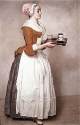
Swiss pastellist, painter, printmaker and writer. He was born to French Protestant parents, who had fled to Switzerland after the Revocation of the Edict of Nantes. Having studied with the miniatureGLOSSARYTerm originally applied to the art of manuscript illumination but later used of paintings, usually portraits, executed on a very small scale. The earliest miniaturists (16th century) continued to use the materials of the illuminators, painting in gouache on vellum or card. painter Daniel Gardelle in Geneva, in 1723 he travelled to Paris, where until 1726 he was a pupil of Jean-Baptiste Massé. In 1734 he submitted his only known history paintingGLOSSARYPainting concerned with the representation of scenes from the Bible, history (usually classical history), and classical literature. From the Renaissance to the 19th century it was considered the highest form of painting, its subjects considered morally elevating., King David and the High Priest Abimelech in the TabernacleGLOSSARYa small canopied recess or container in which the Eucharist or a holy relic is kept. (untraced), for the painting prize of the Académie Royale de Peinture et de Sculpture, but it was rejected. He subsequently travelled to Naples and then to Rome, where he executed a portraitGLOSSARYThe Roman portrait bust survived in the form of life-sized reliquaries of saints, but it was in 15th century Florence that the individual features and character of a contemporary sitter were accurately recorded by sculptors such as Donatello, Desiderio da Settignano, Mino da Fiesole and the Rossellino. A similar degree of realism occurs in 15th century tomb sculpture. The equestrian portrait, based on antique statues such as the Marcus Aurelius monument (Rome, Campidoglio), was revived in the 14th century. Two examples in fresco are Simone Martini's Guidoriccio (c. 1328; Siena, Palazzo Pubblico) and the posthumous portrait of Sir John Hawkwood (1436; Florence, Cathedral) by Uccello, which gives the illusion of a 3-dimensional statue seen from below. The Venetian Republic ordered imposing monuments from Donatello (1447; Gattarnelata, Padua) and Verrocchio (14799; Colleoni, Venice), whilst other statesmen ordered their own images to be erected in public places, directly relating themselves to the military heroes of ancient Rome. Another form of political portraiture derived from antiquity was the commemorative portrait medal designed by artists such as Pisanello. The carved or painted profile portrait became popular in the 1450s. The realism of the clear, flattened image, painted under the influence of Flemish examples by the Pollaiuolo brothers, Piero della Francesca and Botticelli, was superseded by the three-quarter and frontal portrait, psychologically more complex, such as Leonardo's enigmatic Mona Lisa (Paris, Louvre) with her momentary smile or Andrea del Sarto's arresting Portrait of a Man (London, National Gallery). The 16th century portrait became generalized, Lotto's Andrea Odoni (1527; Royal Collection) being an idealized concept of a collector rather than an individual. Group portraits, decorating whole rooms, include the narrative scenes of the Gonzaga court painted by Mantegna (completed 1474; Mantua, Palazzo Ducale) and the elaborate schemes commissioned by the Farnese family in Rome from Vasari (1546; Palazzo della Cancelleria) and Salviati (after 1553; Palazzo Farnese). Portraits were also incorporated into religious narratives, as in Ghirlandaio's fresco cycle painted for Giovanni Tornabuoni in S. Maria Novella, Florence (1486-90). of Pope Clement XII (untraced). In Florence he met Sir William Ponsonby (1704-93), later 2nd Earl of Bessborough, whom he accompanied to the Levant in 1738, breaking the journey in Capri, Messina, Syracuse, Malta and the Greek islands; there, seduced by the beauty of Eastern dress, he made a large number of acute and charming drawings in black and red chalks (Paris, Louvre; Paris, Bibliothèque Nationale).
He spent 4 years in Constantinople (1738-42), after which he adopted Turkish dress and beard, his eccentric appearance being familiar from his numerous self-portraits. Finally he settled at Geneva in 1758, though still travelling elsewhere until late in life.
Though he executed some oil paintings, he specialized in pastelGLOSSARYA drawing medium of dried paste made of ground pigments and a water-based binder that is manufactured in crayon form. portraits. He was probably influenced by the success in Paris in 1720-21 of the Venetian pastellist Rosalba Carriera. His delicate and polished style brought him fashionable success in Paris, and England, which he twice visited (1733-35 and 1772-74). The best collection of his work is in the Musée d'Art et d'Histoire in Geneva, his native city.